Russian-style shadow campaign appears to be behind Fidesz, executed rather amateurishly so far
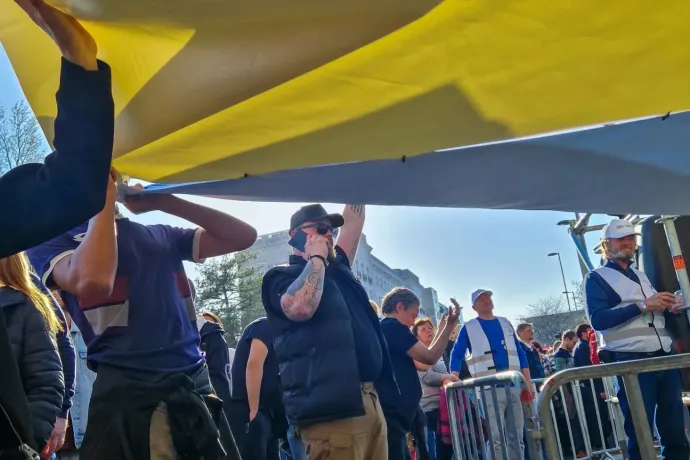


As the parliamentary election campaign in Hungary enters its final stretch, almost every day has brought some particularly exciting political event of late. This was especially true on March 15, when the participants of the Fidesz-organized Peace March and Tisza's National March nearly crossed paths, and the campaign overshadowed the entire national holiday. But one event in particular stood out even among the many interesting happenings of that day: the incident, in which a group unfurled a huge Ukrainian flag during the Tisza Party’s march was widely covered by every Fidesz politician and the entire government-aligned press. Although they presented it as the Tisza Party’s show of support for Ukraine, mounting evidence now suggests that this was likely a provocation coordinated by members of the non-profit organization called the Agency for Developing Digital Democracy (DDÜ).
This incident is not the only thing the DDÜ has drawn attention to itself with recently. We also found evidence that another company affiliated with the foundation behind it is funding the Facebook troll farm exposed by Telex in January, which was primarily used to promote the posts of Fidesz politicians.
DDÜ was founded last July, and until just a few weeks ago, it was best known as the organization behind the Digital Civic Circles (DPK). They organized the first DPK rally held in September at the Papp László Arena and Viktor Orbán’s anti-war nationwide tour in the fall; they are the ones who screen those applying to the DPKs and manage the personal data of DPK members as well. In other words, they are effectively responsible for a significant portion of Fidesz's campaign, which obscures how much the ruling party is actually spending on it. When we tried to learn more about the company last December, we were unable to get any closer to the truth – neither in person, nor online, or by phone – but this secrecy spoke volumes in itself.
It remains unclear to this day where the DDÜ has been getting its funding since it was founded last July. The company's founder, Bence Partos previously told Telex that they organized the DPK meeting held at the Papp László Sports Arena with support from the Foundation for the Development of Digital Democracy – this foundation was registered last August and has been the owner of DDÜ since September; its headquarters are in the same office building as the agency’s. The foundation’s curator is Mónika Szabadosné Tolner, who also serves as the managing director and owner of the nonprofit limited liability company operating the Drug Research Institute, which promotes the ruling party’s narratives.
Last year, while he was still the head of DDÜ, Partos also wrote that the foundation is funded by donations from private individuals. This is a common claim among organizations working on amplifying the government's narrative; Megafon also insists that it does not receive a single penny of public money or state funding, but is financed exclusively by donations from generous patrons. Just as with Megafon, the question arises here as well: how are they able to raise enough money from such donations to rent the Papp László Arena for days on end—and in this case, within just one month?
DDÜ has meanwhile been somewhat reorganised. At the end of September, founder Bence Partos transferred ownership to the newly established Foundation for the Development of Digital Democracy, and Károly Nagy – who has a colourful political background -took over as executive director. Nagy started out in the youth organization of Gábor Fodor’s Liberals, went through the youth wing of Momentum, served as a local council representative for the opposition coalition in the 18th district, and then, following a harassment accusation, left Momentum and switched to the local faction of the far-right Jobbik party. A year later, he was already the manager of the Fidesz-affiliated pseudo-NGO called Transparent Journalism Foundation set up by Partos, and became a regular guest in the government media. It was from here that he arrived at the head of DDÜ in September.
Meanwhile, the foundation that had become the owner of DDÜ set up another company in September; this one was named Morális Forráskód Nonprofit Kft., with Bence Partos as its managing director. It is registered at the same address as the foundation and DDÜ. This is the company that appeared behind the troll network exposed by Telex in January.
We questioned Balázs Orbán (the PM's political director) about the relationship between DDÜ and Fidesz at his campaign forum in Isaszeg last week. “The relationship is similar to that between other non-governmental organisations cooperating with political parties,” Orbán, who also manages Fidesz's election campaign explained. “They are independent of the party and pursue their own activities, but we share common goals. Our common goal is national governance.”
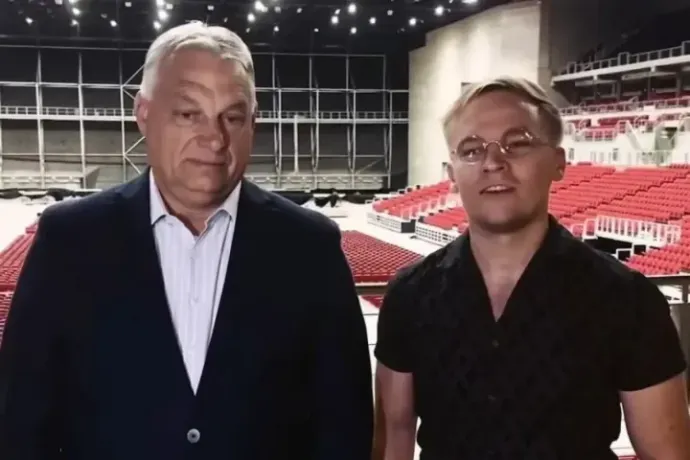
Internet Research and the Development of Digital Democracy
Thus, through the Digital Civic Circles, DDÜ has been closely intertwined with the Fidesz campaign for the past six months. Based on recent developments, however, the role of the company and its affiliated organizations now extends beyond this, to the point where it is beginning to resemble the most well-known Russian propaganda agency.
This is the Internet Research Agency (IRA), better known as the St. Petersburg troll factory, which was founded in 2013 by Yevgeny Prigozhin, the former chef of Russian President Vladimir Putin, who later set up the private military group known as the Wagner Group – the man who rebelled against Putin in 2023, then backed down, and was ultimately most likely eliminated. Although it has been restructured, Wagner still exists today, while the IRA was dismantled in the wake of the rebellion of the mercenary army. During its operation, however, it played an important role in Russian information warfare. It was initially deployed to spread propaganda against the Russian opposition, and later became one of the hubs for spreading Russian disinformation abroad, including Russian operations designed to help Donald Trump get elected as U.S. president.
Prigozhin himself admitted to the latter in 2022, but they also carried out plenty of other operations outside of Russia. The IRA first came into the spotlight in 2015, when an investigation by The New York Times identified the company’s network as the source of a series of conspiracy theories and fake news spreading on social media at the time. By the end of 2015, the IRA was reportedly already involved in a campaign promoting Trump, and by the 2016 presidential election, it was fully engaged in this effort. This has since become a textbook example of foreign influence operations via social media, although it has also become clear that – while they may have been involved, Trump’s victory was not due to Russian Twitter trolls.
This is worth highlighting because, although the IRA mainly engaged in trolling abroad, the same is true of the activities of similar Hungarian organizations. As previously detailed in relation to the activities of the Fight Club (Harcosok Klubja), there is ample evidence suggesting that people’s opinions do not change simply because they read something on social media—which is why it became apparent with the Fight Club, and later with the DPK groups managed by DDÜ, that their efforts serve little purpose beyond strengthening their own base. It would be difficult to deny this based on what we have seen in recent months, with digital freedom fighters waging a fierce but arguably futile battle against laughing emojis, and while Fidesz still isn’t able to let go of the conspiracy theory that their poor standing in the digital sphere is due to Meta deliberately obstructing them.
Regardless of whether such trolling has any substantial impact or not, it certainly needs to be taken seriously; after all, two years ago, the far-right Romanian candidate Călin Georgescu – who unexpectedly won the first round of the Romanian presidential election by a wide margin – was later disqualified by the Constitutional Court because a Russian TikTok campaign was suspected to be behind him. The European Commission even launched proceedings against TikTok afterwards, and virtually all experts agreed that it would not be surprising at all to see similar efforts in this year's Hungarian election campaign.
By now it appears that DDÜ’s sister company is attempting to achieve something similar with its network of fake profiles to what the IRA did.
The network of troll profiles we identified in January was exclusively dedicated to spreading pro-government messages, feeding Fidesz groups, and commenting on the posts of Fidesz politicians – and it turned out that Morális Forráskód Kft. was behind it. Since then, we have identified another, even bigger troll farm, and although it has not yet become clear who is behind it, the two networks have in recent days been seen working together: thousands of their fake profiles liked the posts of Fidesz politicians about the March 15 provocation involving the display of a Ukrainian flag at Tisza's event. This further reinforces the suspicion that
the two companies affiliated with the Foundation for the Development of Digital Democracy are running a shadow campaign similar to those carried out by the IRA, but here, in Hungary.
The provocation with the Ukrainian flag also fits the Russian pattern; the IRA organized several similar operations in the United States. Typically, the scenario involved BlackMattersUS – created by the IRA – organizing events in locations where there was a high likelihood of being able to stir up trouble. For example, they organized a counter-protest among the black community against a rally promoting white supremacy, and the Russian RT later reported on the violence that occurred there, claiming that anti-racists were responsible for it. They also organized, for example, an anti-police demonstration, as well as a Blue Lives Matter demonstration advocating for police rights, on the same day as a Black Lives Matter event. Just as in the online space, their goal in real life was to escalate conflicts, if possible, pit people against each other, and create footage that could later be used to launch even more online troll campaigns. In other words, while they may not have been particularly effective at reshaping voter opinions, they were certainly effective at stoking general social tension.
The incident involving the unfurling of a Ukrainian flag at the National March fits perfectly into this pattern: according to the participants in the march, those who held up the Ukrainian flag were not Tisza supporters, but participants in an organized operation, and were openly hostile toward them; though the operation lasted only a short time, images of it were captured precisely so that pro-government newspapers and Fidesz politicians could later hold them up like a bloody sword.
It was later revealed that two members of the group had, shortly beforehand, hung a banner from the balcony of a nearby building that read “Ukrainian War March” – openly criticizing the National March. Later, 444 also identified several DDÜ employees in photos taken of the same balcony during the National March. One of those visible in the photo is Géza Balog, who is the chairman of Fidelitas" (Fidesz's youth organizaton) Budapest division – and with whom one of the participants in the flag-unfurling incident posted a joint photo on Instagram that very same evening.
The fact that the participants of the operation were exposed so quickly, and the very fact that two people who were so easily identifiable were entrusted with hanging up a banner and then staging a provocation with the flag in almost the exact same spot, does not suggest a high degree of professionalism.
Of course, the IRA wasn’t always successful in America either; there were several occasions when only a few people attended their demonstrations, and local activists often suspected that something fishy was going on behind the scenes.
They did manage to get people talking about it
In early March, Szabolcs Panyi, a journalist at Direkt36, wrote that, according to information he had received, three people sent by the Russian military intelligence agency, GRU, had arrived in Budapest to influence the outcome of the Hungarian election, similarly to what they had done in Moldova during the 2024 presidential election. He reported that the United States had also shared classified intelligence about the team sent to Budapest with its allies. Although Hungarian government officials consistently denied this, a few days later, at a hearing before the National Security Committee of the Hungarian Parliament, it was acknowledged that a warning had been received about the Russians. Last week, an expert from the pro-government think tank MCC also wrote about an unprecedented Russian operation aimed at influencing the Hungarian election being underway.
Whether any such activities have actually taken place during the campaign – ones that might potentially involve the Russians – cannot be determined at this point, but it is certain that, for now, the impact of all of this is nowhere near as significant in Hungary as it was in Moldova two years ago. Or in Romania, where the extent of Russian interference only became apparent right before the second round of the election, leading to the invalidation of the first-round results. Of course, a number of factors contributed to that success: as Péter Krekó told Telexlast year, in Romania, the propaganda was able to latch onto an existing, organic network of influencers. Moreover, they had to promote an unknown politician, not a ruling party with 16 years of governance behind it. In any case, while Russian interference may not be easy to detect, the Russian model – which can be traced independently of that is much easier to recognize in the current Hungarian campaign.
Despite the fact there were early reports suggesting a link between the March 15 raising of the Ukrainian flag and the DDÜ, and despite the troll farms having been exposed, it can't be said that the whole thing was a complete failure. The incident with the Ukrainian flag was the main topic in the government’s media empire for all of last week (until early this week, following an article in The Washington Post, the narrative about the alleged wiretapping of Péter Szijjártó took over), Fidesz politicians talked about it at length, and at last week's government briefing Gergely Gulyás said that it doesn’t really matter what happened, because in his view, there is no doubt that the Tisza Party is pro-Ukrainian anyways. Viktor Orbán, however, considered even the question of whether the incident should be investigated to be ridiculous. He said that “There’s nothing to investigate about whether members of the Tisza Party are “waving Ukrainian flags at home or in public”.
In other words, this stunt certainly succeeded in highlighting what is effectively the most important claim of the Fidesz campaign: that Péter Magyar and the Tisza Party are acting in the interests of Ukraine. The real question, however, is whether they can convince anyone outside their own camp with this method.
For more quick, accurate and impartial news from and about Hungary, subscribe to the Telex English newsletter!