The troll farm at work: thousands of fake accounts are liking Fidesz politicians' posts about Ukrainian flag provocation at Tisza's event

A few weeks ago Telex exposed a massive network of fake Facebook profiles which are being used to amplify Fidesz's campaign messages on the social media platform. At the time, we already suspected that the 1,200 troll profiles we were able to identify were just the tip of the iceberg, and that the network could in fact be much bigger. It now appears that this is indeed the case.
When we examined the posts of several Fidesz politicians promoting the latest campaign message of Fidesz after March 15, we discovered nearly 700 previously identified members of the network among those who had liked the posts. And alongside them, we found more than 1,200 new profiles which also do not belong to real people, with all signs pointing to them being controlled by a single entity.
All of them are used to amplify Fidesz's messaging; all were created recently, no more than three months ago; they are not personal profiles but pages; their profile pictures and content are typically AI-generated (or non-existent); most of them have no followers, or at most 5-10, all of them being other members of the network; they themselves follow almost exclusively Fidesz politicians and are only active under their posts. There are only a few exceptions to this; almost all of these are members of the other, smaller, but manually operated troll network we mapped in January.
After March 15, the scene in which a large Ukrainian flag briefly appeared at the National March organized by the Tisza Party has provided one of the main themes for the Fidesz propaganda. As it soon turned out, the whole thing was most likely an organized provocation, orchestrated by individuals linked to Fidelitas and the Digital Democracy Development Agency, which organizes the Digital Civic Circles – the same ones who are behind the troll farm we exposed. This, of course, did not stop the pro-government press, propagandists, and Fidesz politicians themselves from jumping on the story and loudly proclaiming that this was a massive revelation showing that for the Tisza Party, “Ukraine comes first, but for us, Hungary comes first".
Troll Hunting 101
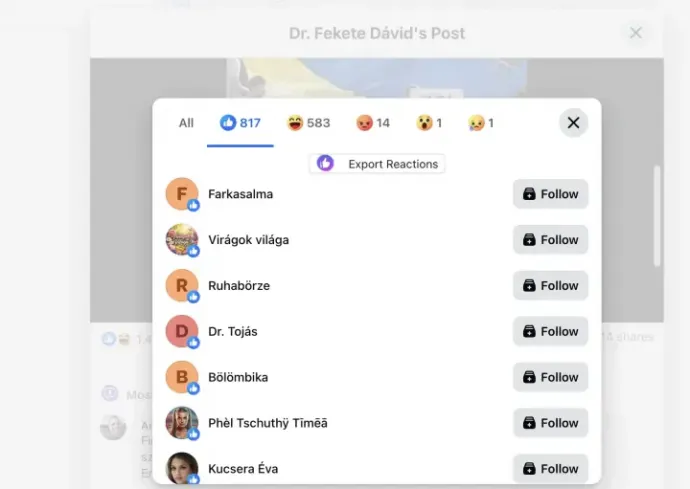
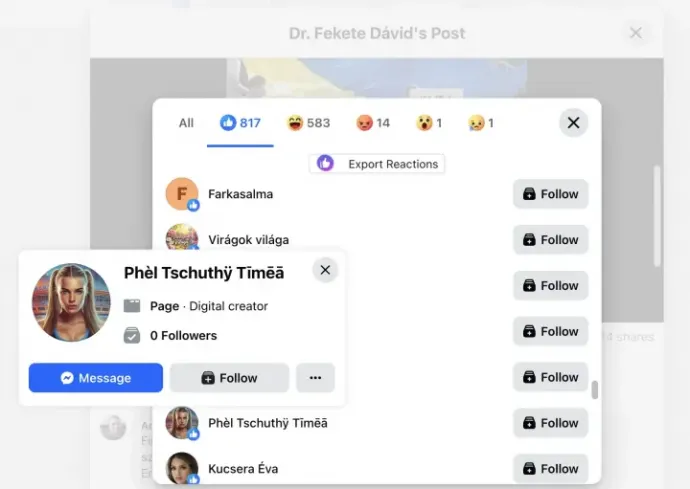
Spotting fake profiles isn’t too hard-anyone can give it a try at home. When you click on the number of reactions on a post, Facebook will list the people who liked it in a small window. Here, select the plain “Like” icon from the list of reaction types (trolls always click this one; they practically never use the alternative emojis), and start scrolling down. If you see something like this, you’ve likely found a troll:
What’s so suspicious about this?
- On the right side, there isn’t an “Add Friend” button as there is in the case of personal profiles, but rather a “Follow” button used in the case of pages.
- None of these pages have a profile picture or they are using an AI-generated profile picture.
- If you hover over the profile picture, it says “zero followers.”
- They are listed one after another in the list, sometimes in groups of ten or twenty, which suggests that they liked the post in a quick succession, one after the other.
Once this is done, you may even click on the page in question and check the date it was created (to see if it’s relatively recent), who it follows (almost exclusively politicians or other suspicious profiles), and what kind of posts it has (or doesn’t have). If all of this checks out, there’s a 99 percent chance you’ve found a troll. We followed roughly the same process, though on an industrial scale and automated it as much as possible.
For the purposes of this article, we examined the posts of ten Fidesz politicians about the Ukrainian flag-related incident at Tisza's March 15 event, which were liked by a conspicuous line-up of fake profiles, so the algorithm would be tricked into pushing the post into the news feeds of as many (real) users as possible. As noted in our previous article, troll farms are typically not deployed for Fidesz’s most popular figures; rather, they are used to boost the reach of second- and third-tier politicians. As we will see, sometimes to a shocking degree, but even this is not always enough to counter the superweapon of the great “haha war”—the laughing emojis.
We identified a total of 1,954 troll profiles under the ten posts, which we listed here.Just how coordinated the operation was is clearly demonstrated by the fact that the most active fake profile, named “Megőrzés és Megújulás” liked nine out of the ten posts; the page named “Zoltán Rimányi” appeared in eight cases, while “Katalin Kiss” and “Megmondja Péter” liked seven of them. Quite a lot of the fake profiles liked six of the ten posts, – 75 of them – including a group of profiles where the names suggest that ice-cold professionalism isn’t exactly rampant in the troll factory: Mekeg, Legel, Bömböl, Recseg, Cincog, Kornyikál, Kopácsol, Csipog, and Röfög. (In English: Bleats, Grazes, Bawls, Creaks, Squeaks, Caterwauls, Hammers, Chirps, and Oinks)
Among our ten examples, we’ve included both nationally known and lesser-known politicians, some of whom are seasoned Facebook users, while others are relative newcomers to social media. Countless other members of Fidesz posted about the provocation involving the Ukrainian flag in a similar style and with similar messages, from every level of the party's hierarchy, but it is important to note that there were many instances where the troll farm did not intervene at all; and some politicians actually chose to ignore the entire topic altogether.
Tamás Menczer
Fidesz’s communications director and one of its most prominent figures is the best-known name on the entire list. According to February data from our “Championship of Likes” the average number of reactions on his posts was 2,600, a figure far surpassed by the 6,240 reactions to the post about the Ukrainian flag. Nearly half of all reactions were sarcastic “haha” emojis, and 46 percent of the remaining likes and other reactions—a total of 1,510—came from the troll farm. This means that three-quarters of the network’s currently known 2,000 or so fake profiles were mobilized to like Menczer’s post.
Dávid Fekete
Fekete is Fidesz's candidate for a parliamentary seat from Győr and a member of the local council; his name already appeared in our previous article on troll farms. His posts usually get 100–150 reactions, but this one garnered 681, a little over half of which were “haha”. Of the remaining 309 likes, we identified 126 as coming from fake profiles. This accounts for 41 percent of all supportive, approving reactions.
Győző Vinnai
Vinnai serves as the clerk of the parliament and has been an MP since 2010. He is running for Fidesz in Szabolcs county. He isn’t much of a Facebook user; his posts typically garner 40–50 reactions. At the time of our data collection, his post about the unfurling of the Ukrainian flag received three times that number – 151 reactions – including 32 “haha” reactions. Roughly one-third of the likes – 32 in total – came from fake profiles.
Attila Fülöp
Fülöp has been featured in the news a lot recently, since being a State Secretary at the Ministry of the Interior, his portfolio includes social welfare policy, which includes children's homes, among other things. His posts typically get 100-120 reactions, but the one about the Ukrainian flag went all the way to 1,136. More than half of those – 643 – were “haha”, which partly explains why the post went so viral. Of the non-laughing reactions, 58 percent – 286 in total – came from troll accounts. In other words, only a fraction of all reactions, less than one-fifth, were genuine.
Lajos Szűcs
Although he has been a member of parliament since 1998. Although he has won a seat seven times which makes him a true political veteran, one can’t really say Szűcs is a household name. This year, he is running in Pest County’s 7th constituency, centered in Vecsés. His average post typically generates around 100 reactions, and this time, his post featuring the Ukrainian flag didn’t exceed that by much more, racking up a total of 157, 12 of which were the laughing emoji. Fake profiles aren’t running rampant on his page either; we found only 25 (17 percent)-but this is where the surprise came in. Lajos Szűcs’s troll farm is actually a separate little team; they aren’t active anywhere else, only on his page. However, every single one of those 25 fake profiles meticulously shares every single one of Szűcs’s posts.
Péter Cseresnyés
Cseresnyés is the former mayor of Nagykanizsa and currently serves as a member of parliament for his constituency. He is running in this election too. His posts typically receive between 50 and 100 reactions, but the one featuring the Ukrainian flag went viral, garnering 1,464 reactions, 587 of which were “haha.” Among the regular likes, we identified 588-or 67 percent-as coming from troll profiles. This is the highest proportion in the entire lineup.
Barna Pál Zsigmond
Zsigmond is a State Secretary and Deputy Minister, who has held a party-list seat in parliament since 2018; he is now running in Újpest and, to put it mildly, is not considered a frontrunner. He’s a veteran of Telex's “Championship of Likes,” having once surpassed half a million likes in a single month, so he’s a seasoned Facebook user. Compared to that, the 1,132 reactions his post featuring the Ukrainian flag garnered aren’t too much, especially considering that nearly half of them-490-were laughing emojis. We counted a total of 291 likes from fake profiles on his page, which accounts for 45 percent of all supportive reactions. Members of the “Patrióta Brekiklub” (The Club of Patriotic Froggies) troll farm, which we exposed in January, also lined up in his support.
Attila Gelencsér
Gelencsér is the representative for the Kaposvár constituency, he has won four times and is now preparing for his fifth term. He is facing a tough challenge, because next to Pécs, this is the least pro-Fidesz area in the entire southern Transdanubia region. His Facebook posts usually get a few hundred reactions, or up to a thousand at most. This time he received 4,821, of which well over half-2,905-were “haha”. We identified 726 troll profiles among the likers, which is equivalent to 38 percent.
Gábor Törő
Törő is another candidate who is not big on using Facebook to communicate. He has been the representative for Fejér County’s District 2 since 2010, has won four times and is running there again. His posts on Facebook typically generate around 150-200 reactions; and it is interesting that even his post featuring the Ukrainian flag did not deviate from this pattern, garnering 177 reactions (24 of which were “haha”). The troll farm provided only minimal assistance, with 29 likes coming from fake profiles (19 percent).
Miklós Simon
Simon has been the MP for constituency No. 6 (Nyírbátor) of Szabolcs county. He has won six times there; given that this is a very strong Fidesz stronghold, it would be nothing short of a miracle if he were to lose in April. His Facebook posts typically receive around 100-150 reactions, though occasionally one will go up to a thousand. In comparison, his post featuring the Ukrainian flag received 6,574 reactions, though this is tempered by the fact that more than half of them—3,651—were laughing emojis. A third of the non-laughing reactions, 969, came from a troll farm.
We recorded the reactions to the posts in the late afternoon on March 17; the figures in the article reflect the status at that time. The posts were already two days old by then, and the number of reactions typically does not increase significantly after that much time. In a few cases, the embedded posts show much bigger spikes; this may be because the post-perhaps thanks to the troll farm’s help-went viral and attracted additional organic traffic, or because it was further boosted by more troll farm likes.
We recorded a total of 4,581 likes from fake profiles under the ten posts, meaning the troll farm was likely running at full capacity on March 15 and thereafter to ensure that the photo with the Ukrainian flag and the “for them it’s Ukraine, for us it’s Hungary” message reached as many people as possible on Facebook. One-third to one-half of the likes on most of the posts – and occasionally even more – came from fake profiles, which constitutes a very serious form of manipulation. This is likely also the reason for the high ratio of laughing emoji reactions too: the activity of the fake accounts boosted the posts’ reach, but among the real users to whom the algorithm showed them as a result, the topic often elicited the exact opposite reaction to what Fidesz would have intended.
For more quick, accurate and impartial news from and about Hungary, subscribe to the Telex English newsletter!