'Preposterous conspiracy theories' – Szijjártó reacts to Washington Post article on staged assassination attempt
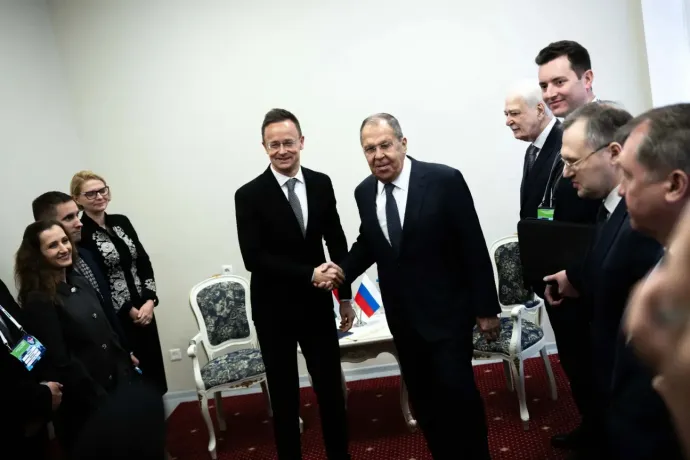



“The Ukrainian propaganda media and their Hungarian partners are spouting nonsense about ‘staged assassination attempts', Péter Szijjártó, Hungarian Minister of Foreign Affairs and Trade said in a video posted on his Facebook page in response to an article in The Washington Post which claims, citing Western intelligence officials and an internal report they obtained, that the idea of a staged assassination attempt against Viktor Orbán was raised within a unit of Russia’s Foreign Intelligence Service (SVR).
Szijjártó also said that the Tisza Party and those who commissioned them have become alarmed by the events of the past week or two. “They see the crowds at Viktor Orbán’s rallies, they saw the biggest Peace March to date, they see that people in Hungary don’t want war.” He believes this is why they have come forward with “conspiracy theories that are more preposterous than anything seen before".
The article claims that a unit of the SVR “began sounding the alarm” last month due to Viktor Orbán’s plummeting popularity. The Russian operatives suggested that drastic action might be necessary to keep Orbán in power, and they dubbed this strategy “Gamechanger.” According to the Washington Post, in the internal SVR document which had been obtained and authenticated by a European intelligence service and reviewed by The Washington Post, operatives proposed a way to “fundamentally alter the entire paradigm of the election campaign” by “the staging of an assassination attempt on Viktor Orbán.”
“Such an incident will shift the perception of the campaign out of the rational realm of socioeconomic questions into an emotional one, where the key themes will become state security and the stability and defense of the political system,” the operatives wrote in a report prepared for the SVR’s main unit for political influence operations, Directorate MS, or Active Measures Department.
The Russian operatives also added that “The majority (52.3%) are dissatisfied with the state of affairs in the country, the dissatisfaction prevails not only in cities but also in the rural areas (50.8%) where traditionally the ruling Fidesz party’s position is strong.”
They also proposed that Orbán’s rule be equated with peace and as a “space for stability, predictability and long-term development” in the campaign and that the messaging be focused on portraying Magyar as a “puppet” of Brussels and his Tisza Party as “the party of war” supporting Ukraine.
According to The Washington Post, it is unclear how high up within the Russian government the SVR’s proposal reached.
Dmitry Peskov, the Kremlin's spokesperson, dismissed questions about the SVR’s strategy document. “This is yet another example of disinformation,” he told The Washington Post. The SVR declined to comment.
The Washington Post also claims that the Russian measures aimed at supporting Orbán include a social media campaign backed by the Kremlin. The goal of this campaign is to spread the message that Viktor Orbán is the only candidate who can defend Hungary’s sovereignty, according to European security officials familiar with the events, who spoke on condition of anonymity.
The Post’s article additionally notes that, according to their source, Hungarian Foreign Minister Péter Szijjártó has regularly consulted with his Russian counterpart, Sergey Lavrov, during breaks in EU meetings, meaning that the Russian leadership has essentially had immediate access to information on every EU matter for years.
Péter Magyar, the leader of the Tisza Party reacted to the information in the Washington Post article at an election rally on Saturday, addressing the subject in front of the crowd:
“The fact that the Hungarian Foreign Minister, a close friend of Sergey Lavrov, has been reporting to the Russians practically minute by minute from every EU meeting is outright treason. This man has not only betrayed his own country, but Europe as well.”
A European security official has also told the Washington Post that their agency had been informed that three individuals acting on behalf of Russian military intelligence (GRU) had recently arrived in Hungary, which confirms a previous report by VSquare on this matter. Orbán has been one of Russia’s best assets,” one of the Western officials said. “It is hard to imagine that the Russians would not be standing ready to assist if things go sideways.”
The Russian Embassy previously said that the claim that Russian intelligence agents had arrived in Budapest to influence the outcome of the Hungarian elections was untrue.
In his reaction video to the article, Péter Szijjártó also said that “Hungarians can clearly see that the only reason why these fake news – these lies which are part of Ukrainian propaganda – are being spread is to support the Tisza Party in the Hungarian elections and to influence the election results.” He also said that on April 12, the Hungarian people can ensure with their votes that “Zelenskyy doesn’t have the last laugh.”
Telex has sent an inquiry to the Hungarian Government’s Information Center regarding the claims in the article. They sent the following response:
“The Washington Post’s report is entirely false, pro-Ukrainian propaganda. Contrary to what it claims, the fact is actually that Ukrainian President Volodymyr Zelensky publicly threatened the Hungarian prime minister during the campaign.”
For more quick, accurate and impartial news from and about Hungary, subscribe to the Telex English newsletter!