Tisza leads by 55-35 among decided voters, with a big lead among total population as well, Medián poll shows


The Tisza Party is currently ahead of Fidesz by 11 percentage points among the entire voting-age population, and has already reached a 20-point lead (55-35) among decided voters with a party preference, according to a Medián poll as reported by HVG. The difference among those with a party preference is 13 percentage points: while almost all (97 percent) of Tisza's supporters say they will definitely participate in the April elections, only 85 percent of Fidesz supporters are certain they will turn out.
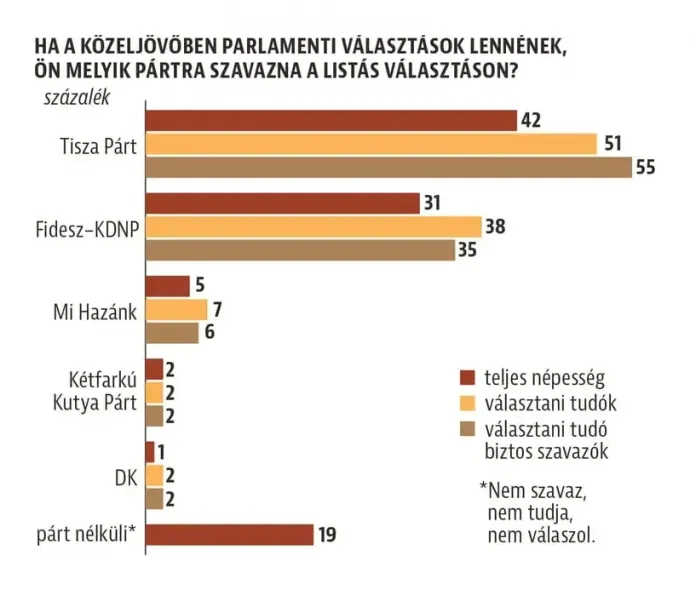
Compared to the previous Medián survey, Tisza was able to improve by 2 percentage points, while Fidesz weakened just as much. Among those certain to vote, Tisza performed 4 percentage points better than last time, whereas Fidesz dropped 4 points, meaning that the gap between the two parties among those certain to vote has widened by 8 percentage points.
Far-right Mi Hazánk stands at 6 percent, which is the threshold required to enter parliament. Other than the Hungarian Two-Tailed Dog Party (MKKP) and the Democratic Coalition (2 percent), which have been stuck at 1-2 percent for months, the smaller parties' voters together do not even make up 1 percent.
Some of the recent scandals may have contributed to Tisza's rise and Fidesz's decline. Medián's survey also addressed the case of the Samsung factory in Göd and the secretly filmed footage likely aiming to smear Péter Magyar, both of which were significant enough to capture public attention, with 89 percent of respondents having heard about them.
Methodology
The survey was conducted between February 18 and 23 by telephone interviews with a nationally representative sample of 1,000 people. Minor distortions in the sample were corrected using mathematical procedures, known as weighting, based on data from the Hungarian Central Statistical Office (KSH), so that the sample accurately reflects the composition of the voting-age population by place of residence, gender, age, and educational attainment. The margin of error for the published data is ±3.5 percent at most, depending on the distribution of responses in the total sample.