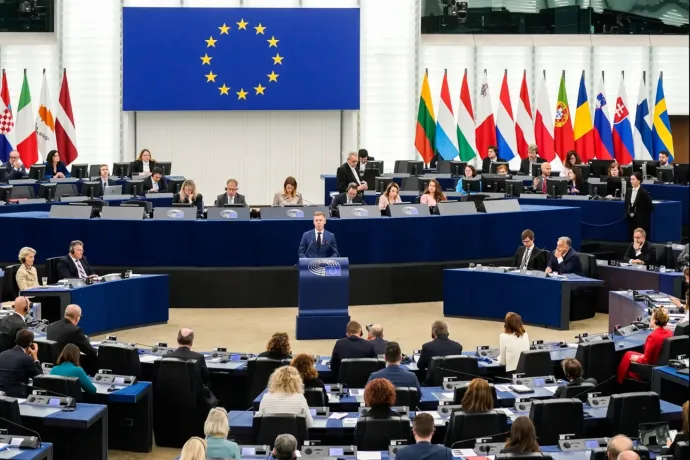



Fidesz was still preparing for another two-thirds majority victory in early May last year when Péter Magyar made a promise in the European Parliament that if the Tisza Party were to form a government, Hungary would join the European Public Prosecutor’s Office (EPPO). A year later, after the Tisza Party’s landslide victory in the parliamentary elections, he reiterated this at his first international press conference as the incoming prime minister.
Magyar listed this among the four-step package he was willing to implement in exchange for EU funds, which had been frozen due to the EU's rule-of-law concerns. Neither the European Commission nor the Council of Ministers is requiring membership in the European Public Prosecutor’s Office in any of the proceedings related to EU funds. Regardless of this, it may still end up being part of the package. The powers of the European Public Prosecutor’s Office will open up new possibilities and would certainly play an important role in the fight against corruption in Hungary.
While political will is an essential prerequisite for joining the EPPO, the process is more complex than that; making it a condition for accessing EU funds would therefore be a race against time.
Of the funds that have been withheld due to concerns about the rule of law, €10.4 billion from the Recovery Fund will only be available until August. For these funds to become available, a total of 27 anti-corruption and rule-of-law milestones need to be met, which the Orbán government included in its recovery plan approved in 2022 after reaching an informal agreement with the European Commission.
Hungary is almost the last one
The European Public Prosecutor’s Office began its work in 2021 following lengthy negotiations amongst the 27 member states. It was initially not established with the participation of all member states, but rather through enhanced cooperation tailored to smaller groups of member states; but the number of members gradually increased. By now, aside from Hungary, only Ireland and Denmark remain on the outside, though the two have been granted an exemption from cooperation in the areas of justice and home affairs.
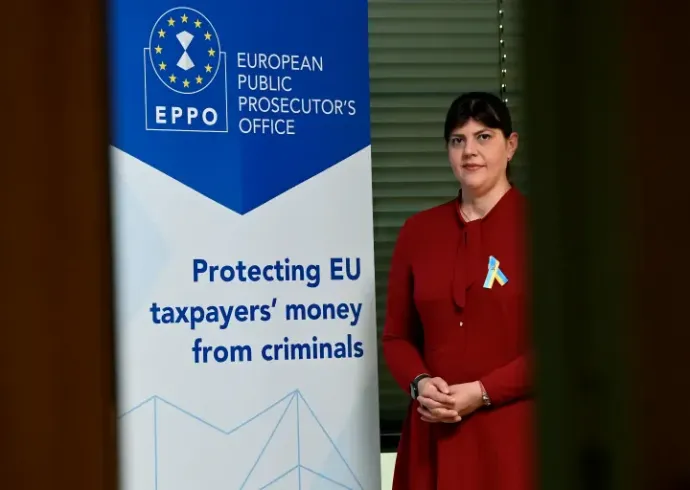
Laura Codruța Kövesi, who previously led Romania’s anti-corruption prosecutor’s office, serves as the Chief Prosecutor of the European Public Prosecutor’s Office. Last year she noted that it was “typical” for Hungary not to have joined the organization. From the outset, the Orbán government has consistently rejected the idea of joining the EU Public Prosecutor’s Office and was originally opposed to its establishment too. This means that there are still a number of legal requirements that need to be met before Hungary can join.
Judit Varga, Hungarian Minister of Justice at the time, also argued against participating when the European Public Prosecutor’s Office was being launched: “The Hungarian Government—in line with the Parliament's preliminary position—has decided that it does not wish to participate in the establishment of the European Public Prosecutor’s Office, nor in the enhanced cooperation. This is a matter of sovereignty. By establishing the European Public Prosecutor’s Office, Brussels is seeking to gain even more power for itself at the expense of the member states.”
EU investigations have stalled in Hungary
The European Public Prosecutor’s Office is an organization with unique jurisdiction. It deals exclusively with economic crimes, specifically
- fraud affecting the EU budget;
- VAT fraud involving amounts over 10 million euros (approx. 3.6 billion forints); and
- fraud involving EU funds exceeding 10,000 euros (approx. 3.6 million forints); as well as
- the investigation of cross-border VAT fraud.
“The European Public Prosecutor’s Office has the right to initiate investigations and can act as a prosecutor in national proceedings,” international lawyer Tamás Hoffmann explained to Telex when talking about the scope of the organization’s authority. This is on an entirely different level from that at which the European Anti-Fraud Office (OLAF) has been able to operate.
OLAF was not able to conduct investigations on its own; it could only rely on the local authorities of member states and, ultimately, could only make recommendations to the prosecutor’s office of the relevant country to initiate an investigation. The Hungarian authorities would then simply either ignore this, or would close the case after a lengthy investigation, citing a lack of criminal activity – regardless of whether the case concerned suspicious hospital procurements, a tender in the education sector, or even the prohibited surveillance of OLAF staff.
When OLAF investigated the Elios case linked to Viktor Orbán’s son-in-law, the government ultimately thwarted OLAF’s investigation by opting to give up EU funding and instead finance the public lighting project of István Tiborcz’s (the PM's son-in-law) company by using Hungarian taxpayers’ money.
In Hungary, the cases uncovered by OLAF have yielded strikingly low results: while, on average across the EU, member states’ authorities recovered 71 percent of the funds in proceedings initiated based on OLAF’s recommendations, in Hungary this rate was only 18 percent
—the Financial Times recently reported.
Orbán, who has been advocating for a Europe of nation-states as opposed to a “federalist Europe,” rejected the idea of joining the European Public Prosecutor’s Office, claiming that it would undermine national sovereignty. “You may choose the European path, but don’t think that the option to choose independently will still be there afterwards, because once we choose to go down that path, there will be no turning back. That’s what the European Public Prosecutor’s Office is all about too,” he said last September at the picnic in Kötcse.
According to prime minister-elect Péter Magyar, however, it was never about protecting sovereignty, but rather about allowing Orbán and his allies to funnel funds unimpeded into the pockets of those close to the government. The European Public Prosecutor’s Office is “the organization that could prevent billions of euros in EU funds from continuing to flow to Orbán’s oligarchs and his family members”, he said as early as the fall of 2024, following the Tisza Party’s first successful test—the European Parliament elections.
The European Public Prosecutor’s Office has seen a dramatic increase in activity year after year: in 2024, there were 1,500 investigations underway, and last year that number rose to 3,600 across the 24 EU member states that have joined the Office. One of the largest fraud cases involves the port of Piraeus in Greece, where €250 million worth of contraband goods were seized. The total value of cases handled by the organization was €25 billion two years ago and reached €69 billion in 2025—of which €45 billion was related to VAT fraud, according to the organization’s report from last year.
The Orbán government argued against the establishment of the European Public Prosecutor’s Office on the grounds that it would allow for the scrutiny of VAT-related matters, stating that “more than 95 percent of VAT revenues flow into the national budget, and thus this would violate the principles of subsidiarity and proportionality, thereby raising concerns about sovereignty.”
That said, this does not mean that the European Public Prosecutor’s Office had no oversight in Hungary under the Orbán government. They acknowledged that there is an important exchange of information between the organization and the Hungarian prosecutor’s office; and in 2021, a cooperation agreement was signed between the two, just as it was with Ireland and Denmark, which are also non-members.
However, with the Tisza Party’s two-thirds election victory, the situation has completely changed, and Hungary will soon join the organization, though this still requires a series of legislative amendments.
Even with a two-thirds majority, there is much work to be done
“The jurisdiction of the European Public Prosecutor’s Office represents a new dimension that the Hungarian legal system does not yet recognize. To make it compatible with the system, there will need to be a great many legislative amendments,” said Tamás Hoffmann. The first step is to ratify the founding treaty at the international level, followed by amendments to the Criminal Procedure Act, the laws governing the prosecutor’s office and the police, and the Constitution itself. On top of that, joining the EPPO could have countless minor legal implications, and making adjustments to this will be time-consuming simply due to the sheer volume of necessary amendments.
“With a two-thirds majority, this process can be completed, but a great deal of work is needed to ensure there are no problems with legal technicalities. It should be voted on as a package, and it will make a difference whether we have to start preparing the necessary changes to the Hungarian legal system from scratch now, or whether drafts for the necessary legislative amendments have already been prepared” the researcher at the Institute of Legal Studies of the Center for Social Sciences and lecturer at Corvinus University said. Since the Orbán government was opposed to membership, it is likely that the needed plans are not at an advanced stage of development.
The change in government has now provided an opportunity for this, but it will require even more intensive work, given that, in parallel with the preparations, a significant restructuring of the ministry is also getting underway, both in terms of personnel and institutional structure.
Magyar’s statements have made it obvious that the country joining the European Public Prosecutor’s Office is a clear political priority.
“The question is how long it will take to put together the team that will draft the package of legislation affecting so many areas, which will then pass through parliament without a single hitch,” the international lawyer noted. In his view, when it comes to the vote, the challenge is clearly not one of securing political will, but rather of producing a package that will ensure that the legal consequences of accession are consistent with the Hungarian legal system in every area.
Magyar listed joining the EPPO among the four measures he would undertake to secure EU funds. So far, in line with the Orbán government’s stance, this has not been included either in the preconditions for receiving the €10.4 billion from the recovery fund or as a condition for the €4.2 billion, from the conditionality mechanism which have been made temporarily inaccessible (and where more than €2 billion became permanently unavailable). However, an article in Válasz Online warned that a group of experts working along the Tisza for the past year and a half has identified deficiencies which, technically, cannot be remedied in the time available.
EU funds had previously been blocked in connection with the rule of law in Poland as well, and the new government that replaced Law and Justice (PiS) found itself in a similar predicament when it took office in 2023. For them at that time, it was not the tight deadline but presidential vetoes that posed an obstacle to meeting the conditions, which they sought to remedy in part precisely through joining the EPPO. According to Reuters, Adam Bodnar—then still the incoming justice minister—said in November 2023 that the announcement of their joining was “good for the recovery fund because it shows that we can be held more accountable. They expected a response from the European Commission within four months—the new Hungarian government will have roughly that amount of time to meet the conditions for the Recovery Fund, but it may be possible to resolve the potentially unmet conditions more quickly through other means.
For more quick, accurate and impartial news from and about Hungary, subscribe to the Telex English newsletter!