The leaked Szijjártó wiretaps indicate that neither he nor Orbán understood that Europe is not a game
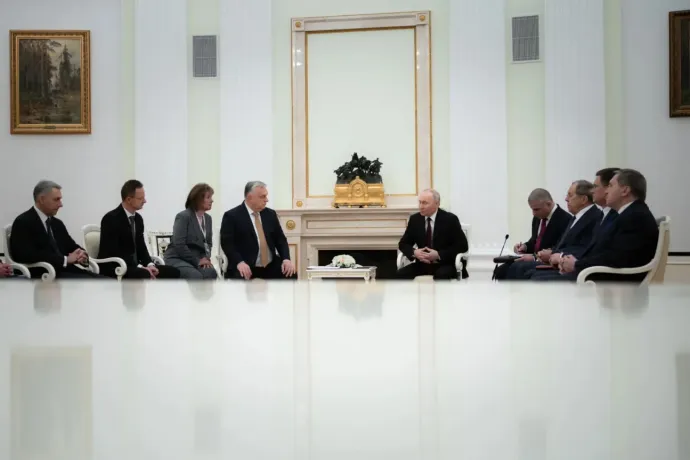


Where is Péter Szijjártó? One day after Tisza's landslide election victory, while the international press was abuzz with headlines about the fall of Viktor Orbán’s regime, the Hungarian press was mostly preoccupied with the question of why the foreign minister—one of the faces of the Fidesz campaign—wasn't there on stage alongside János Lázár and Viktor Orbán during the latter's concession speech. Moreover, Szijjártó—who is usually active on social media—was nowhere to be seen on Monday; during the day, he merely changed his profile picture to a Hungarian flag.
On Monday afternoon, when Péter Magyar held an international press conference, the future prime minister announced: to his knowledge, Szijjártó and his colleagues were busy shredding documents related to sanctions against Russia at the Ministry of Foreign Affairs. It is unclear how much of this is true, but the fact remains that many already view Szijjártó as a puppet of the Russians, and even within Fidesz, his reputation is not very good on account of having become too close with the Russians.
The recordings were used as a weapon against Orbán’s foreign minister
Viktor Orbán presumably intended for Péter Szijjártó to play a different role in the campaign than the one he ultimately ended up with. He ended up taking the hardest hits in the final stretch of the campaign, when his phone conversations with Sergey Lavrov were leaked.
The leaked audio recordings revealed two things. First, that the relationship between the Hungarian Foreign Minister and his Russian counterpart is quite asymmetrical: while Szijjártó has practically viewed the EU leadership as an enemy, he has regarded the Russian leadership as a political ally. This is embarrassing in and of itself, given that the Russians started a war in Ukraine, and the Szijjártó–Lavrov relationship cannot be justified merely by the fact that the Orbán government wanted to maintain pragmatic ties with Moscow.
On the other hand, it also became clear that Szijjártó was wiretapped using intelligence agency methods by the intelligence agency or agencies of a foreign state, and the conversations obtained by these means were then used as a weapon against Orbán’s foreign minister.
Although Szijjártó defended himself by saying that he had never said anything he would not openly stand by, this is precisely what gave him away: it turned out that the Russians have essentially been pulling the strings of the minister who was eager to please Lavrov, wanted to win his favour, and collaborated with him, and Szijjártó’s loyalty lay not with the EU but with Moscow. This was a serious blow to Szijjártó, even though he had never denied his friendship with Lavrov. (English subtitles available for the video below.)
They received advance warning
The leaked Lavrov-Szijjártó conversations made it absolutely clear: the Orbán government’s policy toward Russia likely alarmed one or more – presumably EU member – states so much that their intelligence services undertook active operations to undermine it.
Szijjártó's calls with Lavrov had been recorded years earlier, but their being leaked was the result of a political decision that is only made when behind-the-scenes warnings have proven futile.
The fact that the situation escalated to this point was primarily due to the Orbán government’s misjudgment of the situation. In behind-the-scenes discussions, government officials argued that Orbán believed that with the support of the U.S. president behind him, he would not have to conform to the expectations of European leaders.
They even received a serious warning before the audio recordings were leaked. On March 16, Szijjártó himself revealed that the Germans had threatened him during the Foreign Affairs Council in Brussels. But even then, he exploited the threat for domestic political purposes, creating the impression that he was acting in the nation’s interest.
“I’ve been sitting in on these meetings for 11 and a half years, and I’ve never experienced anything like this: a very rude, blatant, shameless threat from the Germans. The Germans openly threatened us, saying there would be very harsh, very serious consequences if we did not give up representing the national interest in matters related to Ukraine,” the minister said after the meeting. It is unclear whether the Germans were involved in leaking the audio recordings; in any case, Szijjártó did not grasp what the cost might be if European leaders were aware of him tipping off the Russians.
Szijjártó was warned/threatened by the Germans after Orbán blocked the EU loan intended for Ukraine, which had already been approved and which, incidentally, would not have cost Hungary a single penny. The Hungarian Prime Minister justified this by claiming that, in his view, the Ukrainian leadership is deliberately failing to repair the Druzhba oil pipeline which the Russians had attacked, thus preventing Russian oil from reaching Hungary.
From European politicians' perspective, it is irrelevant whether Orbán’s obstruction and the anti-Ukrainian policy amplified during the election campaign amounted to openly serving Russian interests or “merely” served campaign interests, since the result is the same. For years, Orbán enjoyed using foreign policy for domestic political purposes. For years, he reveled in the fact that he had become an international brand, a role model worthy of emulation among populist politicians. However, this is only the political dimension. He either failed to assess the national security risks of all this, or he believed that time was on his side and he could later shape the EU in his own image. He was also mistaken in believing that his friendship with Trump would offer him protection from European leaders.
There may have been more material prepared in case they remained in power
The leaking of Szijjártó's conversations also foreshadowed that if Fidesz were to win the election, European diplomats would no longer tread lightly with Orbán’s government, and more drastic measures might be taken against them. This is what diplomats speaking anonymously to Politico indicated, roughly around the time Szijjártó and Lavrov’s conversation was made public.
But the publishing of the minutes of the phone call between Orbán and Putin also fit into this pattern, as did the statement by Andrzej Derlatka, the former head of Polish intelligence, who bluntly called Orbán and Szijjártó Russian agents. “I’m watching what’s happening in Hungary, and I’m shocked by what I’m seeing. Orbán has not only leaked information from the European Union but also from NATO. Meanwhile, Donald Trump is pretending not to notice this,” Derlatka said. He also mentioned that he had worked at NATO headquarters and knows how seriously they take security there.
The leaking of Szijjártó's conversations is indeed serious, as Orbán and Szijjártó have said themselves, but not only because it is obviously illegal to record such a conversation. It is, in fact, not at all uncommon for states within an alliance to spy on one another. What makes the matter so serious is that it was the audio recordings themselves that were leaked, as this is the ultimate step. It is almost certain that the phone conversation conducted on an open line was merely the tip of the iceberg, and there is operational intelligence available against Orbán and his associates that would have been used against them had they remained in power.
This can mean only one thing: that Hungary ended up alone, and that Europe's leading nations had come to view the Orbán government—which had aligned its foreign policy with that of Russia— as a potential threat that must be stopped at all costs.
This is unprecedented, but it clearly illustrates how poorly the Hungarian prime minister understood the potential consequences of continuing to operate—along with his minister—as a representative of Moscow.
However, it is precisely in this context that what has happened should be understood not merely as a message and warning directed at the Hungarian Foreign Minister or Viktor Orbán. The French far-right politician Marine Le Pen—who previously secured a loan from the Hungarian MKB bank on Viktor Orbán’s direct instructions—and certain politicians from the German AfD should also consider themselves among the intended recipients.
Furthermore, the crackdown on Orbán is also directed at Serbia, which is seeking to join the EU. Brussels is likely to use financial pressure on our southern neighbor the same way it did with Hungary. The goal is the same: to distance countries from Russia, to reduce Russian influence, and to prevent them from acting as a stick between the spokes.
Admittedly, unlike Orbán, Serbian President Aleksandar Vučić acted much more cautiously recently when commenting on the explosives found near the Turkish Stream pipeline in his country. As is well known, during the final week of the election campaign, Serbian authorities found explosives near Trešnjevac close to Kanjiža, not far from the Serbian-Hungarian gas pipeline known as Turkish Stream. The Orbán government suspected the Ukrainians behind it, claiming that it was in their interest to cause damage to the infrastructure.
However, the explosives were likely planted as part of a false-flag operation intended to amplify Fidesz’s anti-Ukrainian campaign. This is suggested by the fact that details of the bombing plot had leaked weeks in advance, along with its intended objectives, but the government nevertheless immediately exploited the incident for campaign purposes. Many were surprised that, contrary to expectations, Aleksandar Vučić did not get in on the game. Although he stated that he would like Orbán to win the election, he indicated that they are unwilling to comment on the matter until after the election is over. To be sure, the Serbian authorities did announce that the claim about Ukraine’s involvement was disinformation.
For more quick, accurate and impartial news from and about Hungary, subscribe to the Telex English newsletter!