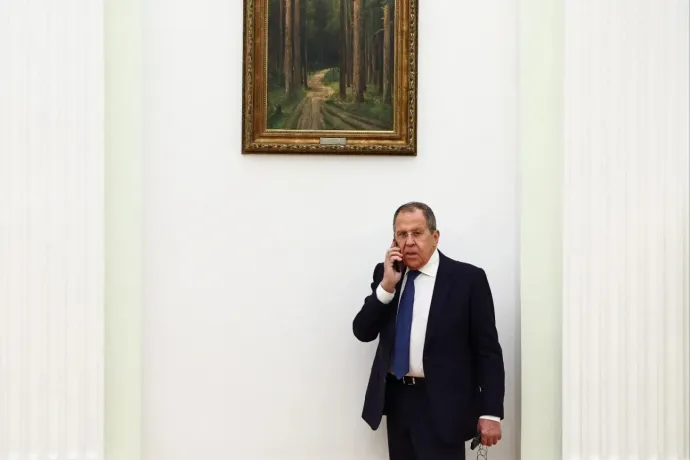


A consortium of investigative journalism outlets released new recordings of phone conversations between Péter Szijjártó and Russian Foreign Minister Sergey Lavrov on Wednesday. The recordings revealed, among other things, that Szijjártó had offered to send European Union documents to his Russian counterpart via the Hungarian Embassy in Moscow, and they also shed light on what the two diplomats discussed ahead of Viktor Orbán’s visit to Moscow in July 2024. In another recording, Szijjártó is inquiring about the meeting between Donald Trump and Vladimir Putin in Alaska.
VSquare, FrontStory, Delfi Estonia, The Insider, and the Ján Kuciak Investigative Center published the first part of their series on Hungarian-Russian relations last week. In it, they wrote that Péter Szijjártó has repeatedly acted in the interests of the Kremlin at European Union meetings and consultations in recent years, and he has regularly briefed the Russian Foreign Minister on developments in the EU. According to the leaked audio recordings, Szijjártó made efforts to have Russian individuals and organizations subject to EU sanctions removed from the sanctions list, and to this end, he also worked closely with Pavel Sorokin, Russia’s Deputy Minister of Energy.
The piece published on Wednesday suggests that the Hungarian government has systematically used the issue of the rights of the Hungarian minority in Transcarpathia as a weapon to stall and slow down Ukraine’s EU accession negotiations. The telephone conversations between 2023 and 2025 show that Szijjártó’s role was by no means limited to leaking sensitive discussions and minutes from within the EU. During numerous phone calls, Szijjártó provided Lavrov with important information about how the West intends to exert greater pressure on Russia to end the war in Ukraine. According to the article, during breaks in EU negotiations, Szijjártó could hardly wait to contact Lavrov to seek his advice or permission to take steps that were detrimental to the EU and Ukraine.
On July 2, 2024, Hungarian Prime Minister Viktor Orbán visited Kyiv to meet with Ukrainian President Volodymyr Zelenskyy. This was the first time since the start of the full-scale Russian invasion that the Hungarian PM had traveled to Kyiv to hold bilateral talks with the Ukrainian president.
On that day, Szijjártó called Lavrov again to inform him about the meeting between Orbán and Zelenskyy. The timing of the call was crucial, as it took place one week before the NATO summit in Washington, where Western support for Ukraine was one of the top items on the agenda. In his phone conversation with Lavrov, Szijjártó wanted to find out whether Russian President Vladimir Putin would be willing to meet with Orbán “anywhere in Russia” prior to the NATO summit, since “the Prime Minister is completely flexible regarding the location.” According to Szijjártó, Orbán wanted to explain to Putin the “consequences of the Kyiv meeting.”
Lavrov then wanted to know in what capacity Orbán would be negotiating with Putin: as the Hungarian prime minister, or as the “President of the European Union,” since Hungary was holding the rotating presidency of the Council of the European Union at the time. Orbán used this situation to launch an initiative he called a “peace mission,” during which he traveled to Kyiv, Moscow, Washington, and Beijing for talks.
“We cannot divide the two, but I think that it increases [the] significance, that he is the Chair of European Union,"
Szijjártó replied to the Russian Foreign Minister's question. We wrote in detail in this article about how the Hungarian government conflated Orbán’s “peace mission” with the rotating EU presidency.
According to the article, the Hungarian government did everything it could to keep the plan of the Orbán-Putin meeting secret from EU and NATO allies because they feared resistance from Western countries. When news of the meeting leaked, EU representatives emphasized in advance that Orbán is representing only Hungary, not the entire bloc. But neither Orbán nor Putin saw it that way – as the recently leaked phone conversation shows. The meeting finally took place on July 5, 2024, in the Kremlin, where Putin immediately started by introducing Orbán as a representative of the EU.
During the phone call prior to the meeting, Lavrov also had a request for Szijjártó, which went as follows:
S.Lavrov: Look, I wanted also to call and check about [the] compromise you reached with [the] European Union on opening of the negotiations for Ukraine on accession. And there were reports that the decisive role was played by the language of national minorities.
Szijjártó: Absolutely. It was the case.
S.Lavrov: We are trying to get hold of the exact document, but…
Szijjártó: I will send it to you. It’s not a problem.
(…)
S.Lavrov: Ok, Peter, if you can send me the document, I would appreciate this.
Szijjártó: I immediately do it. I send it to my embassy in Moscow, and my ambassador will forward it to your chief of staff, and then it’s at your disposal.”
It was not clear exactly what document Lavrov wanted from Szijjártó. The Hungarian Ministry of Foreign Affairs and Trade did not respond to related questions from the international consortium of journalists that released the audio recording. A high-ranking EU official stated with “99 percent certainty” that the document Szijjártó promised to send to Lavrov was the negotiation framework, which was already publicly available on EU websites at that time. “I don’t understand at all why Lavrov played this game with him. This framework is a public document,” he said. According to a Western intelligence chief, it is possible that Lavrov was simply testing how far Szijjártó was willing to go to provide information to Russia. “It’s almost like a loyalty test to judge an asset’s willingness to follow orders or comply with tasking assignments,” the official said.
The article also reported on a phone call fromAugust 16, 2025. This conversation focused primarily on the U.S.-Russia summit in Alaska that had taken place shortly before. Szijjártó was trying to get some behind-the-scenes details about the meeting between Donald Trump and Vladimir Putin. He was particularly interested in finding out why the two presidents’ joint lunch had been canceled and why the Russian president had left Anchorage in a hurry after barely three hours of bilateral talks. Was this “not a signal of a bad mood or disappointment between the two of you?” Szijjártó asked, to which Lavrov assured him that the joint lunch had in fact “never been canceled. And the lunch is not something which I would really like, knowing the American gastronomic art," the Russian foreign minister remarked.
Szijjártó asked whether there had been any progress regarding economic cooperation with the Americans and the resumption of trade relations, to which Lavrov simply replied that the matter had not been discussed. In response to an additional question, Lavrov said that new sanctions had not been discussed during the talks either. “It was a very friendly conversation covering many topics, including some entirely personal matters that have nothing to do with politics. But regarding Ukraine, we explained our position clearly, and I believe Trump understood the essence of it when he stated in his interview with Fox News that lasting, long-term peace is much better than a ceasefire,” – Lavrov said.
Szijjártó: A blatant act of intelligence interference
Péter Szijjártó described the release of the additional audio recordings featuring his conversations with Russian Foreign Minister Sergey Lavrov as an “unusually harsh and blatant act of intelligence interference.”
The Hungarian Foreign Minister wrote on Facebook that there are four things that are clear from the leaked recordings, namely that Hungary is firmly committed to peace, that it stands most resolutely for the Hungarians of Transcarpathia, it is fighting for cheap Russian oil and gas, and that they consider Brussels’ policy to be “very dangerous and a complete tragedy.”
For more quick, accurate and impartial news from and about Hungary, subscribe to the Telex English newsletter!