Explosives found near gas pipeline to Hungary in Serbia


On Sunday morning, the Serbian press reported that suspicious items had been found near Trešnjevac, close to Kanjiža, in the proximity of the Serbian-Hungarian gas pipeline known as “Turkish Stream.” Serbian police and military personnel were immediately deployed to the site, with drones, thermal cameras, search dogs, and helicopters also brought in, and several streets in the area were closed off.
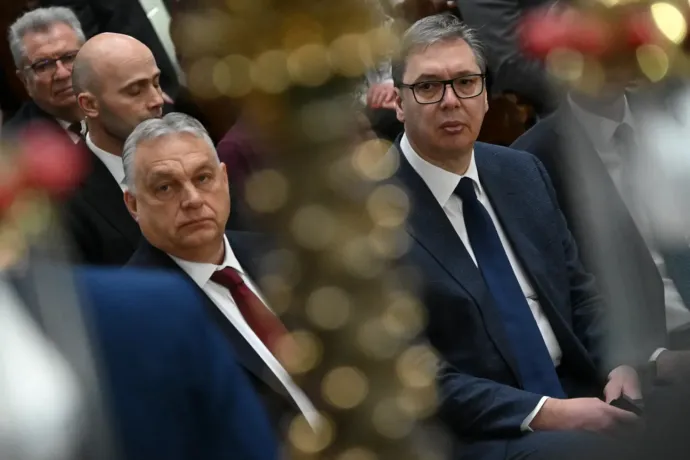
Serbian President Aleksandar Vučić later stated that powerful explosives and detonation cords had been found near the pipeline, and said he had informed Hungarian Prime Minister Viktor Orbán about the “threat to critical gas infrastructure”.
Orbán posted on Facebook shortly after the Serbian president's announecment: “Serbian authorities found highly destructive explosives and the devices needed to activate them near the critical gas infrastructure connecting Serbia and Hungary. The investigation is ongoing.” At the same time, the Prime Minister announced that he had convened an emergency meeting of the National Security Council for Sunday afternoon. Orbán has since then, early on Sunday afternoon delivered a speech at the opening ceremony of the renovated Citadella in Budapest, but made no mention of the events in Serbia there.
Foreign Minister Péter Szijjártó also reacted to the news at noon on Sunday, stating, “We reject this latest attack on our sovereignty in the strongest possible terms, as an attack on the security of our energy supply can only be interpreted as an attack on our sovereignty.” Tamás Menczer, communications director for the governing Fidesz party wrote that a terrorist attack had been foiled near the Hungarian border, and while the investigation may provide answers to the arising questions, the energy infrastructure serving Hungary “must be protected both within Hungary’s territory and on the territory of other countries, since we know very well that the Ukrainians have already blown up the Nord Stream gas pipeline before.”
Bálint Pásztor, president of the Association of Hungarians in Vojvodina, (the biggest party of the Hungarian ethnic minority in Serbia) also posted on Facebook about the incident: “Serbian security forces foiled a terrorist attack near Trešnjevac.” He also wrote that authorities found two large bags of explosives during the investigation. He added that if the bombing had gone ahead, “not only would the gas supply to Northern Vojvodina and Hungary have been cut off, but human lives would also have been at risk in Kanjiža.”
Péter Magyar, president of the opposition Tisza Party, posted on Facebook urging Viktor Orbán to invite him to the National Security Council meeting as well, since “regardless of who organized this provocation, the TISZA government will be the one that will have to resolve the situation at hand. According to Magyar, if Viktor Orbán ends up using this incident for his campaign, it will be an open admission that this is a premeditated false-flag operation. In his message to the Prime Minister, he said that he would not be able to keep next Sunday’s elections from happening, nor “millions of Hungarians putting an end to the most corrupt two decades in our country’s history.”
Péter Buda, a national security expert and former senior national security officer, writing on his Substack, pointed out that “in certain circles, based on leaked information, there had already been talk of a false-flag operation planned against critical infrastructure of Hungarian interest on the Serbian side of the border.” According to Buda, he had spoken on multiple occasions in the past few months leading up to the Hungarian elections about the possibility of explosive devices being found near critical infrastructure that is of interest to Hungary.
Two days ago, Russia expert András Rácz posted on Facebook about a similar scenario – albeit with different names – in which a similar type of threat occurs on the territory of Serbia. Rácz told 24.hu on Sunday that “from the perspective of a fictional attacker, it would be very strange to attempt an assassination now. This only benefits Viktor Orbán and the Fidesz campaign. No one else.
László Józsa, the former president of the Association of Hungarians in Vojvodina and the former president of the Hungarian National Council of Vojvodina, told Hvg.hu that based on Vučić’s statement, one can conclude that “the alleged perpetrators took the explosives out to the field and left them there, thinking they would return later.” According to Józsa, this is a diversion and it is only a matter of time before “they say they have found an arrow pointing to Péter Magyar.”
Independent MP Ákos Hadházy wrote on Facebook that the whole thing is “transparent and pathetic,” but in his view, the silver lining is that “according to this, Orbán also believes the numbers of independent pollsters.” Hadházy says that there could be some pretty nasty things in store for the campaign next week “from the struggling regime.”
“Preparation for bombings in Serbia? The Defense Council being convened? Oh, come on!” – reacted Klára Dobrev, president of the Democratic Coalition (DK), adding that the council should rather be convened due to “pro-Russian, anti-EU policies.”
For more quick, accurate and impartial news from and about Hungary, subscribe to the Telex English newsletter!