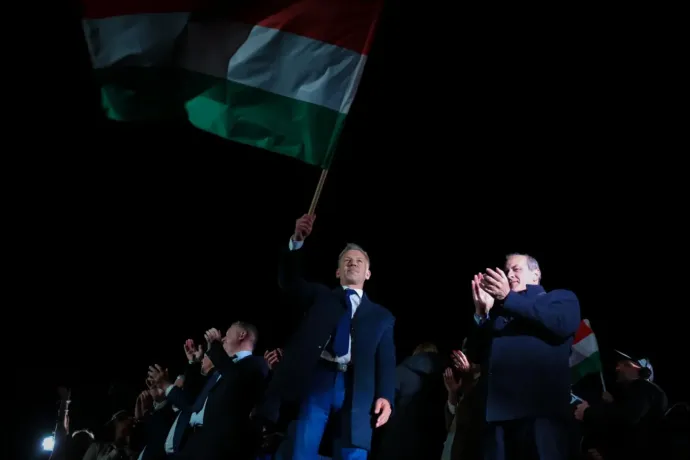

- Viktor Orbán has conceded defeat, he has congratulated Péter Magyar, who delivered his victory speech
- Tisza is leading by a large margin, with over 97 percent of the votes counted and a two-thirds lead; Péter Magyar has delivered his victory speech
- Tisza supporters are celebrating in the streets of Budapest by honking horns, lighting fireworks, and dancing in the streets
- Far-right Mi Hazánk is on track to enter parliament. As things stand, a parliament with three parties seems likely
- In light of the result, Klára Dobrev and the entire leadership of the Democratic Coalition have resigned
Ezt a közvetítést már lezártuk.
Downtown Budapest has turned into one big party, with many people partying to mark the Tisza Party's unprecedented victory. Drivers are slowing down and shaking hands with passers-by, and fireworks have been lit.
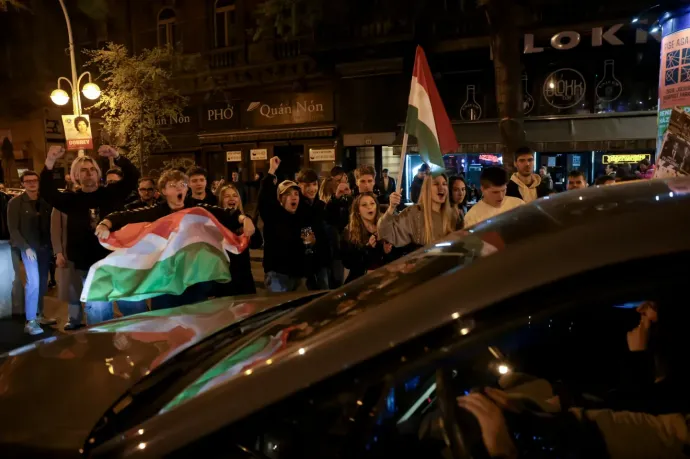
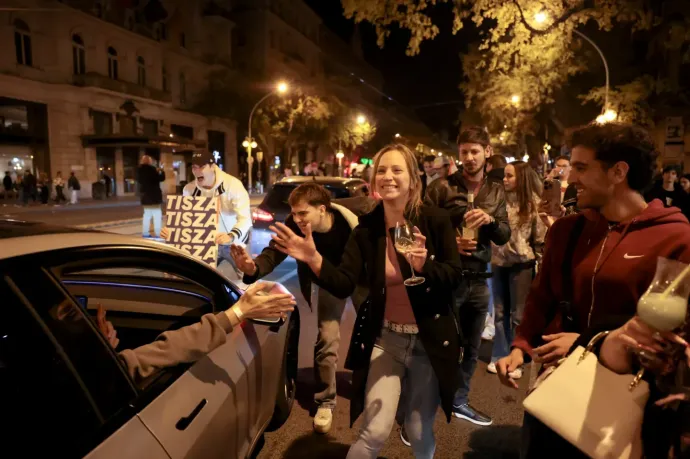
This concludes our election special. Join us tomorrow, 2pm Hungary time, when we will report from the Tisza Party’s press conference.
For more quick, accurate and impartial news from and about Hungary, subscribe to the Telex English newsletter!



The Tisza Party has won a landslide victory in Hungary's parliamentary elections; with 95 percent of the votes counted, the only question remaining is whether Péter Magyar will secure a two-thirds majority in parliament. Fidesz-KDNP candidates are facing an insurmountable gap in the vast majority of constituencies, and Viktor Orbán has conceded defeat.
The Hungarian Prime Minister, who has been in power for 16 years, has become a major international player in recent years; so it is no coincidence that the Hungarian elections were watched with keen interest not only in Brussels, but also in the United States and Russia. Orbán has become an iconic figure of right-wing populism, and has been regarded as an ideological partner by several world-class politicians. His battles with the leadership of the European Union have on several occasions hampered the bloc's decision-making ability, and his illiberalism and pro-Russian stance have earned him many followers among the enemies of the establishment.
Péter Magyar, on the other hand, campaigned on returning Hungary to the Western alliance system, so it is understandable that many foreign politicians expected a more cooperative Hungary if the Tisza Party won the election.
European Commission President Ursula von der Leyen wrote that Hungary had chosen Europe and returned to the European path. In a message written in Hungarian, von der Leyen stated,
“Europe’s heart beats stronger in Hungary tonight.”
Von der Leyen featured prominently in Fidesz's campaign; the Commission President’s face appeared on most of the billboards displayed across the country. Orbán and von der Leyen have clashed frequently in Brussels, as Orbán has repeatedly attempted to block the Commission’s proposals using his veto power in the European Council.
German Chancellor Friedrich Merz congratulated Péter Magyar, expressing his hope that they will be able to work together for a strong, secure, and united Europe.
Emmanuel Macron also congratulated the Tisza politician on X. Similarly to his German counterpart, the French president evaluated the election as a sign of Hungary’s commitment to Europe. Macron expressed his hope that Péter Magyar would work with him to move toward a more sovereign Europe, and he also posted a photo of himself with the Tisza politician.
On behalf of the Italian government, Giorgia Meloni wished Péter Magyar success in his work; also thanking her “friend,” Viktor Orbán, for their close cooperation over the years. The right-wing prime minister emphasized that Italy and Hungary are bound by a deep friendship. “I am certain that we will continue to cooperate in a constructive spirit, for the benefit of our peoples, and in the face of common challenges at the European and international levels,” she wrote.
One of Europe’s most prominent left-wing leaders, Spanish Prime Minister Pedro Sánchez, congratulated Hungarian citizens on the historic election. Sánchez also believes that Sunday’s results are a triiumph of Europe and European values.
British Labour Party leader Keir Starmer went even further, stating that
today is a historic moment, not only for Hungary, but for European democracy.
Yair Lapid, the leader of Israel’s largest opposition party, also offered his congratulations. Lapid has Hungarian Jewish ancestors from Vojvodina (northern Serbia); his father emigrated to Israel as a Holocaust survivor. Ekrem İmamoğlu, the imprisoned Turkish opposition leader, sent his best wishes to Péter Magyar from his prison cell.
A few minutes later, a message arrived from Volodymyr Zelenskyy, who, in addition to his congratulations, emphasized that Ukraine has always sought good neighborly relations with Hungary. The Ukrainian president could be one of the biggest winners of Orbán’s defeat, as the Hungarian prime minister essentially built his entire campaign around the perceived threat posed by Zelenskyy and the Ukrainians.
Romanian President Nicușor Dan also congratulated Péter Magyar and the Tisza Party. In a message shared on X, he wrote: The Hungarian people have spoken with a clear and powerful voice. The president also noted that Romania and Hungary, as neighboring countries and members of the European Union and NATO, work together based on shared values. He wrote that he is looking forward to opening a new chapter in Romanian-Hungarian relations.
“The Hungarians have made a historic decision for a free and strong Hungary in a united Europe, rejecting forces that ignore their interests. Congratulations to Péter Magyar on winning the election! I look forward to working together on what connects Estonia, Hungary, and Europe!” – Estonian Prime Minister Kristen Michal wrote in response to Tisza’s victory.
Norwegian Prime Minister Jonas Gahr Støre called the result highly significant and congratulated Péter Magyar and Tisza on their victory. “This result is of great importance for all of Europe,” the Norwegian head of government wrote on X.
Petr Pavel described the high voter turnout in the Hungarian elections as a victory for democracy in and of itself. The Czech head of state spoke to reporters at Prague Airport before departing for Argentina and Chile, and also expressed his hope that Hungary’s relations with the Czech Republic and its allies would improve in the wake of the elections.
Former Czech foreign minister and current Member of the European Parliament, Alexander Vondra, believes that the Tisza Party’s victory offers hope for the revival of the Visegrád cooperation. In his view, this depends on an improvement in Hungarian-Polish relations, which have been “greatly damaged” due to the ties between Viktor Orbán’s government and the Russian government.
Viktor Orbán’s close allies, such as Russian President Vladimir Putin, U.S. President Donald Trump, Turkish President Recep Tayyip Erdoğan, and Israeli Prime Minister Benjamin Netanyahu, have not yet reacted to the Tisza Party’s victory.

Horváth Kávai Andrea
Ukrainian President Volodymyr Zelensky published a post in English and Hungarian, saying: Congratulations to Péter Magyar and the TISZA party on their landslide victory!"
He wrote that Ukraine has always strived for good-neighborly relations with every European country, and we are ready to advance our cooperation with Hungary. Europe and every European nation must strengthen; millions of Europeans yearn for cooperation and stability. We are ready for meetings and joint constructive work for the benefit of both nations, as well as for the sake of Europe's peace, security, and stability.
Horváth Kávai Andrea
“My fellow countrymen! Hungarians! We did it! The Tisza and Hungary have won this election. Not just by a little, but by a lot. In fact, by a great deal. Together, we have ousted the Orbán regime; together, we have liberated Hungary,” Péter Magyar began his speech. He then thanked his audience for the result.
“Our victory is visible not only from the moon, but from the window of every Hungarian home. Whether it’s the smallest mud-brick house or a high-rise apartment building, in a big city or in the countryside, it’s visible from every Hungarian window,” Magyar continued.
The Tisza Party’s top candidate added: “Never before in the history of democratic Hungary have so many people voted, and no party has ever received such a strong mandate as Tisza. We thank you for the approximately 3.3 million votes with which you have given us a historic mandate to govern today. You have given us a mandate to build a functioning and humane homeland for all of us, for every Hungarian.”
Tisza not only won this election, but all signs indicate that we will have a strong two-thirds majority in parliament, Magyar said. In his view, this mandate will enable the most efficient and peaceful transition.
He thanked his family, his sons, his colleagues, and the party's 50,000 volunteers, as well as every Hungarian who supported the transition to democracy.
Magyar said that they won against all odds, even though the ruling party had deployed its entire apparatus, the secret services, and hundreds of billions of forints on smear campaigns against them.
“My friends, you have brought about a miracle today; today, Hungary has made history,” said Magyar, who believes they have triumphed over evil and done what the nation demanded of them. “The Hungarian people have said ‘no’ to deception, lies, misdirection, and betrayal,” he said.
“My dear friends, two years ago, a few people set out, and in the battle much like the one between David and Goliath, love triumphed—because in the end, love always triumphs. Thank you all for heeding the biblical advice not to be afraid,” – said Péter Magyar, to which the crowd began chanting, “We are not afraid!” “
”Thank you for believing that we can change our destiny, that we can write our history ourselves,” said Magyar, then added: “How many times have people told us that it wasn’t worth going to the countryside ? How many times have we heard that we must come to terms with "his Majesty’s" opposition, that we must make deals, because there is no other way. But of course there is—today you have proven that yes, it can be done.
According to Magyar, “there have been moments of grace in Hungarian history; 1848 was such a moment, and so was 1956. And let’s declare: April 12, 2026, is now also one of them. May this day too be a date inscribed in gold in the annals of Hungarian freedom! This is a victory for freedom, a victory for truth over lies. Let it also be a victory for those who did not vote for Tisza; let it be “a brilliant and magnificent victory for all Hungarians .”
Magyar then continued: “Every Hungarian feels in their heart that this is a wonderful victory. Our country has decided: it wants to live again, it wants to be a European country once more.” The crowd then began chanting, “Russians, go home!”
“Hungary wants to be a country that is nobody’s vassal, where performance matters, where citizens can count on their government, and where everyone is entitled to adequate healthcare and quality education. A country where no one is stigmatized for thinking differently than the majority. No one is stigmatized for loving someone differently than the majority, or for believing in something different than the majority. A country where who you know is not what matters, but rather what kind of person you are, where you can feel safe having children and starting a family," said Magyar, amid repeated interruptions of cheers.
Magyar then continued: “Every Hungarian feels in their heart that this is a wonderful victory. Our country has decided: it wants to live again, it wants to be a European country once more.” The crowd then began chanting, “Russians, go home!”
“Today, the Hungarian people have said a resounding and clear ‘yes’ to removing from power those who divide the people. The Hungarian people have said ‘yes’ to Europe, to a free Hungary, so that we can put the country in order. This is the duty of every Hungarian government,” said Péter Magyar.
“The Tisza government represents everyone, which is the duty of every Hungarian government; we must not make distinctions between Hungarians, nor divide and incite against each other, because that is a sin.”
He urged Hungarians who had moved abroad to return home in as large numbers as possible, because there will be much work to be done. He promised that the army, the police, and the secret service would serve exclusively the Hungarian people. He said that the state would take care of the most vulnerable and help them move forward.
“We are aware of our responsibility, and it is a tremendous task. Today we celebrate, then we get to work; we will work together toheal the wounds, and to clear away the rubble. I'm asking you all to join us on this path,” the president of the Tisza Party said.
“We know that the mandate we received today is unprecedented,” Magyar said. “We know that people who never thought they would stand with us voted for us today. We know this, and we will know it every day, and we will earn your trust every day, every hour.”
According to Magyar, “we will have a government in which every Hungarian will see that we are taking this mandate seriously. Because we have been given a mandate to rebuild our country, to heal our country’s wounds. We know that the situation is dire; we see the figures; we see what our predecessor did to the economy, law enforcement, child protection, and transportation. The task ahead us is enormous.
Magyar then said: “I call on the outgoing prime minister to function as a caretaker government from today onward and not to make any decisions that would tie the hands of the next government, the Tisza government.” Magyar continued: “If, during the transition—which we hope will be brief—any serious issue or decision affecting our nation arises, feel free to contact me; you have my phone number.”
Magyar then turned to the part of his speech dealing with civil law. As he said: “Today, the Hungarian people have decided in favor of regime change. Therefore, those who have been puppets and pillars of the system must leave public life. I call upon the President of the Republic to immediately nominate me, as the lead candidate of the winning party, to form a government, and thereafter to step down from office with whatever dignity he has left.
Magyar then proceeded to list at length the state and judicial leaders who, in his view, must resign from their posts. Magyar asked them to step down on their own accord and not wait until they are dismissed.
- the President of the Supreme Court;
- the President of the Constitutional Court;
- the Prosecutor General;
- the President of the State Audit Office;
- the President of the Economic Competition Authority;
- the President of the Media Authority;
- and the President of the National Judicial Office.
Magyar promised that Hungary would join the European Public Prosecutor’s Office and that they would not allow anyone to enslave Hungary again. He said that Hungary would once again be a strong ally of the European Union and NATO, and that Hungary’s place was, is, and will always be in Europe. Magyar intends to strengthen and expand the Visegrad Four alliance, and to this end, his first trip will take him to Poland. “My second trip will be to Vienna, and my third to Brussels, to bring home the EU funds that the Hungarian people are entitled to,” he said. Magyar listed a number of European leaders who had already congratulated him, and said that as prime minister, he would represent every Hungarian person in the Carpathian Basin and around the world.
Péter Magyar promised that “from now on, we will no longer be a country with no consequences” and that “those who have stolen from the country must be held accountable”. The crowd then began chanting, “To prison with them!”
Magyar promised that the “Tisza government will liberate the justice system and establish the National Asset Recovery Office, where the country’s best investigators and lawyers will work.” So Captain Bence Szabó and Captain Szilveszter Pálinkás! should get ready, he said. Magyar then specifically thanked the youth for bringing hope back to the Hungarian people, and the elderly for not believing the lies that were spread about Tisza.
He then addressed the Fidesz supporters as well, saying: “My dear Fidesz-supporting compatriots! I know you are disappointed today; I know it is hard to accept defeat, especially a major and well-deserved defeat; I know you are angry with us, and with me personally, because being in the opposition is difficult. But I, Péter Magyar, promise you today that I will be your prime minister as well, and I will work to heal the wounds so that we can accept one another even when we have different views.”
Finally, Péter Magyar spoke about the importance of reconciliation:
“Dear three million three hundred thousand Tisza voters! I'm asking you to begin the process of reconciliation by extending a hand to every Hungarian. From now on, there are no better or worse Hungarians, only Hungarians; from now on, this country is alive again,” Magyar said, then quoted József Antall’s words: “I serve, and I will serve as long as it benefits the nation.”
Data from polling stations continues to arrive; with 81,49 percent of the votes counted, the Tisza Party holds a comfortable two-thirds lead. Here's a brief overview of the key figures at this point:
- “Prime Minister Viktor Orbán just called to congratulate us on our victory,” Péter Magyar posted on his Facebook page at 9:11 p.m.
- Viktor Orbán later conceded defeat at Fidesz’s election eve event. He said the result was painful but unambiguous. Now that the burden of governing no longer weighs on their shoulders, they will work on strengthening their community.
- The Tisza Party has a lead in 94 individual constituencies. Péter Magyar’s party has even won in counties that have long been strongholds of Fidesz, such as Bács-Kiskun, Somogy, and Zala.
- As things stand, they could win as many as 137 seats, which would easily constitute a two-thirds, constitutional majority.
- Fidesz is projected to win only 11 individual constituencies. Four years ago, they won in 87 constituencies.
- Justice Minister Bence Tuzson, government spokesperson Eszter Vitályos, and András Tállai—who has been the Member of Parliament for Mezőkövesd since 1998—may lose their seats in Parliament.
- The Democratic Coalition and the Hungarian Two-Tailed Dog Party (MKKP) are far from the 5 percent threshold for entering parliament; for the Dogs, even reaching 1 percent is questionable. This is important because if they fall below 1 percent, they must repay the state campaign funding.
- Voter turnout is at a historic high. By 6:30 p.m., 77.80 percent of eligible voters—5.856 million citizens—had cast their ballots. Four years ago, turnout was 67.8 percent half an hour before the polls closed, and 70.21 percent for the entire day. Since the change of regime, the highest turnout to date was in 2002, when turnout was 73.51 percent. The full turnout figures will not be known until several days from now.
- Votes cast at diplomatic missions and through re-registration, as well as mail-in ballots cast at diplomatic missions, will be tallied by April 18, so we will have to wait a bit longer for 100 percent of the votes to be processed.
Horváth Kávai Andrea
“French President Emmanuel Macron and Manfred Weber, President of the European People’s Party have just called to congratulate us on our victory,” Péter Magyar announced on his Facebook page.
Horváth Kávai Andrea
Péter Magyar posted on social media, announcing that Viktort Orbán called him to congratulate. More information soon.

According to a statement from the international election observation mission of the Liberty Coalition for Free and Fair Elections (LCFFE), Hungarian voters were able to cast their ballots for members of the next Parliament in a democratic and free election. According to their statement, following several weeks of preparatory work, on election day more than 80 LCFFE observers monitored the electoral process throughout the country. During their work, the observers inspected more than 70 polling stations in 45 individual constituencies.
Overall, the election observers assessed the election process and what they observed at the polling stations positively, and said they did not witness any significant incidents that would have substantially affected the integrity or proper execution of the election process. Mission members are currently continuing their work, monitoring the counting of votes in several polling stations. The election observers said they did observe some incidents during their work, but neither individually nor collectively did those incidents indicate a failure to meet European election standards.
(MTI)
“We’ve seen the latest polls, and based on the turnout figures and the data we’re receiving, we’re optimistic,” Péter Magyar said at the Tisza Party’s election headquarters. In his view, the high turnout is an indication of several things, including the fact that most Hungarians understand just how important this election is.
“This has become, and will be, a celebration of democracy,” said Magyar.
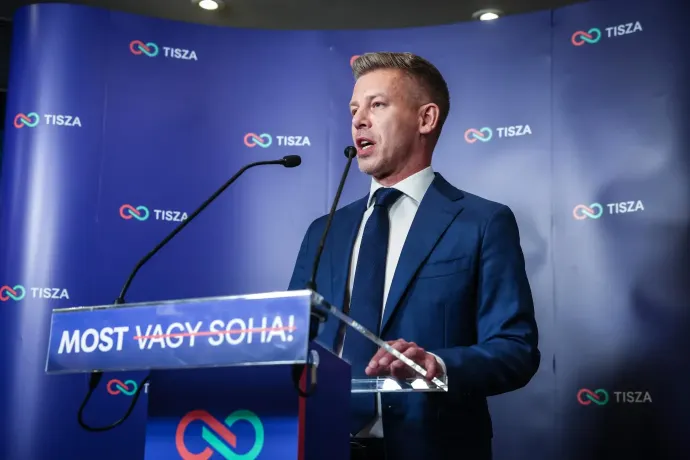
The chairman of the Tisza Party asked his supporters and all Hungarians to remain cheerful and calm. “We have seen and heard the indications of what the ruling party is planning, and what kinds of provocations they might resort to. Signs of madness are beginning to take hold of them, and they have been hallucinating about the occupation of public buildings. Anyone who can count to two knows that a party expected to win a landslide victory under an unfair electoral system has absolutely no interest in carrying out any acts of violence,” Magyar said.
“My first words are ones of gratitude, because the extraordinary turnout we saw and experienced shows that the Hungarian democracy is exceptionally strong,” said Gergely Gulyás, Minister of the Prime Minister’s Office said at the press conference of the Fidesz-KDNP coalition after the polls closed. According to Gulyás, the high turnout was partly due to the mobilization efforts of Fidesz and KDNP.
The minister stated that “Overall, this election provided an appropriate framework for the democratic expression of opinion. We hope that the governing parties will once again receive a mandate to govern for the next four years.” They are confident that Fidesz-KDNP will secure the 100 parliamentary seats needed to win the election and form a government.
Lőrinc Nacsa, deputy leader and spokesperson of the KDNP parliamentary group, noted that “a very high turnout is always a strong message for democracy,” and he also thanked everyone for their votes. “Today’s sunny day, with its high voter turnout, was overshadowed by the fact that over the past two days we received 1,500 reports of potential election fraud committed by our opponents,” Nacsa added, but they are confident that their political community will be the one to lead Hungary for the next four years.
Journalists were not allowed to ask questions at the press conference; both politicians left the stage after their brief remarks.
The mayor of Budapest, Gergely Karácsony also shared his thoughts about how the outcome of the elections could influence the Hungarian capital. The opposition mayor has had a rocky relationship with the Orbán government for many years. Overtime, the government has gradually introduced several measures which have significantly reduced the capital’s income, almost resulting in insolvency several times.
“In a small country like this, pitting such a large capital city against the entire country is a strategy that will destroy the nation,” Karácsony said.
Speaking in Telex’s studio, Karácsony said he doesn’t see “how Hungary’s EU membership could be compatible with a Fidesz administration in the long term”. In his view, if Orbán and his party remain in power and continue their policies, it will ultimately lead to Hungary’s exit from the EU.
“Overriding the perspective offered by the European Union amounts to betraying our homeland,” he stated.
He noted that it would be a mistake to expect immediate change if Fidesz were to leave power. This kind of approach "by definition usually leads to disappointment" – which is usually followed by a return to the old ways, which Orbán’s friends in the Czech Republic, Slovakia, and the United States have managed to achieve, he explained.

“All political change that moved Hungary closer to Europe has originated in Budapest,” Gergely Karácsony stated at the end of the interview, emphasizing that they have a political mission. In his view, humanist values have been confined to the “reservation” that is Budapest, but now there's a potential to release these on a national level. He cited last year’s Pride as being of particular significance in this regard, where hundreds of thousands of people showed Viktor Orbán that he has no power over them. At the end of the conversation, he promised that no matter what happens, there will be a Budapest Pride in 2026 as well.
He said that the Tisza Party had assured him that they would resolve the situation in the capital if they won the election. In his view, this is the key to their survival. He still considers the Budapest Act, which is part of the Tisza Party’s program, to be important, and said he had previously brought up similar ideas with Viktor Orbán. He would like to see this law enacted before the end of 2026 so that the city can move forward in 2027.
Karácsony’s relationship with the representatives of Tisza in the Budapest City Council has not been without conflict, but despite the differences the have had, he hopes that Tisza will become more involved in matters relating to Budapest should they win. “I don’t envision our future to be a bed of roses,” he said, but he claims that anything would be better than the current situation.

“We know of at least three Russian government agencies, or agencies close to the government that have interfered or are interfering in the Hungarian elections”, Russia expert András Rácz said in Telex’s studio in our live coverage of Hungary’s pivotal parliamentary elections on Sunday. He gave examples for how pro-Russian narratives and disinformation about Ukraine were used in Fidesz’s campaign, and spoke about the potential reason for pro-government media outlets claiming that Tisza is preparing for acts of violence on election day.
Just like Viktor Orbán, the chairman of the Tisza Party, Péter Magyar also addressed the members of the press after voting on Sunday morning.
He was very confident in a Tisza victory and said that if they won a two-thirds majority, one of their first acts would be to limit the prime minister’s term to two consecutive terms and submit Hungary’s application for joining the European Public Prosecutor’s Office, among others.
Horváth Kávai Andrea
After casting his vote in the morning, Prime Minister Viktor Orbán briefly answered qestions from the press. When asked if he had a message for Péter Magyar, he replied, “Well, I’ve already sent my message to the voters.” The press also wanted to know how big a defeat Fidesz would have to suffer for him to resign as president of the party, to which he replied: “A big one”.
The latest report from the Clean Voting Coalition, established by the Hungarian Civil Liberties Union and the Civil Kollégium Foundation has detailed several irregularities that occurred on election day.
As reported, in Dunaújváros, at polling station No. 18, voters are receiving ballots on which the name of the candidate who withdrew from the race has not been crossed out. In Fejér County’s 4th single-member district, Zsolt Szabó, the Democratic Coalition (DK) candidate withdrew his candidacy in favor of Ervin Nagy (Tisza Party).
In Hajdúhadház, at the polling station on Bercsényi Street, people are being escorted inside, with a gray Jeep waiting for them in front of the polling station, while in Hajdúsámson, ordinary citizens are accompanying elderly voters into the booth, claiming they asked for help with voting. In Makó, the same cars have been driving around since this morning: locals say that those organizing the transportation are in constant communication with members of the Roma ethnic minority's self-government and Fidesz's municipal representative for the area.
Reports of packages being handed out have come in from Miskolc and Kazincbarcika; in the latter town, Fidesz candidates were seen distributing packages to voters. A photo was also taken today in Kazincbarcika showing Zoltán Demeter, the Fidesz–KDNP candidate, handing a gift package to a voter.
“Hungary’s peace and security may hinge on a single vote today; if we fail to act, the threat of war looms over us; if we make a mistake, the financial security of Hungarian families will be at risk,” Viktor Orbán urged voters on his Facebook page in the afternoon.
The Prime Minister said that this decision “cannot be undone tomorrow,” and “therefore, no patriot can stay home today.”