Friends with benefits: Szijjártó coordinated with Kremlin about Russian agencies discrediting Tisza Party politicians
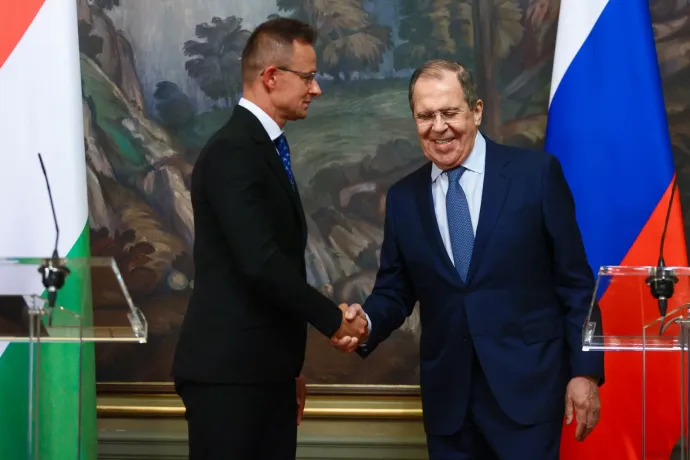


On several occasions, former Hungarian Foreign Minister Péter Szijjártó received documents from the Russians, detailing the defamatory material Russian intelligence agencies had prepared about István Kapitány-who had by then joined the Tisza Party-with the goal of strengthening Fidesz’s chances in this year’s election-investigative journalist Szabolcs Panyi writes in his book Friends with benefits, (Barátság extrákkal) which uncovers how deeply the Russians had embedded themselves in the previous Hungarian administration for the purpose of advancing their own interests.
Ambassadors as couriers of Russian letters
In the book, Panyi writes that several documents were sent to Budapest from Moscow through the mediation of Hungarian diplomats, following coordination between Szijjártó and the Russian government. These documents informed the then foreign minister of the steps taken by Russian intelligence agencies on behalf of Fidesz towards undermining the Tisza Party.
“As part of the effort to discredit Kapitány, we prepared and distributed a series of articles compromising the Hungarian politician. To this end, we used publicly available data showing that between 2014 and 2024, the target worked as vice president responsible for the development of Shell’s energy subsidiaries-including those in Russia.”-this is how one of the documents obtained by the author begins. It was sent to the Hungarian Foreign Minister at Russia’s own initiative and in consultation with Szijjártó by the First Deputy Prime Minister of Russia through the Hungarian Ambassador to Moscow.
The document contained links to pages featuring texts written in Hungarian-in some places noticeably not at a native-speaker level, but quite reminiscent of Russian terminology-alongside links to AI-generated videos allegedly showing Kapitány with others celebrating the outbreak of the war against Iran at a private party. The purpose of the video was to portray the participants in the fake video as oil shareholders standing to profit from the war.
The noise is more important than the message
No matter that it was Donald Trump who started the war, and on Israel’s side, which would mean that according to the Russian's storyline, the people in the fake video were supposedly cheering the move of the U.S. president-whom Viktor Orbán’s government regularly called a “peacemaker”. By this point, however, the essence of the strategy has long ceased to be conveying a specific message or persuading people. Instead, the goal became to simply make noise-“seize the moment”-in this case, simply to portray the people in the video as rejoicing over a war that supposedly benefits them. Context didn’t matter; contradictions didn’t need to be resolved. It was enough to rely on voters’ amnesia, their lack of knowledge, or simply on the fact that the abundance of conflicting information makes voters apolitical, which makes it harder for them to trust anyone.
According to the Russian document, the video reached 160,000 people on TikTok.
Incidentally, shortly thereafter, the claim that Kapitány is profiting from the war-induced rise in oil prices through his stock holdings also appeared in Fidesz’s narrative. While still prime minister, in his February speech on the state of the nation, Viktor Orbán referred to Shell as “tax collectors of death”-though he was speaking about the Russian-Ukrainian war at the time. The fact that Vladimir Putin was the one who had started it seemed to be irrelevant-again. In fact, Orbán's failure to mention this-even without Russian intelligence machinations-indicates just how deeply the Russian narrative had permeated the Hungarian government at the time: according to this narrative, the West had provoked the war and had also started it—and the West is the reason it is still dragging on.
Szijjártó's behaviour made the Hungarian ambassador in Moscow uncomfortable
According to the book, the document cited above reached Budapest on March 23, 2026 via Norbert Konkoly, the Hungarian ambassador to Moscow, whom Szijjártó summoned again a few days later, instructing him to pick up another batch of documents from the Russians and to bring them home. The diplomat refused, indicating that this role of a courier was not a task well suited to him. According to the book, it was understood that Konkoly did not agree with the way the Hungarian government was building its relationship with the Russians, and Szijjártó’s regular trips to Moscow also made him feel uneasy. The leaked phone conversation between Szijjártó and Russian Foreign Minister Sergey Lavrov-a relationship that could be described as bizarre from a diplomatic standpoint-clearly illustrated this dynamic, with the Hungarian side clearly in a subordinate role.
Seeing Konkoly’s reluctance, Szijjártó instead asked the Hungarian ambassador in Belgrade to forward the documents from Moscow to Budapest on several occasions. József Magyar complied with this request on March 27 and again shortly thereafter.
One of the documents lists articles designed to discredit the Tisza Party, including an anonymous January article in Kárpáthír titled “Shell, BlackRock, and Tisza: Who really controls Péter Magyar?”
It has long been known that the above mentioned website disseminates messages from the Kremlin. At one point, the site was operated by Jobbik-during the time when the former Hungarian far-right party was still under the influence of Béla Kovács-who later became known as “KGBéla". The former Jobbik MEP, who now lives in Moscow, was exposed as a Russian agent by our colleague András Dezső. The Russian intelligence services continued to make use of the site even after Kovács's fall. According to the report, this article generated 150,000 views, though whether this was the actual reach or the service perhaps inflated the numbers to make its work appear even more successful is open to debate.
The common message of all the materials is that Tisza’s leadership lives abroad, they are wealthy, their own enrichment is their priority, and they are willing to work against Hungary’s interests-i.e., they support the war, the resulting rise in energy prices, and would eliminate the utility rate cuts-all of which are accusations familiar from Fidesz’s campaign.
As mentioned above, however, it is not so much the repetition of a consistent message that matters as it is the creation of noise-so much so that Russian intelligence services created materials aimed at a Ukrainian audience in which they portrayed István Kapitány as an agent of Kremlin, Panyi notes, citing a Telegram group.
The effort was there, but the effectiveness was lacking
According to the document cited by the journalist, the Russians circulated their materials on Dutch, Italian, German, Luxembourgian, and even Nigerian websites. These allegedly generated 2.9 million views, with shares accounting for 486,000 views-though, once again, it’s unclear how many of these figures represent actual readers.
Based on the book, however, there is no question that the Russian intelligence services were working to make things easier for Fidesz.
The timing is also striking: the posts targeting Kapitány-including materials from Fidesz and their government, as well as videos posted by Viktor Orbán and Péter Szijjártó on Facebook and Instagram were all published after Szijjártó received the Russian documents after March 20.
Of course, Fanny Kaminski-who played a pivotal role in developing Orbán’s campaign materials for nearly twenty years-could have reached this conclusion on her own too, but the fact remains that based on the Russian documents referenced in the book, the key points deemed important by the Kremlin and the way Fidesz spoke about the Tisza Party and some of its politicians are strikingly similar.
As for the quantity, the Russians wasted no time: according to the documents Panyi examined, one letter alone reported on the distribution of 64 different materials across 18 countries, all of which were aimed at discrediting Kapitány.
Once again, the effectiveness of all of this is questionable-and, given the election results, it was clearly a failure-even though Russia did put in the effort. Except that these efforts were not really in line with the reality in Hungary. For example, it is a particularly outdated tactic to try to instill fear in the Hungarian minority in Transylvania by claiming that a win by the Tisza Party and “Kapitány's people, who represent big international investors, would once and for all settle ‘the Transylvanian question’ in Romania’s favor.” But the term “ethnic Hungarians” used in reference to minorities also points to a linguistic outsider, specifically a Russian author.
Countless materials published by the Russians across various platforms and social media sites also claimed that Kapitány coordinated with Ukrainian President Volodymyr Zelensky about shutting down the Friendship oil pipeline, and plans to cut social benefits in the event of a Tisza victory were also mentioned.
The shared interest is certain; cooperation merely a possibility
Although the Kremlin’s intention to keep Fidesz in power and the interests of Viktor Orbán’s government were obviously aligned, even with this information about such active correspondence with Russia, it remains unclear to what extent the development of Fidesz's campaign messages was coordinated.
If there was an agreement, however, Viktor Orbán would certainly have had to know about it-a Hungarian intelligence officer told Panyi after Fidesz’s defeat. Panyi’s book, however, contains information suggesting that Fidesz's leadership did not reject the idea of potentially relying on Russian assistance.
According to a source within the Ministry of Defense, the Hungarian side even had a ten-point plan for keeping the Orbán government in power, which was built on cooperating with the Russians. “This plan was essentially a scale of escalation: it outlined the extent of Russian assistance we would request,” according to the source quoted in the book. “Part of this involved requesting assistance from the GRU [the Soviet-era acronym still used today for Russian military intelligence-Ed.], but that was only around the third point. In other words, much harsher and more violent measures could have followed.”
Prior to the publication of this article, we submitted the following questions to the Ministry of Foreign Affairs. We will report on any substantive responses we receive:
- Did the former Hungarian ambassadors to Moscow and Belgrade continue to serve within the Ministry of Foreign Affairs after their recall?
- Is there an investigation into whether Péter Szijjártó built his relationships with the Russian side in a manner consistent with or contrary to his position as Minister of Foreign Affairs?
- Are the documents handed over to Péter Szijjártó-in coordination with Russian First Deputy Prime Minister Denis Manturov-and brought back to Hungary by the Hungarian ambassadors in Moscow and Belgrade at the request of the then Foreign Minister part of this investigation?
- Is the Ministry of Foreign Affairs aware of these trips by the ambassadors to bring the documents-which had been coordinated with the Russian side-back to Budapest?
- Are the activities of the Russian intelligence services during the Hungarian election campaign part of an investigation aimed at mapping the extent and nature of Russian influence on the former Hungarian government?
For more quick, accurate and impartial news from and about Hungary, subscribe to the Telex English newsletter!