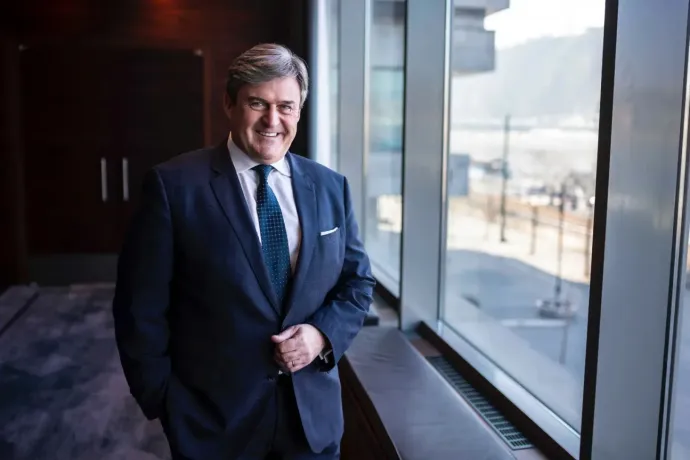


Even those closest to him were surprised to learn that István Kapitány had become the Tisza Party's head of economic development and energy policy. Many sensed that, before retiring, he wanted to have one last big hurrah, that he missed his former environment at Shell. But those who knew him thought that his career would take him in a completely different direction and that he might even return to the international oil industry.
In a way, he even hinted at this himself. Britain's BP recently announced that it was selling the majority of its shares in Castrol to a company called Stonepeak. A week ago, István Kapitány posted on LinkedIn: "It was a great pleasure as an industry expert to work with and advise Stonepeak on the Castrol deal from the beginning stages through due diligence and signing. I look forward to continuing to support Stonepeak on this journey…”
Many interpreted this as meaning that the businessman could return to operational management, given that the few activities he has been involved in over the past year and a half could hardly be enough to satisfy him after his 37-year career at Shell: since 2020, he served as president of the Hungarian Association of Executives and the honorary president of the Hungarian Business Leader Forum (HBLF), and was a member of the board of trustees of the Budapest Olympics Movement (BOM), which advocates for the Olympic Games coming to Hungary. He also gave lectures and consulted. What our sources predicted was not what ultimately happened: István Kapitány did not return to the international oil industry, but chose to pursue a career in Hungarian politics.
Tisza's latest reinforcement, István Kapitány, is not an unknown name in Hungary: last year, Partizán conducted a lengthy video interview with him, and a few years ago, G7 published an in-depth portrait focusing mainly on the daily life of the top executive. There is also other recent material of him speaking: for example, in December he appeared on the Cégépítők program with Judit Zolnay, who has also tried her hand at management in the United States. And those who have not heard of him before could now watch the interview during which Péter Magyar introduced him, which had already been viewed 275,000 times as of the time of writing.
We tried to find out more about him from those in the various fields he has been active in, such as the domestic and international energy industry, the Hungarian Business Leaders Forum, the BOM, and the Hungarian Association of Executives. We will only touch on his well-documented biography briefly, focusing instead on the past few years.
A brief overview of his career
Let us first briefly review the past, István Kapitány's beginnings and his early career. The life of the now 64-year-old executive began with a tragedy: in November 1963, when he was two years old, his father, István Kapitány Sr., who was a pilot with the Hungarian airline, died in a plane crash. The Malév flight was flying on the Budapest-Frankfurt-Paris route when the disaster struck near Le Bourget airport, which was attributed to icing. Senior pilot István Kapitány, all the passengers and crew, a total of 21 people, died in the accident.
For a while, the young István Kapitány wanted to follow in his father's footsteps and considered a career in aviation, but in the end he chose to follow after his mother's side of the family, who were merchants. This side of the family had spice shops in Debrecen and the surrounding area, and even after the nationalization, several members of the family continued to work in commerce, first as employees and then as business owners. Young István Kapitány, who grew up in Budapest's Angyalföld neighbourhood eventually graduated from the College of Commerce and Hospitality, and found a job in the same field.
According to a story that has been written about many times, his career at Shell began when one of Shell's managers made a complaint at the department store where he worked, and Kapitány handled the situation so well that he was immediately offered a job. From this point on, his story is truly like a fairy tale: that of a Hungarian boy who came from afar and overcame every obstacle.
At Shell, Kapitány continued to move ahead, or rather, to climb the ladder. He first became the company's national manager, then vice president responsible for European trade, worked in South Africa and as vice president responsible for North America. He worked in Budapest, London, Hamburg, Johannesburg, and Houston. In 2014, he was appointed global vice president of the oil company. At the peak of his career, he oversaw half a million employees and was involved in the development and launch of the company’s V-Power premium fuels. In April 2024, he announced himself that he was leaving Shell.
He is very confident, but is less familiar with the Hungarian environment
Most of those we spoke with consider Kapitány to be a likable, jovial leader, describing him as straightforward and good at building relationships with people – some even used the word "cute" to describe him. One of our sources, who had a positive opinion of him, said: “He’s definitely not the type to kick downwards while sucking up to those above him. We always felt that, even though he had a lot of people working for him, the lower down the hierarchy a colleague he spoke with was, the more supportive he was. I know of several cases where he helped his co-workers on personal matters." According to his admirers at Shell, Kapitány was a firm believer in meritocracy, i.e., that excellence should be the basis for advancement. For example, he supported the stronger involvement of women in the industry.
Another acquaintance highlighted his mentality and self-confidence, both of which are unusual in Hungary: What he represents may seem to many in Hungary as a sort of self-confidence, as if he believed he could do no wrong and always knew everything. This is how István seems in his public appearances, but this is definitely due to the strongly Anglo-Saxon leadership culture in which he lived. At the same time, in a small group setting, especially one-on-one, he is not like that; there, it becomes clear that he does have dilemmas, and he no longer pretends to know everything.”
This was confirmed by another of our sources, who said, "His communication style is very American; he is not your classic Hungarian businessman. There is no sense of uncertainty about him." Several of our sources mentioned his outstanding communication skills. One source also said that they appreciated that "if you want to do business with him, you can count on him being very straightforward: he'll tell you if he intends to proceed, but also if he doesn't," he doesn't waste people's time.
Seen from a distance, i.e., from the perspective of competitors and the Hungarian business community, who have a more superficial connection to him, we also found some who were more critical in their statements. Some simply find this smooth career success "suspicious," while others suggested that large multinational oil companies are not places where one can reach the top "just by being nice," so if he reached the de facto glass ceiling for Eastern European managers (the level of global executive vice president), then there must have been careerism and aggressiveness involved.
Finally, there are those who feel that István Kapitány did not keep a real connection with Hungary during his international career, that he is not familiar with the profession at home, so despite his background in the oil industry, the domestic energy sector will not be familiar territory for him. And he ultimately won't be familiar with macroeconomics, which he has not dealt with before, but would have to do if he ends up being Minister of Economic Development one day. According to this critical view, his very Western background is not suitable for understanding the Hungarian environment.
The past few years
Although we spoke with many people about Kapitány, no one could say exactly what the businessman's main activity has been since leaving Shell. What is certain is that he has continued to travel extensively, negotiating and doing business both domestically and internationally, and has been very active, both at home and abroad, according to an acquaintance. At the same time we know that he has always maintained ties with Hungary, even during his time working abroad: he regularly came home with his wife and two children, and cultivated his Hungarian roots and kept real estate here.
He has always been attracted to holding public office. His position in the Hungarian Association of Executives, which he held until a week ago, is closely linked to what has perhaps earned him the most criticism in his circle. This was the way he handled his first public meeting with Péter Magyar. Those we interviewed had different recollections of the story, but what is certain is that a photo of him having coffee with Tisza's president was published last October. Our sources disagreed on whether this was handled correctly.
Some said it was fine, adding that Kapitány asked the leadership if it bothered them and requested a vote of confidence, which they granted. Others resented that with the campaign approaching and everyone aware that Péter Magyar was already busy interviewing candidates, the president commented on the meeting by saying that it meant nothing, that he would sit down for coffee with anyone who asked for his opinion. In hindsight, it seems that this meeting was more than just a simple exchange of ideas, and it did indeed lead to conflict within the Association, which ultimately resulted in Kapitány's departure from his position.

Meanwhile, we have found that many people both in the Association of Executives and in the BOM are fond of Kapitány. The BOM has already produced an energy minister in the person of Csaba Lantos. If István Kapitány ends up becoming energy minister, Lantos may even return, one of our sources said jokingly.
Another source mentioned that, strangely enough, the BOM has become one of the most pluralistic Hungarian organizations today, as in addition to board members committed to the ruling party, two members of the opposition, Krisztián Kulcsár and István Kapitány are also in the leadership. Kapitány himself is reportedly a big sports fan, with a passion for Formula 1, soccer, and the Olympics.
They gave him an award, now they'll go after him
Because of his successful career at Shell, István Kapitány was often described in the Hungarian press as the Hungarian-born executive with the highest international business position ever. He reportedly really liked this label, was proud of it, and enjoyed appearing in public and talking about his successes.
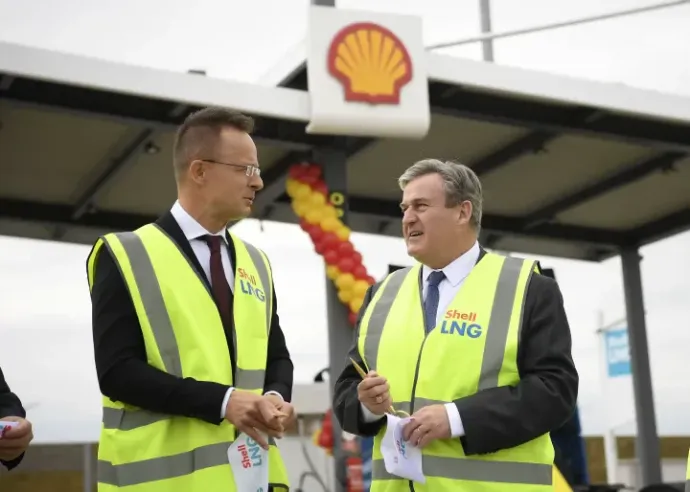
From what we heard, he never had any major conflicts within Shell, but now that he has entered Hungarian politics, he will certainly have no shortage of them. The gathering of potential weak points and elements suitable for building a negative campaign has already begun: the government-friendly media has already portrayed István Kapitány as a representative of the "soulless, global multinational world." Even though in 2023, the government awarded him the Officer's Cross of the Order of Merit of Hungary, and Péter Szijjártó himself praised his performance, which adds a particularly interesting twist to the way they are now beginning to attack him.
The negative evaluations published so far have, of course, mentioned Shell as his place of employment, given that every Big Oil company has had its share of scandals in recent decades that can be linked to senior executives. However, the Fidesz-friendly press and the circle of experts attacking Kapitány, have also strongly emphasized that after Shell was nationalized in Hungary in 1949, the company's return in 1960 and the opening of its first gas station in 1966 were aided by a foreign trade company called Interag, which was headed by the son of former communist leader Ernő Gerő, who often exploited his political connections when conducting shady business deals. Blaming Interag's crimes on a young man who started his career at the company in 1987 seems like quite a forced insinuation though.
And on the topic of a career at Shell: our sources tell us that being a Shell executive in Hungary is "safer" than running a Hungarian-owned company. A Shell executive doesn't have to invest in soccer or support CÖF (An NGO that has received donations from a Fidesz-funded foundation and state-owned companies and which has regularly provided support in various forms to the Orbán governments), even if the government asks them to. Everyone understands that this is not possible – subsidiaries of companies of this caliber are more likely to play ball with their own headquarters than with local political leaders.
Previously, it wasn’t seen as an obstacle in Hungary if someone started out at Shell; in fact, several former employees of the company have gone on to climb high in the ranks. Perhaps few people remember today, but István Varga, the Minister of National Development and Economy in Gordon Bajnai's government was previously the manager of Shell Hungary, as was György Mosonyi, the former co-executive of Mol Nyrt.
Alluding to his background in the oil industry, István Kapitány introduced himself self-deprecatingly in a recent video as "the Hungarian Jockey Ewing," even though those who know him say that he is nothing like the main villain of the Dallas series. "He's a really nice guy, not how you would imagine a top oil executive to be, he's too human for that," they said about him, while those in the industry are certain that there must be another, tougher side to his personality, given that consistently performing so well at a company like that is not easy. Teamwork is very important, but so is charisma. From what we've heard, István Kapitány was great at presentations and enjoyed having an audience of sparkling eyes watching him.
"I think that's what he was missing. I know he's given presentations since then, but I'm sure that constant recognition is like a drug for him. He loves being a rock star and wants to remain one,"
one of his colleagues said about him.
For more quick, accurate and impartial news from and about Hungary, subscribe to the Telex English newsletter!