Hungarian Parliament adopts new child protection law, opposition votes against it
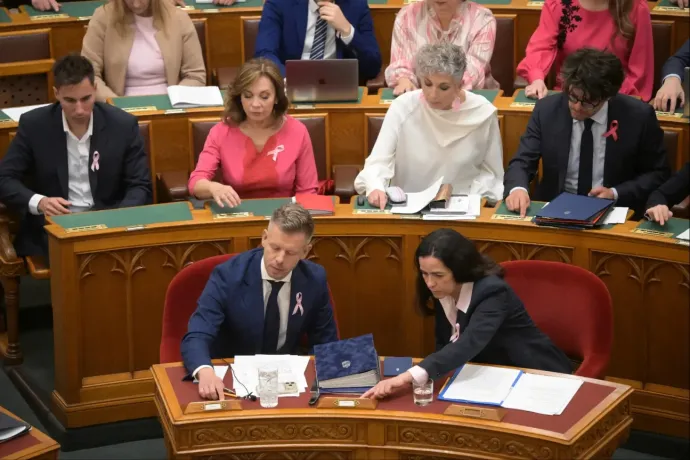



The Hungarian Parliament approved an amendment to the Child Protection Act on Tuesday, adopting a new proposal submitted by the government a month ago which, among other things, aims to protect minors from media content promoting sexual violence, manipulation, and exploitation. The Hungarian Parliament passed the bill with 139 votes in favor and 51 against, according to MTI.
Representatives from Fidesz and Mi Hazánk voted against the bill. Commenting on this on social media, Prime Minister Péter Magyar wrote : “Together, Fidesz and Mi Hazánk voted against legislation designed to increase the protection of children. They voted down measures designed to help infants left in hospitals and to protect children from all forms of violence. How shameful!” When the bill was introduced in September, the Prime Minister said he was confident that, despite their existing disagreements, no member of parliament would vote against legislation aimed at tightening protection for children.
The justification for the proposal states that under the Fundamental Law, every child is entitled to the protection and care necessary for their proper physical, mental, and moral development. According to the law, this requires effective regulation capable of preventing, identifying, and addressing dangers to children. Therefore, the primary objective is to protect children from pornographic, age-inappropriate, or violent sexual content, as well as from content which is seriously harmful to children’s development.
The bill also includes provisions for protecting children in public areas or other public spaces from visual or audiovisual communication that could adversely affect their physical, intellectual, emotional, or moral development. The rules governing the crime registry system will also be amended: accessing data for the purpose of protecting children will remain possible, but access will be subject to prior official review, and additional safeguards will be introduced to ensure data protection and technical security.
The proposal would also address the subject of children left in hospitals. If a child’s hospital stay is not justified by their health condition, the child welfare authority will have to take action within eight days to determine the reasons for the child’s continued stay in the hospital and to identify, as soon as possible, the next steps that would serve the child’s best interests.
Fidesz’s anti-LGBTQ+ law did not protect children but infuriated the EU
In 2021, the European Commission launched infringement proceedings against the Orbán government over its law which had been diverted into an anti-LGBTQ+ measure at the last minute; and in December 2022, the EU body filed a lawsuit with the Court of Justice of the European Union. The European Commission requested that the court rule that the Hungarian authorities had violated their obligations under EU law.
The Court of Justice of the European Union issued a ruling on the case this past April, according to which the Hungarian government violated its obligations under EU law by enacting the legislation. For the first time in its history, the court found a ‘separate breach’ of the part of the EU’s founding treaty that ‘defines the common values shared by all Member States and serves as the foundation of the Union.’ These are requirements which countries not only have to comply with before becoming members of the EU, but even before they can become candidate countries. Following the court’s April ruling, the European Commission may file a new complaint with the Court of Justice of the European Union as the final step in the infringement procedure. This could result in a financial penalty that could even be deducted from EU funding.
The “Article 7” procedure was designed to allow the EU to defend its fundamental values. Such a procedure was initiated against the Hungarian government in 2018, but since then, it has neither moved forward nor backward. EU affairs ministers and state secretaries are set to hear from their Hungarian counterpart on the matter this Tuesday.
In addition to all this, as a “horizontal condition,” the case has been blocking approximately 0.5-0.6 billion euros marked for Hungary in cohesion funding since the end of 2022. This amount is not included in the 16.4 billion euros whose release was the subject of a political agreement reached in May between Prime Minister Péter Magyar and European Commission President Ursula von der Leyen.
For more quick, accurate and impartial news from and about Hungary, subscribe to the Telex English newsletter!