Magyar in Brussels: We have agreed on the release of €16.4 billion
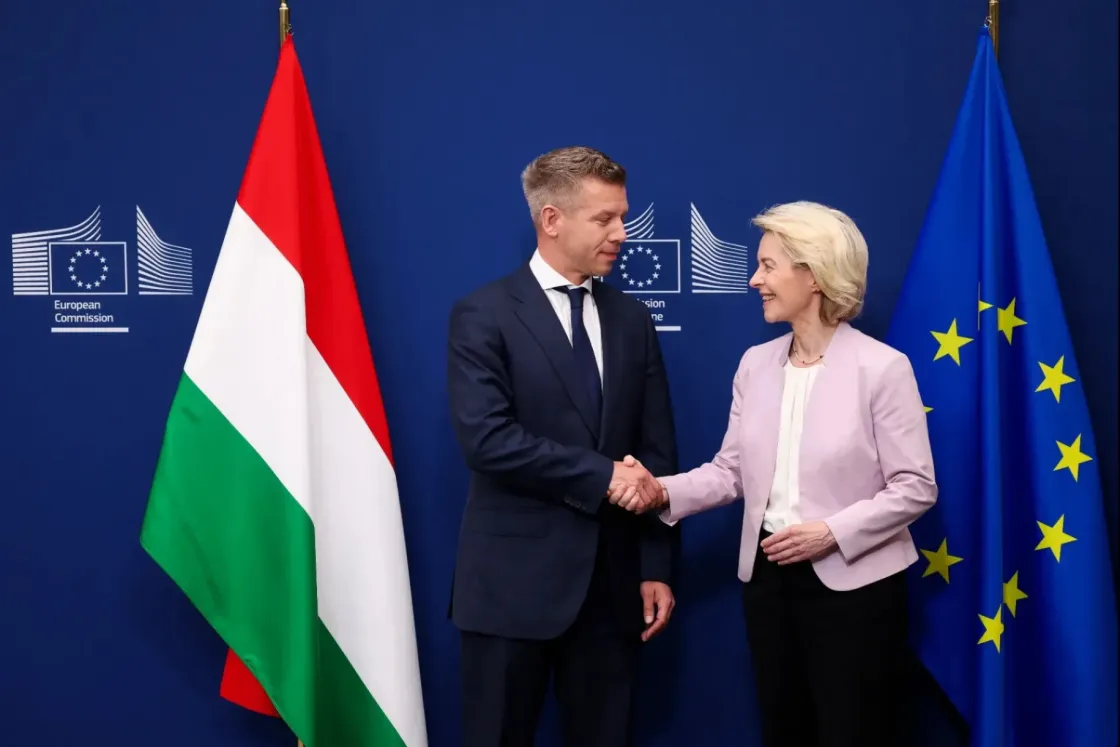


“April 12 will remain in all our memories for a long time,” the President of the European Commission said on Friday after meeting with Hungarian Prime Minister Péter Magyar in Brussels. According to Ursula von der Leyen, the consequences of the election—in which Hungarians chose democracy and “a return to the heart of Europe”—are already being felt.
During the meeting with the Hungarian Prime Minister, they agreed on a “robust framework” to address corruption and rule-of-law concerns, and the Hungarian government had decided to
- join the European Public Prosecutor’s Office;
- strengthen the powers of the Integrity Authority;
- review public procurement laws;
- and “phase out” public interest asset management foundations.
Von der Leyen said that during the review of the one-time recovery fund, they also agreed on a “safe and sound landing zone,” so she is confident that they will be able to make the €10 billion fund available.
She also added that there are “good news” about the Erasmus student exchange programs—which students from Hungarian universities that have switched to the new model have not been able to participate in since the fall of 2024, but starting in the next academic year, they “will be able to join the Erasmus community again".
Péter Magyar announced that, under the agreement, they had agreed about the release of 16.4 billion euros—which is 13 percent of Hungary’s gross domestic product.
“We’re here, and I’m very happy—and the Hungarian people will be happy with the result too,” he said. “We’re bringing home the EU funding that the Hungarian people are entitled to,” said Magyar, adding that the previous government had constantly lied to Hungarians about the EU, “and they also lied about the real reason why the EU funds had been frozen.” They lied that all this happened because Hungary took a different stance on migration and the war between Russia and Ukraine. The real reason, however, “was corruption. A level of corruption that had long been unimaginable in the EU and in Hungary as well,” Magyar said, emphasizing that he believes that Viktor Orbán and his family were also directly involved in this.
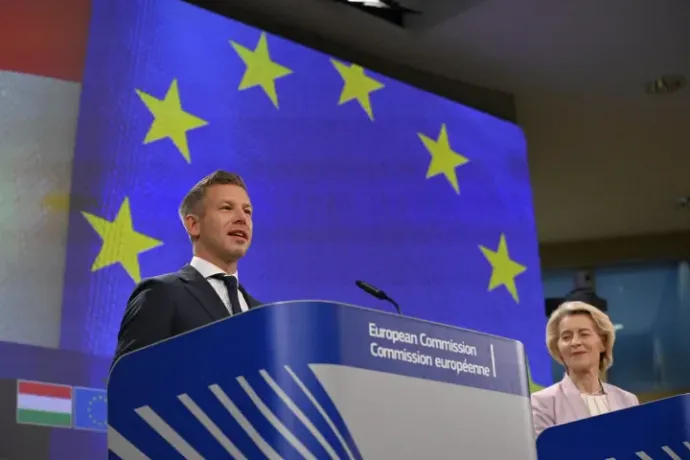
He found it regrettable that the necessary steps could have been taken long ago, if only there had been a will to do so. “Today we proved that the issues and expectations here in Brussels were not ideological, but that we must ‘simply’ take action against corruption”; in fact, he said they may have even exceeded expectations, for example, by joining the European Public Prosecutor’s Office (which indeed was not among the conditions).
He also said that they will be making substantial changes to the asset declaration system, as it has been little more than a formality until now. A very strict asset declaration system will be put in place. It will be verifiable, with consequences: if someone intentionally provides false information in their asset declaration, they could face up to two years in prison.
“Three weeks were enough to achieve what Viktor Orbán and his outgoing government failed to achieve—or perhaps didn’t even want to achieve—in three years.” “Our goal was clear all along during the negotiations; we negotiated very hard, fought for every euro cent, and negotiated hard even into last night—and we were successful. This is a shared success of Hungary and the EU institutions”, he said.
Of the 16.4 billion euros
- 4.4 billion euros are catch-up funds, which can be spent on developing transportation, healthcare, social and environmental objectives, and small and medium-sized enterprises;
- 2.2 billion euros are earmarked for education and the development of higher education;
- several billion euros can be allocated to projects that have already been completed or are about to be implemented;
- 1.5 billion euros can be allocated to the development of the electricity grid;
- new trains will be purchased to replace the old, leased ones;
- there will be digital developments;
- support for small and medium-sized enterprises has also been agreed upon;
- and funds can also be spent on rental housing to alleviate the housing crisis.
“I think this is truly a historic day—for Hungary, certainly—and if there’s this much money to be received here, I’d be happy to come to Brussels more often.”
What did they negotiate about, and why?
Péter Magyar arrived at the European Commission’s headquarters in Brussels early Friday afternoon to discuss a political agreement on frozen EU funds with Commission President Ursula von der Leyen.
“We are setting off for the most important negotiations of recent years. The fate of 6,000 billion forints in EU funding is at stake. At the start of the negotiations, I will hand over Hungary’s official application to join the European Public Prosecutor’s Office to the President of the European Commission,” the Prime Minister posted on Facebook just before he left for the meeting, describing it already then as “a historic agreement.”
As previously reported, the new government must act particularly quickly regarding the Recovery Fund, which is separate from the regular EU budget. The conditions for the one-time payment of 10.4 billion euros to Hungary must be fulfilled by the end of August.
Under the Orbán government’s commitments, the Hungarian state needs to comply with 27 rule-of-law and anti-corruption preconditions (“super milestones”) to even be eligible to request regular payments and avoid having to return a one-billion-euro advance. According to the European Commission, this money alone amounts to roughly five percent of Hungary’s gross domestic product. Due to the partially or fully overlapping conditions, the bulk of the roughly seven billion euros which have been blocked from the regular budget could thus be released, and the “Erasmus issue” would also be resolved (moreover, the rule-of-law conditions could also apply to Hungary's 16-billion-euro SAFE defense loan).
The Orbán government has made no official progress on the preconditions since the end of 2023. In the words of former Minister for EU Affairs János Bóka, “there is still debate over whether compliance is adequate,” meaning that, in his view, the EU body found that Hungary hadn't complied with all the conditions.
A working group within the Tisza Party has spent the past year and a half working on solutions to these problems. When Magyar arrived in Brussels on Thursday, he said:
“There are still some issues left open, but we have essentially reached agreements on a great many important matters. These include public interest asset management foundations,” but the strengthening of the asset declaration system and the expansion of the Integrity Authority’s competences as well.
In addition to the preconditions, the Orbán government had also committed to hundreds of reforms, targets, and developments (“milestones”) to be pre-financed from the national budget, generally with interim deadlines.
There will be a transition period for the bodies overseeing universities
In response to a question from the press, the Commission President said, “We now have a very solid foundation for further discussions on the rule of law,” as well as on reforms and investments. All the reforms in the package must be implemented and completed, and the investments must be carried out. The moment the Hungarian Parliament adopts a piece of legislation, the the funding associated with that specific milestone will be released.
Magyar noted that there were certain milestones and super-milestones that can no longer be met because the deadline has passed or they have become obsolete; Hungary does not need to fulfill these. “Apart from these, we can meet all super-milestones and milestones,” he said. In his view, the European Commission is handling the matter with sufficient flexibility—within the limits permitted by legislation, regulations, and European institutions—to ensure this can be achieved by August 31. These are typically related to the fight against corruption and thepublic asset management foundations.
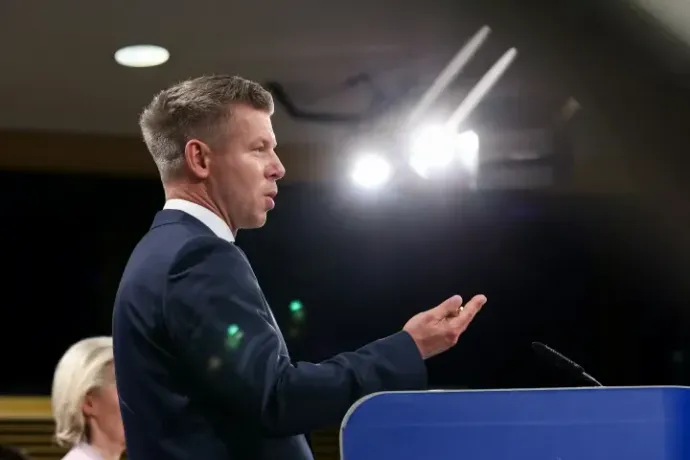
“There will be a transition period for the public interest foundations overseeing universities,” as some universities also have control over hospitals, and universities are institutions where it takes time for the ownership structure to be reorganised. This will last until August 31, 2027.
He pointed out that public foundations not affiliated with universities will be dissolved by August 31 of this year. He specifically highlighted the MCC as one facing this fate. Public functions will be taken over by the state or the new owner. According to Magyar, the problem was not privatization itself or the creation of such foundations, but rather the manner in which “state and national assets were transferred through opaque and unverifiable channels,” even into private hands under the control of oligarchs.
Release of funds isn't connected to Ukraine's EU accession
In response to a question, Magyar said that there was no connection whatsoever between the question of Ukraine’s EU accession and the release of Hungarian funds. The Prime Minister reiterated that they want guarantees that Hungarians in Transcarpathia can use their mother tongue in schools or in administration. For now, negotiations are taking place at the expert level.
“The negotiations are very encouraging,” Magyar said. “There have been several rounds of talks, and I hope they can finalize the 11-point proposal package, and that Ukraine will incorporate the agreement into its legislation soon afterwards.”
Following that, an official meeting between the Ukrainian and Hungarian foreign ministers could take place, after which Magyar would be happy to meet with Volodymyr Zelensky somewhere in Ukraine, “preferably in Transcarpathia, where the Hungarian minority lives, in a Hungarian-populated settlement.” “It is time to open a new chapter in Hungarian-Ukrainian relations,” he said. We want to have good relations with all our neighbors, though there are points of contention with others as well, he said, and announced that the V4 meeting will take place in Budapest on June 23.
Von der Leyen also confirmed that there is no link between the release of EU funds and Ukraine’s EU accession. “This is a merit-based process,” she said, adding that Ukraine and Moldova meet all the conditions to open the first negotiation chapter. In her view, they have carried out the necessary reforms, and there is no reason to postpone the process. But she said that this would be discussed at the European Council meeting on June 18–19.
The agreement does not mean that work can stop
In his Monday interview with Telex, the Prime Minister said that they are mainly speaking with the European Commission about the projects. “Our goal is to secure funding for as many useful projects as possible—for the Hungarian people, for companies, and for sectors such as transportation infrastructure, healthcare, and housing—things that will be implemented in the future,” he said.
Magyar acknowledged the good intentions of the European institutions, but noted that there are constraints.
“It’s a pretty rigorous system over there, in Brussels; but they’re trying to help any way they can,” he said.
In his view, there are certain major milestones and decisions that can no longer be made because the previous government had run out of time. Here, they need to find a different solution that could then be accepted.
As the Prime Minister told Telex on Monday, the agreement does not mean that the work will stop. “This is a political agreement; the devil is in the details, and everything really has to line up here.
Payment requests can be submitted until the end of September, and the funds will be transferred by the end of the year, so what percentage of the funding has been saved will only become clear after that.
For more quick, accurate and impartial news from and about Hungary, subscribe to the Telex English newsletter!