The two messages behind Hungary's expulsion of ten Russian diplomats
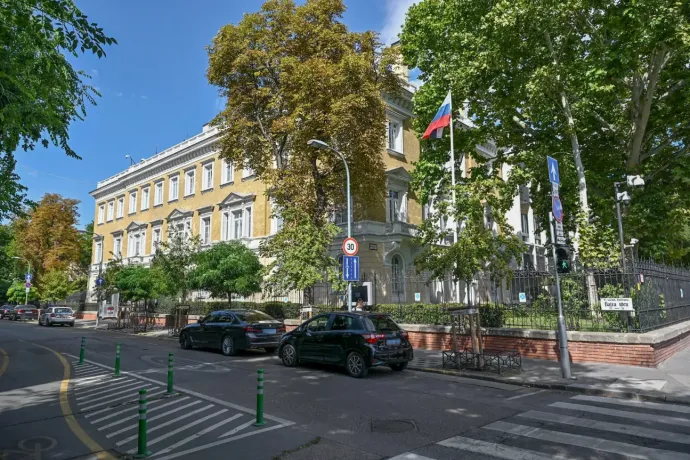


Ten members of the diplomatic staff at the Russian Embassy in Budapest have without doubt engaged in espionage (alongside other activities) in Hungary, which is why they are being expelled—this is how Hungarian Foreign Minister Anita Orbán’s Tuesday announcement on social media can be interpreted, though it naturally carries a political message as well—at least two, as a matter of fact.
“Acting on my instructions, on Tuesday the relevant official from the Ministry of Foreign Affairs informed the Russian ambassador to Hungary that, according to the assessment of the Hungarian authorities, 10 members of the Russian mission had engaged in activities in Hungary that are unacceptable for diplomats under the Vienna Convention”-Anita Orbán wrote in the statement which was also read out by PM Péter Magyar during Tuesday’s parliamentary session. The Prime Minister added that the Tisza government would defend the country’s sovereignty.
Two messages
One of the political messages behind the announcement could be to make it clear to Russia that a new era is dawning and that Hungary will no longer go easy on Russian intelligence agents. After all, in recent years, not a single Russian diplomat has been expelled through such a public announcement, even though there have been plenty of reasons to do so.
The other message is the same, but is not directed at Moscow; rather, it is aimed at the Western allies and partners who have in recent years lost trust in the Hungarians. And “partners" do not only mean certain Western countries, but the intelligence agencies as well, which have become distrustful of Hungarian authorities precisely because of the Orbán government’s pro-Russian policy.
The fact that there have been at least ten Russian diplomats in Hungary who are not only diplomats but also spies is not particularly surprising given the previous administration’s-surprisingly accommodating-policy towards the Russians. When Russia attacked Ukraine in 2022, most EU member states responded by expelling Russian diplomats one after another, but even then, Hungary remained an exception, leaving the Russians alone.
The fact that ten employees of the embassy are being expelled simultaneously, citing the Vienna Convention, means that these individuals have been identified as intelligence agents.
Intelligence operatives working in Hungary can essentially be divided into two types: there are those who arrive in the country under diplomatic cover, but counterintelligence knows that they are “not just diplomats.” The host country is usually aware of this even before the diplomat arrives in the country. One way this can be determined is by cross-checking the individual’s background through other countries' intelligence services. And the reason why intelligence agents around the world—not just the Russians—use diplomatic cover is primarily because even if they are exposed, they cannot be held criminally liable.
A country's counterintelligence service therefore keeps a record of intelligence agents working under diplomatic cover, but what it does with them is primarily a political decision. Their expulsion is always a political decision, made at the level of the foreign minister or the prime minister, but it is initiated by the intelligence services.
We sent questions to the Ministry of Foreign Affairs to find out when it became clear to the Hungarian authorities that the 10 staff members at the Russian embassy were engaging in activities which are unacceptable for diplomats. In its response, the Ministry of Foreign Affairs said that, for the time being, it does not wish to share any further information related to the expulsions.
In May, VSquare reported that after the Hungarian election, a Russian intelligence officer working under diplomatic cover was quietly expelled from Hungary. According to the VSquare article at the time, Hungary expelled Artur Sushko after the Constitution Protection Office (AH) discovered that, as an intelligence officer working under diplomatic cover at the Russian Embassy in Budapest, he had for years been gathering information on institutions close to the government.
A ‘quiet expulsion’ is when the government does not announce the expulsion to the public. Unlike the measure just announced, a quiet expulsion carries no political message.
Compared to her predecessor Péter Szijjártó, Anita Orbán has maintained a much more reserved diplomatic relationship with Russia. In the early days of her tenure as minister, on May 13, after Moscow launched a drone attack against Transcarpathia (Ukraine’s region home to a significant Hungarian ethnic minority) she summoned the Russian ambassador. In comparison, the last time Szijjártó had summoned a Russian diplomat was in February 2022.
What does the relevant section of the Vienna Convention address?
The legal basis for handling intelligence activities (espionage) disguised as or linked to diplomatic immunity is provided by the 1961 Vienna Convention on Diplomatic Relations.
Under the convention referenced in Anita Orbán’s post, if the authorities of the host country prove or have reasonable grounds to suspect that a diplomat is engaged in intelligence activities, they are not required to bring the diplomat to trial. Instead, the host country may—without providing a justification—declare the individual persona non grata. The sending country must recall the diplomat within the specified time limit, or the diplomat must leave the country’s territory. If it fails to do so, the diplomat may lose his or her official status upon the termination of their immunity.
In international diplomacy, the terms “activities unacceptable under the Vienna Convention” or “violation of the convention” are, in almost every case, diplomatic euphemisms for espionage that has been uncovered or is suspected.
The response is usually reciprocal
The expulsion of spies (diplomats) is generally countered by the other country with a reciprocal measure, so it is to be expected that Russia will also expel Hungarian diplomats whom it considers to be intelligence agents. Since Hungary has never before expelled this many Russian diplomats, it is quite certain that Russia will take retaliatory action.
Russia will respond to Hungary’s decision to expel ten Russian diplomats, according to a report by the Russian state news agency TASS, citing a statement from the Russian Foreign Ministry. Maria Zakharova, the spokesperson for the Russian Foreign Ministry promised a “harsh and painful response.” “The response to the Russophobic lobby in Budapest will be harsh and painful,” she told TASS.
That said, the expulsion of Russian diplomats was to be expected after the April 12 election; the only question was the timing. One of Foreign Minister Anita Orbán’s most important goals is to regain the trust of Hungary's Western allies. Under the Orbán administration, it was the country's relationship with Poland that deteriorated the most; Polish intelligence agencies have practically cut off all communication with their Hungarian counterparts, and the relationship with the Baltic states became similarly strained.
The most important question now is how Moscow will respond to all of this besides taking reciprocal measures.
For more quick, accurate and impartial news from and about Hungary, subscribe to the Telex English newsletter!