Hungarian FM reports on Hungarian-Ukrainian agreement, but still no clear date for Magyar-Zelensky meeting
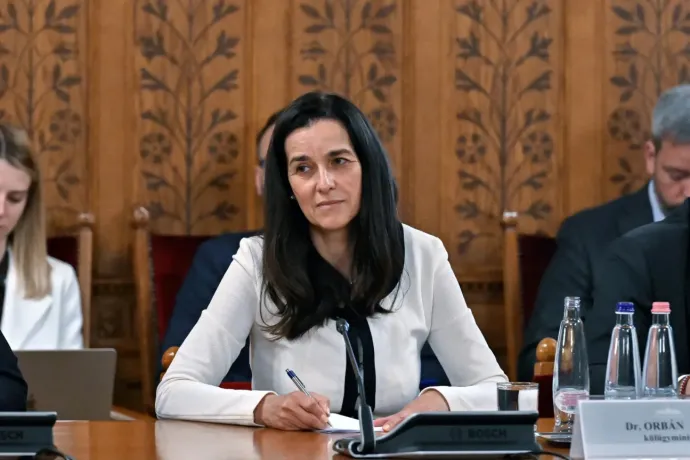


“Hungarian foreign policy has once again become visible and proactive in Europe,” Anita Orbán said at Thursday’s meeting of the Parliament’s Foreign Affairs Committee. According to the Minister of Foreign Affairs, the foundation of a sovereign foreign policy is based on Hungary being a constructive member of the alliances to which it belongs.
In line with this, Hungary is also taking an active role in the V4—which had been neglected during the previous government’s tenure, as that administration found it increasingly difficult to find common ground with governments from other political families within the group, primarily Poland, after Donald Tusk’s Civic Coalition came to power there. “We have now recalibrated Hungarian-Polish relations,” said Anita Orbán, referring to Péter Magyar’s first foreign trip, which took him to Warsaw.
As a result of this trip, Hungary will soon be hosting a summit of V4 prime ministers.
There will also be a Hungarian-German summit in Berlin in early October, which will be opened by the two countries' foreign ministers. This will be followed by consultations between the German and Hungarian governments with the participation of several key ministers, the Foreign Minister announced.
Anita Orbán mentioned the recent visit of the Irish Prime Minister to Budapest, which is significant because the EU will negotiate its next seven-year budget during the Irish presidency.
Ukraine: A priority
“This achievement was not the result of flashy political gestures, but rather of a Sisyphean effort, it is the result of a great deal of consultation and negotiation,” the Foreign Minister said about the recently announced Hungarian-Ukrainian agreement. Its main points are as follows:
- Ukraine has committed to restoring the system of schools for ethnic minorities, thereby guaranteeing the free use of the Hungarian language and the use of national symbols, including the Hungarian national anthem and flag.
- In municipalities where more than 10 percent of the population is Hungarian, the Hungarian language may be freely used in healthcare, at events, at academic conferences, and even in political campaigns in Ukraine.
- All of this is part of the action plan, which determines the course of the accession negotiations between Ukraine and the EU, which have not yet begun.
- The accession process will begin once Ukraine has fulfilled these conditions. Even after that, the accession process will not proceed according to an accelerated schedule but will follow the standard timeline and will be preceded by a referendum.
It was to be expected that one of the main topics of the meeting would be related to Ukraine, as there had been talk last week that Péter Magyar and Volodymyr Zelensky might be meeting as early as the beginning of this week. However, the meeting between the two leaders still has not taken place. This time, the Foreign Minister did not mention a potential date for the meeting.
There is now a good foundation for a meeting between the two countries' leaders though, as the Hungarian Prime Minister announced last week that a substantive agreement had been reached with Ukraine on the rights of the Hungarian minority in Transcarpathia. This issue had brought relations between the two countries to a never before seen low point during the previous government’s tenure, especially after the start of the war Russia launched against Ukraine in February 2022.
Fidesz’s Atlanticist is optimistic
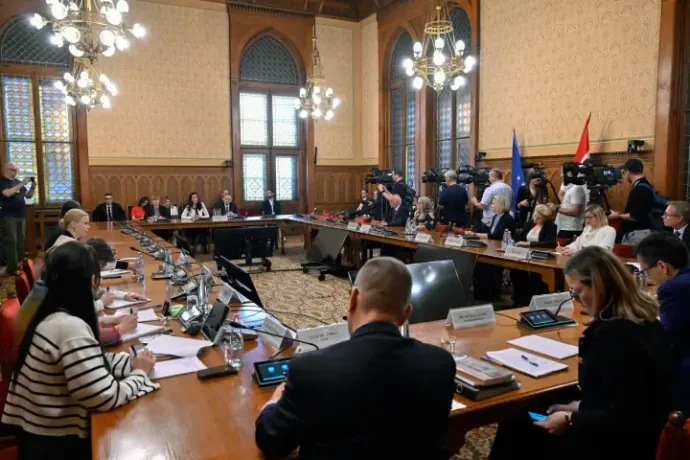
Zsolt Németh was the first to ask questions during the second part of the meeting. The Fidesz politician—who is known for representing an Atlanticist foreign policy stance which has been sidelined from the mainstream of the former ruling party—said that he hopes the committee will be able to cooperate well, “and the minister’s presentation provides a good foundation for this.”
Speaking about Hungarian-Polish relations, Németh described the situation of the two politicians from the former Polish ruling party, Law and Justice (PiS) as "a sensitive issue". According to him, there have been countless events which call the rule of law in Poland into question, making it justifiable for the former Polish Minister of Justice, Zbigniew Ziobro, and his former deputy, Marci Romanowski, to leave the country. According to Németh, it was “no coincidence” that they had previously been granted entry to and asylum in Hungary, from where Ziobro had already departed for the United States in the wake of Fidesz’s election defeat. According to Németh, who served as chair of the Foreign Affairs Committee during the previous legislature, the cases of the two Polish politicians must be handled with great caution.
Rejoining the ICC
Németh brought up the fact that the new government has decided that Hungary will rejoin the International Criminal Court (ICC). This, however, raises questions:
"If we want to see Benjamin Netanyahu in Hungary, we must formulate a position on rejoining the ICC that is reassuring for the Israeli side—since in this case, the arrest warrant issued by the ICC against the Israeli Prime Minister would have to be enforced.
Németh congratulated the parties on reaching an agreement between Ukraine and Hungary. The Fidesz politician noted that there had previously been steps taken by the Ukrainian side that had made it difficult to reach an agreement; as an example, he cited the 2021 proceedings against an organization linked to the Hungarian Cultural Association of Transcarpathia (KMKSZ), which forced KMKSZ President László Brenzovics to flee to Hungary at the time. Nevertheless, he considers the overall balance to be positive.
Foreign policy strategy to be ready in August
“There has been a decade-long shortcoming with regard to the country's foreign policy strategy,” noted Márton Ádám Hajdu, chairman of the Foreign Affairs Committee, referring to the fact that the last time the Hungarian government issued a strategy outlining the main direction of the country’s foreign policy interests was in 2011. The Tisza government is currently working on correcting this.
Anita Orbán promised that the strategy would be largely ready by August.
There were no fundamental disagreements relating to the normalization of the relationship between Hungary and Ukraine. According to Hajnalka Juhász (Fidesz-KDNP), it is of paramount importance that all guarantees about minority rights be established during the accession process. The EU can only assess whether a given candidate country meets the required standards for minority protection during the accession process, but “there is no follow-up,” the opposition politician pointed out. Politicians from Tisza also agreed with this; the committee chair responded to this by noting that “it is indeed important to keep in mind that during accession negotiations, we can secure the minority-related outcomes that are extremely important to us.” He added, however, that accession is a long process, so there will be time to resolve every issue and lay out every guarantee precisely.
Liliána Grexa, the representative of the Ukrainian minority in Hungary wanted to know
when the meeting between Magyar and Ukrainian President Zelensky—which, according to several statements, is already being planned—would take place; however, the Minister of Foreign Affairs did not address this in her response.
The minority spokesperson pointed out that it would be worthwhile to involve the representative of the Ukrainian minority in Hungary in the development of bilateral relations, to which the Minister of Foreign Affairs replied that the minority spokesperson has a place on the government’s joint committee.
For more quick, accurate and impartial news from and about Hungary, subscribe to the Telex English newsletter!