Szijjártó to Telex: The very suggestion that the Russians are holding something over us is deeply offensive
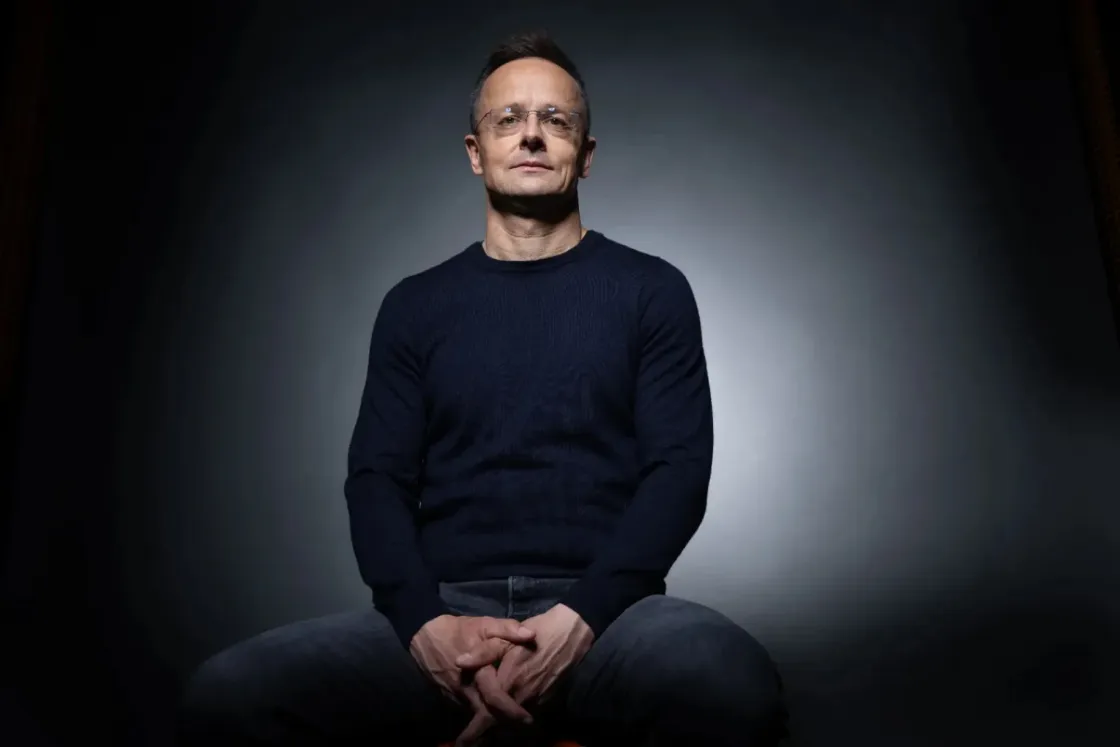



More people trusted Tisza than Fidesz, and more people liked Tisza’s policy proposals; so consequently, the party that won the election—which is Tisza—will go on to form the government, outgoing Foreign Minister Péter Szijjártó said during a live broadcast on Telex. The reporter noted that him saying this is surprising in light of the fact that throughout the campaign, Fidesz had consistently communicated that it would be either Viktor Orbán or Volodymyr Zelensky (suggesting that Péter Magyar is "Zelensky's man") who would form the next Hungarian government. Szijjártó now commented that what he knows for certain is that the results of the parliamentary election aligned with Zelensky’s wishes, and that Ukrainians clearly had a vested interest in Fidesz’s defeat.
This was the first time the outgoing minister sat down for an interview with Telex, even though in the six years our site has existed, we have sent countless interview requests to his office. When we asked him about this, he said that there were several reasons why he had never before agreed to come to Telex, one of these being scheduling difficulties. On top of that, when he asked members of his staff responsible for media relations for their input on this, he was told it wouldn't be a good idea. Now, however, there is an extraordinary situation that calls for extraordinary measures, so he took this decision into his own hands. He agreed that if Fidesz hadn’t suffered a severe defeat on 12 April, he might not have been sitting in our studio.
During its campaign, Fidesz also repeatedly claimed that if Tisza won, there would be war in the country and Hungarians would be conscripted into the army. So, will there be war now? – Telex asked, to which Szijjártó replied that he hopes, and indeed prays, that the country will not be dragged into the Russian-Ukrainian war.
When asked if he expects to receive a draft notice, the outgoing Foreign Minister—who runs long distances on a daily basis—replied: “I've never been in the army; and I don’t think that—at 48 years of age—if anyone looked at me, they’d consider me fit to go and fight on any front.” Are you afraid your sons will be drafted? Telex then asked, to which he replied: “That's not entirely unrealistic. When looking at how things are unfolding in the world, the global mood, and recalling the hours I spent at Council meetings in Brussels over the past few years, or the past 11 years in my role year after year, week after week, day after day, I do fear that international politics has slipped into accepting that this is a time of war.”
When we asked him a second time whether he told his sons that there might be a war if the Tisza Party won, he said he never told his sons that they might end up going to war, because they never talk about politics at home. He even forbade his sons from getting too involved in politics, because he considers it too brutal.
The Tisza Party has consistently denied that they do not intend to lead the country into war, and Fidesz has never provided any evidence to the contrary.
“Then why did they campaign with a message that Tisza consistently said wasn’t true?” Telex asked. Szijjártó’s response was: Tisza is a member of the European People’s Party, which is pro-war.
When asked what impact he believed Fidesz’s constant scare-mongering with war had on the mental health of the Hungarian people, Szijjártó said that there have also been (ethnic) Hungarians who had died in the Russian-Ukrainian war, and that Fidesz had based its policy on protecting the country from the threat of war, but this was always done with good intentions.
The results of the latest Medián poll were released midway through the interview, showing Tisza at 66 percent and Fidesz at 25 percent. When presented with this data, Szijjártó commented: 'It's a good thing the election isn't happening right now. They would have won by an even bigger margin.'
Who is part of the nation?
“A community can only be rebuilt and rise again if the fundamental meaning and purpose of social organization—cooperation—is realized within it. This is the signpost for the changes ahead of us.” The reporter read this quote from 2010, when Fidesz, upon the creation of the System of National Cooperation, declared that the socialist-liberal government “pitted members and groups of society against one another instead of fostering cooperation.” Fidesz then said that they would instead be committed to emphasizing the importance of cooperation. Did you succeed?— Telex asked. According to Szijjártó, he personally succeeded in this, as he has always worked to ensure that people are judged based on their performance, not their party affiliation.
“Then why is it that so many people in Hungary today feel that Fidesz has stirred up hatred among the people?” we asked. Szijjártó disagreed; in his view, they have always striven to make Hungary a livable country. He doesn’t deny, however, that there are people in their circle who “have grossly abused the fact that ministers, state secretaries, and government officials have worked diligently and with respect.”
So, in his view, so many people thinking that politicians have incited hatred isn't because of the politicians themselves, but because of those who "took advantage" of the politicians. He maintained this claim despite the fact that Viktor Orbán, in his speech on March 15th 2025, labelled half the country as “bugs,” and their critics were constantly stigmatized, sometimes called “warmongers” and other times “the people of Soros.” According to Péter Szijjártó, Orbán did not insult anyone when he said: “After today’s festive gathering comes the Easter cleaning: the bedbugs have survived winter. We will dismantle the financial machinery that bought politicians, judges, journalists, pseudo-NGOs, and political activists with corrupt dollars. We will dismantle the entire shadow army.”
In the interview—just as Fidesz did throughout the campaign—Szijjártó repeatedly claimed that they represent "the national side". “But who is it exactly who belongs to this national side?” asked Telex. Szijjártó said that they see themselves as patriots and defenders of sovereignty, and this can certainly be called the national side, since they have always been ready to fight for national interests. “What those who oppose us, who disagree with us, or the other political side think of themselves is up to them to define, and they have every right to do so,” he said. When asked to elaborate on this, he said that those who do not belong to "their side" are also part of the nation: “This is how we are the Hungarian nation, All 15 million of us.” Regardless of what anyone thinks about politics or the economy, everyone belongs to the Hungarian nation. He disagreed with the suggestion that their use of this term was an insult to countless Hungarians who felt that it logically followed from their use of this term that those who disagree with Fidesz do not belong to the Hungarian nation.
In response to a question about his views on what has been happening in media outlets close to the government in recent years, he said that he does not watch TV or read online news sites. He explained that he avoids such media because it kills the soul; he only watches sports, both on TV and online. He obtained the information necessary for his work as foreign minister from embassies, his colleagues, and the briefing materials prepared for him.
Does Fidesz need to apologize?
When asked what he thought of Antal Rogán’s tenure as minister, given that the party's political activities were built on inciting hatred (giant billboards, smear campaigns, character assassinations)—with Antal Rogán at the center of it all—he replied: “It personally upsets me that you’re accusing a community—of which I am a part—of inciting hatred.” He said he has never known Rogán as someone who would want to incite hatred towards anyone. Moreover, he believes that a great deal of character assassination has been directed against him as well.
“Hungarian politics is much more brutal than politics in many other parts of the world,” he said. And although Fidesz has been in power for 16 years, he believes they are not the only ones responsible for this. “But what is Fidesz’s responsibility in this?” Telex's reporter repeated, to which Szijjártó replied that all political sides are responsible. He did not answer subsequent questions about what Fidesz’s responsibility is in inciting hatred and division among the country's population. “Should Fidesz apologize to voters for its communication style?” we asked, to which he replied: “One cannot hold governing politicians solely responsible for shaping the country’s mood, though they certainly bear some responsibility, as do others.”
Lőrinc Mészáros’s accumulation of wealth
“Could the fact that Lőrinc Mészáros, Viktor Orbán’s childhood friend, is now the richest man in the country have contributed to the perception that Fidesz is stealing everything?” asked Telex. To this, Péter Szijjártó replied that he has known Mészáros personally for twenty-two years. “You shouldn’t be asking me about how he achieved what he has in life, you should be asking him. He’s an adult. He’s obviously capable of explaining how he got to where he is.” He said he is not willing to take responsibility for it, and he has never asked Mészáros about it. There is no doubt in his mind, however, that twenty-two years ago, it would never have occurred to him that Mészáros would become not only one of Hungary’s wealthiest men, but one of the world’s richest men as well.
Could the wealth accumulated by Lőrinc Mészáros, István Tiborcz, István Garancsi, László Szijj, and the many others have played a role in Fidesz’s election defeat? – we asked again. Szijjártó repeated his previous answer, stating that some people had taken advantage of Fidesz, and it was through this prism that the public perception of the party and the election results were formed. And he finds this infuriating. He doesn’t know how these people became so rich, but he believes it is true when Viktor Orbán says he doesn’t deal with business matters. In his view, this phenomenon didn’t come about because of Orbán.
Here he brought György Matolcsy and the MNB affair into the story, because, in his view, if there's anyone who really used to like Matolcsy, it was him, but he has no idea how the whole scandal surrounding the Central Bank came about, because that wasn’t the Matolcsy he knew. That’s another reason he’s “furious,” because he believes this also contributed to their election defeat.
Just as with the clemency case—for which, he said, there’s still no satisfying explanation— about which he feels “helpless rage". Despite this, he has never personally questioned the key figures himself—namely Katalin Novák, Judit Varga, and Zoltán Balog. Szijjártó also claimed that their party never discouraged them from making public statements about the case, nor did they call on Novák and Varga to resign.
On the relationship with Russia
When Russia attacked Georgia in 2008, Péter Szijjártó was one of the most vocal critics of the Russian aggression; they even organized a rally to protest Russia's actions. Since then, Putin’s regime has become even more authoritarian, yet Szijjártó behaves completely differently today—how does he explain this? – Telex asked. According to Szijjártó, in recent years people have refused to understand his position, which is as follows: he condemns Russia’s attack on Ukraine, but the question is a different one now: the question is whether the war can end as soon as possible, and efforts must be made toward that end.
Hundreds of thousands of people have chanted “Russians, go home” in the streets of Hungary recently, viewing the parliamentary election as a choice between East and West. Don’t you think your actions played a role in creating the impression in many Hungarians’ minds that we are drifting away from Europe and moving closer to Putin? – we asked. Szijjártó said he regrets that this is how people perceived it, because in his view, that is not the reality. He focused on building good relations with all countries, including with Russia. Referring to the leaked phone calls between him and Russian Foreign Minister Sergey Lavrov, he said that it pains him that many in Hungary consider him a traitor, because has never committed such an act. He also finds the assumption offensive that, during the handover, the Tisza government might discover a document relating to the Hungarian government, Viktor Orbán, or Szijjártó’s ties to Russia, which could have serious legal consequences.
Szijjártó is bothered by the fact that they are called pro-Russian, because they have never served Russian interests. Can he say for certain that the Russians are not holding anything over him or over Viktor Orbán? we asked. “How could they? With all due respect, even the suggestion is offensive—very offensive,” he said. He believes that the debate about who approves or doesn't approve of the quality of Hungarian-Russian relations is legitimate, “but to cry ‘treason’ and talk about ‘being in their pocket’ over this—I think that’s going too far. Accusing someone of treason is a very serious matter.” He stressed that every time he attended a meeting of the Council of Foreign Ministers, he explained what he had discussed with Lavrov over the phone, what the Russian side was thinking, and what they were interested in. He also claimed that he had never passed on any classified information to the Russians.
We asked him about the former member of the Jobbik Party, Béla Kovács, who is wanted in Hungary and has fled to Moscow. Kovács was convicted by a final ruling of the court for spying against EU institutions for Russia. Did you ever ask Lavrov to extradite Kovács? – we asked. “I didn’t ask, because the case wasn’t on my radar,” he replied, and continued: "But now that I think about it, since there is a final judgment against Béla Kovács for spying on EU institutions for Russia, perhaps I could have asked, but ‘to be honest, I didn’t really pay much attention to Béla’s case.’ However, if the Tisza government were to ask the Russians for this, I would fully support it."
He then spoke enigmatically about there being a reason why the Russians have not bombed areas of Ukraine inhabited by Hungarians, and suggested that this was “probably no coincidence,” but he did not explain what he meant by that. He believes that normal Hungarian-Russian relations likely contributed to this.
Are the Szijjártós billionaires?
We asked him about Viktor Orbán citing "the luxurious lifestyle of some" as one of the reasons for Fidesz's election defeat—did he feel that this was directed at him? Szijjártó then said that everyone always brings up the fact that he and his wife vacationed on the yacht of László Szíjj, a pro-government oligarch, in the summer of 2020. At the time, he never gave an explanation to the independent press for this. Now he said that his best friend had gone on theboat with his family, and it was he who had invited them. “My thinking was that with Covid going on, it would be complicated to organize it any other way, we didn’t have much time, so I decided to go. That was my decision process. So we went with them,” he said.
He claimed that this has nothing to do with the fact that Viresol, the joint company of László Szíjj and Lőrinc Mészáros, received 6.2 billion from the Ministry of Foreign Affairs and Trade in 2017, and then received another 220 million in 2020, the year of the yacht trip: “There is absolutely no connection between the two; you can be completely certain of that.” “If a politician from another party said the same thing, would you believe their explanation?,” we asked. He replied that he hadn’t encountered that question before. He then mentioned that, to his knowledge, one of his friend's companies had applied for a grant from the Ministry of Foreign Affairs during the Covid pandemic and received 280 million forints. His conscience is clear, however; and if the Tisza government reviews those tenders, they won’t find any signs of corruption, he said.
He doesn’t know how many millions of forints’ worth of jewelry his wife was wearing when they went to Hungaroring in 2025, because they don’t talk about such things at home. News reports estimated the value at over six million forints (16.400 euros). When asked if they were billionaires, he replied: “Are we billionaires? No. Do I have a billion forints at home? No, I don’t—where would it come from? According to him, there isn’t that much money in the family bank account either. We then asked him about the interior design company his wife founded (Interior Design Belsőépítészeti Kft.) in 2019, which generates annual profits of 400–500 million forints (between 1 million and 1.3 million euros); which means that they could easily be sitting on well over a billion forints. “Yes, but that’s not in the family accounts, ” Szijjártó said. They live off this money and invest it, he said. He attributes the company’s success to good management and employees, but he does not get involved in the its operations, he claimed. He was unable to help with how the company, which neither has a website nor a phone number, could be contacted.
Szijjártó hopes that Viktor Orbán has only noted down good things about him. He said this in reference to what Orbán said at the Kötcse picnic in 2025: “Nothing will be forgotten, everything will be recorded, and everything will be sorted out." He said that since the election, Orbán has not yet given him an evaluation on his work.
As for the future, he believes that the future of Fidesz is inconceivable without Viktor Orbán, and he would not consider it a good thing if Orbán were to step down from leading the party.
He is grateful to God that Orbán did not name him as a potential prime minister alongside Mihály Varga, János Áder, and János Lázár, because he never had such ambitions. He does not see himself as the leader of Fidesz either. He also believes that Fidesz needs to change, but he cannot imagine the party without its current leading politicians.
For more quick, accurate and impartial news from and about Hungary, subscribe to the Telex English newsletter!