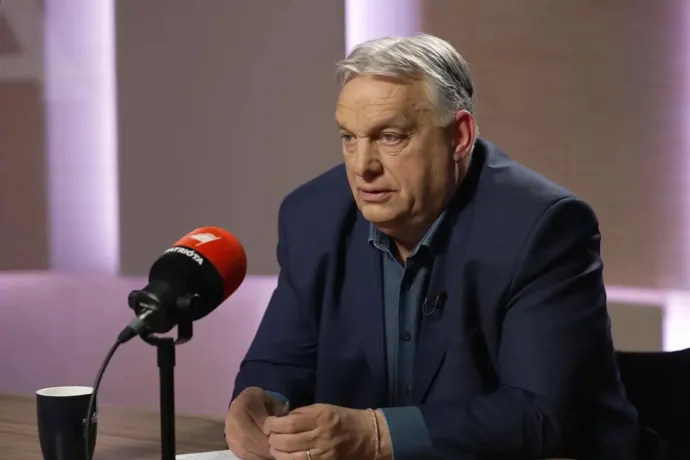


For the first time since his party, Fidesz, suffered a crushing defeat at the hands of the Tisza Party and its leader, Péter Magyar, on Sunday, April 12—despite having been poised for victory—outgoing Prime Minister Viktor Orbán sat down for an interview.
“How severe was this defeat, and do you plan to resign?” was the first question posed to Orbán on the pro-Fidesz Patrióta on Thursday evening. Orbán replied that the degree of the defeat was clear from the numbers. “The scale of the defeat is significant. As for the consequences, it’s more than just having to replace one or two people.
According to Orbán, a complete renewal is needed because a political era has come to an end, “I think it is clear both emotionally and from the numbers too. The right-wing community cannot continue to live the way it has lived up to now.” In his view, this renewal extends to the entire national camp, and he believes many new movements will emerge. “Fidesz and its leader must make it clear— I must do it too—that we are here and they can count on me. A great many people are working to get this renewal underway,” he said.
According to Orbán, they should have built Paks 2 (Hungary's second nuclear plant) much faster.
“After the first results came in, I could already see that there would be trouble, because the final results showed something completely different from what our campaign was built on.
The campaign was based on the assumption,” he said, “that turnout would be the same as it had been in the past.” But turnout was much higher, and he soon understood, he said, that the increase was distributed differently in terms of party support. “I saw that this was a problem, and I went through that emotional roller coaster that we’ve all been riding ever since.” He said he felt pain and emptiness. “On Sunday it was just pain, by Monday it was emptiness too; since then I’ve been healing through work therapy," he replied.
When asked what message he would send to their voters, Viktor Orbán said that in his view most people are now worried about their country, and he too can say, “May God protect Hungary.” As for whether they voted well, he said yes; he wanted to reassure them that they did vote well, and they can be certain that he would have been able to solve the problems facing Hungary. They have reason to be proud of the Fidesz government’s achievements despite the defeat. “We must bear it with dignity.” This is a test of strength, according to Orbán.
Yet there are still more than 3 million people who voted for the Tisza Party, but why did so many vote for the Tisza Party?—they asked him. He said he does not want to tell those who voted for the Tisza Party that it was a bad decision, only that it can not yet be known whether it was a good one. “We will never root against our own country,” he added.
Speaking about the campaign, he said his opponent’s message was stronger. He said he couldn’t blame his staff; as all conditions were in place for him to get his message across. “You can’t assess a defeat like this in just four days,” he said; he is now mulling over why he wasn't able to represent and convey Fidesz’s message—that theirs is the right path—more convincingly. He doesn’t have an answer yet; “I’m trying to recover from this shock myself.”
If he had known the final election results, he would have run a different campaign in hindsight, but his previous message “came from the heart,” “I took this seriously, and I took the people seriously,” “I spoke frankly with everyone about the country’s situation, but I must not have said something right, because the other proposal” received far more votes.
“I, I am the party president,” he said when asked who was responsible for the defeat.
He said that within the party, there is responsibility for intent, but as the party's leader, he is the exception to this and is responsible for results.
According to Viktor Orbán, voters voted for the future, not about the past. He believes it will take them time to gather 8–10 reasons for their defeat. Next week, they will gather activists and volunteers in every constituency to meet with them—"I’ll go too"—and they will then have a clearer picture about it all. Orbán said he has already begun to organize the first steps of Fidesz's renewal, and he will also propose convening a party congress to elect new leadership; in his view, they will have already completed most of the renewal process by June.
They will also vote on the president and vice presidents, as well as on the party’s organizational structure.
“Did you foresee this outcome?” they asked. “If I had foreseen the outcome, I wouldn’t have run this kind of campaign. (…) I, too, thought we would win.”
He said that the voters who showed up at a rate of 70–72 percent either didn’t want to listen to him or he was unable to reach them.
In response to András Bencsik’s criticism that Orbán was misled by right-wing pollsters, the outgoing prime minister replied that he may have been inaccurate here, because “I can’t defend myself by saying I was misled. I also had the results from left-wing pollsters on my desk.”
Certainly, he said, when asked whether the excessively luxurious life of those in NER (Fidesz' governing elite, complete with the politicians and the oligarchs profiting from the system – TN) and corruption may have played a role in the Tisza Party’s two-thirds victory.
“I have never tolerated any form of corruption,” Orbán said. “I refute any propaganda to the contrary. Never. In every single case where serious suspicions arose, the authorities have always taken action, and I have always supported the authorities’ actions,” he stated. He said that whenever he addressed groups with large capital, he had clear expectations as prime minister: no corruption, taxes must be paid, and jobs must be provided for people. He stated that he supported the authorities in investigating the allegations.
He has no message for the future government; he said he views them through the lens of the commitment they have made: “They said that people will live better,” and that they will be able to cope with the challenges ahead “better than we can.” When asked what they would advocate for in parliament, he replied that wherever they see destruction, they will stand up for the people.
Referering to Péter Magyar having called on the President and the heads of several public authorities who have been appointed by Fidesz to resign, Orbán said that in his view, it is completely unacceptable to disrespect the President of the Republic, who was elected by Parliament, neither respecting his person nor the office he holds; or to threaten leaders holding other positions of constitutional trust who are performing public service. “You cannot call for their resignation”; if they want to remove someone, they should find a legal way to do so, but in his view, they should not threaten anyone with dismissal.
At one point, Orbán came close to offering an apology, but then said instead that he would like clarify if he had expressed himself ambiguously, because he had been asked whether Fidesz was the only one that could defend the nation’s achievements. He said he did not want his words to be understood that way.
In his view, if the right wing manages to renew itself, it will quickly become capable of taking action; he believes the renewal process could be completed by early fall or late summer. “We’ll see where Fidesz fits into this as well.”
He believes renewal is only possible if the people within the party want to renew what they are part of. He says the first task is to navigate the handover and also to renew the parliamentary group.
“Those who have just entered parliament are not the ones we will need there,” Orbán said. In his view, those people would have performed well in a previous era. “But the balance of power has shifted, and we need representatives of a different kind.”
He will also meet with the leaders of the “think tanks” that assist their work to seek advice, he continued. Orbán reiterated that they will also visit the constituencies.
“This is the community I belong to. (…) This is my home. And as one grows older, more and more is expected of them,” he replied when asked where the path forward lies.
Orbán said he has always loved organizing this community, but over the past 16 years he had less time for it due to governing. When they lost the election in 2002, he said, they had to reorganize everything, and that’s when the civic circles emerged. “This is now the third time they’re expecting this from me,” he said of the reorganization.
When asked if he was preparing for movement-based political action, he replied, “That’s what the people decided.” In his view, there is no longer a left or a right here; there are no longer traditional political camps, but rather a national camp and another camp—“the big, Brussels- globalist camp,” as he put it. War, peace, national sovereignty, and economic issues—these are the questions that will need to be answered, according to Orbán.
He believes that they will need to unleash internal energies: “The patriots are moving forward. The future belongs to the patriots; the future belongs to the national side.”
What will his role be in all this? “I’ve done a great many things in my life; at times I’ve even grown weary. After this defeat, instead of feeling older, I suddenly feel younger; this pain has unleashed a tremendous amount of energy within me.” According to Orbán, he won’t be the one to decide what to do. “If they say, ‘Prime Minister, you can’t just be wandering around the locker room right now,’ then he’ll go and get them ready, and will lead them out onto the field—he said, using a soccer analogy.
For more quick, accurate and impartial news from and about Hungary, subscribe to the Telex English newsletter!