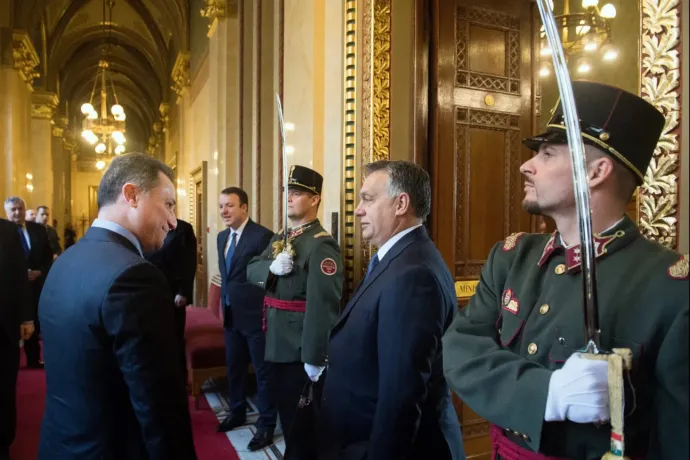


The fate of politicians who received political asylum from the Orbán government and are facing convictions or legal proceedings in their home countries has become uncertain in the wake of the Tisza Party’s two-thirds election victory. At his international press conference last Monday, Péter Magyar already indicated that they would review the status of former North Macedonian Prime Minister Nikola Gruevski, as well as that of Poland’s former Minister of Justice, Zbigniew Ziobro, and his deputy, Marcin Romanowski.
“Hungary is not a dumping ground for internationally wanted criminals,” he declared.
The situation is complicated by two factors: on the one hand, all of them have been granted asylum; on the other hand, an international arrest warrant—issued on a second attempt following last year’s rejection—is currently in effect only against Romanowski. Moreover, according to Balkan Insight, it appears that Gruevski’s home country is not actually pushing for his extradition at this time, due to reasons of domestic politics.
Asylum is not set in stone
Marcin Romanowski, a politician of the Fidesz-ally Law and Justice (PiS)—which has been in opposition since 2023—arrived in Hungary and was granted political asylum in December 2024. In Poland, the prosecutor’s office charged him on 11 counts, including allegations that he had misused public funds. Donald Tusk’s government was so outraged by the Hungarian government’s move that it recalled its ambassador accredited to Budapest, while according to information from last year, the accused Polish politician was living in District I. In order to make helping Romanowski possible, the Orbán government even amended a law, thus risking the further deterioration of its already strained relations with the Polish government. The government’s justification was that the Polish politician would not receive a fair trial in his home country.
As for Ziobro, who is-among others-facing charges for the illegal use of the Pegasus spyware, it was revealed in January of this year that he had come to Hungary with his wife “under the asylum granted by the government.” He is currently facing 26 charges, including abuse of office and leading a criminal organization. We wrote in detail about the political context of his case in this article. Although a Warsaw court has ordered Ziobro’s arrest, this cannot yet be enforced due to appeals, which also means that no international arrest warrant can be issued.
Of the three, Gruevski has been in Hungary the longest. He used to lead the former Yugoslav member state for ten years under the banner of the VMRO–DPMNE (Internal Macedonian Revolutionary Organization – Democratic Party for Macedonian National Unity). After losing the 2016 elections, charges of corruption were brought against him; he then fled his home country to avoid a two-year prison sentence and, with the assistance of the Hungarian government, arrived in Hungary via a third country at the end of 2018. Since then, in his absence, the politician—who is also accused of conducting mass wiretapping—has been sentenced to 10 years in prison in two additional corruption cases.
During the previous Social Democratic government, the North-Macedonian authorities requested Gruevski's extradition, but he was protected by political asylum. The political situation in North Macedonia has meanwhile changed; VMRO–DPMNE is now back in power, and the current prime minister, Hristijan Mickoski has no interest in bringing Gruevski—who remains popular within the party—back home and sending him to prison as mandated by the court ruling. According to Balkan Insight, the party leadership fears that this would divide the ruling party.
The extradition request sent by the previous Macedonian government in Gruevski’s case has since expired; the current government has not renewed it, and there is no Interpol warrant in effect. True, even if there were, it could not be enforced due to his political asylum status, which grants him protection. However, this status can be revoked.
The status of an asylum seeker is an objective fact, and the relevant circumstances must be examined to determine whether it should be granted. If the examination shows that the applicant has a well-founded fear of persecution, the status may be granted.
“However, if it turns out that the original assessment was flawed—that there is no persecution, but the applicant is simply the subject of ordinary criminal proceedings—then the decision that was originally approved can be revoked,”
– international lawyer Tamás Hoffmann told Telex. According to the lecturer of Corvinus University and a researcher at the Institute of Legal Studies of the Research Center for Social Sciences, this is not a protracted process: while an administrative decision to revoke the status may be challenged in court, the proceedings tend to move quickly. This requires initiating a review of the status, which the Hungarian authorities can do on their own.
A verdict at home is not enough
In Gruevski’s case, however, if there remains no international arrest warrant or extradition request against him, the Hungarian authorities have nothing further to do, and the politician is not automatically required to leave Hungary. Since he is not an EU citizen, however, he must find a legal basis for staying within the EU. If he does not receive a Schengen visa from Hungary or another EU member state, he must leave the EU, but even then the authorities are not required to take him into custody and hand him over to North Macedonia. For that to happen, a valid extradition request would have to be received from that country, or an Interpol warrant would have to be issued—and there are no signs that the Skopje government has such plans.
As for the two former Polish government officials, their EU citizenship adds to the complexity of the situation. Refugee status can be revoked in the same manner as described above:
In Romanowski’s case, revoking his refugee status would also mean that the authorities would have to arrest him based on the Interpol warrant and, after careful consideration, hand him over to the Polish authorities.
In Ziobro’s case, however, in the absence of an extradition request based on an international arrest warrant, no action would need to be taken, and he could remain in Hungary or another EU country without hindrance. “An EU citizen can only be expelled in very justified cases: when they are a threat to national security or to public safety,” the international lawyer said. As a theoretical possibility, he noted that if a person in such a situation had meanwhile obtained Hungarian citizenship, that too could be revoked—even in the case of naturalization—if it is proven that the underlying grounds for granting it were false.
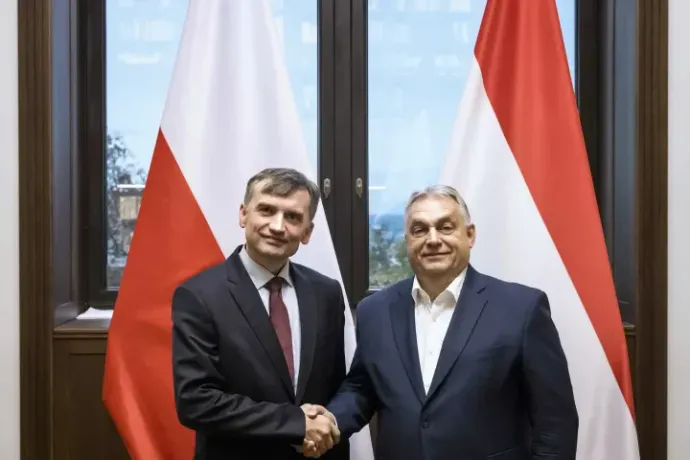
The Polish head of government said after Magyar’s press conference on Monday that he had already spoken with the chairman of the Tisza Party about the case of the two former Polish government officials prior to the elections. “The situation is clear; there is nothing more to add. […] I hope I will be able to welcome the two gentlemen in Poland,” Reuters quoted Donald Tusk as saying.
Bringing Ziobro to trial would be a real success for Tusk
For now, bringing Romanowski home seems simpler—provided he remains in Hungary—“but bringing Ziobro to trial would be the real success for the Polish government,” Michał Kokot told Telex. According to the journalist from Gazeta Wyborcza, the former minister can count on less support from his political base; reportedly, even some in the upper echelons of PiS were not particularly pleased that he had fled to Hungary to avoid prosecution. Incidentally, he only joined PiS after the 2023 parliamentary election defeat; prior to that, he had led one of the smaller partners within the governing coalition, Sovereign Poland (SP), which has since been dissolved.
Ziobro would have been more useful to PiS if he had stood trial, because then the former ruling party, which has been at odds with the EU, could have presented this as evidence of Tusk’s political persecution. The image of the former justice minister fleeing accountability is now less useful for such political games, and it is also partly a liability that this refuge was provided by Orbán’s government. Additionally, the relationship between Fidesz and PiS has soured over Ukraine and the Hungarian government’s overly close ties with the Kremlin, although former Prime Minister Mateusz Morawiecki did travel to Budapest in late March to campaign alongside Orbán at CPAC Hungary.
Viktor Orbán was a good ally in the EU, and cooperation with him was very valuable to Polish sovereigntist politicians, Jarosław Kaczyński, the leader of Poland’s main opposition party said at a press conference in Warsaw last Tuesday. He also announced that he would not congratulate Péter Magyar on his victory. Other PiS politicians, however, made it clear that their distancing from him was only intensified by Fidesz’s defeat last Sunday. “The direction of our politics was completely different from his,” the PiS vice-chairman said of Orbán. “There are no friends in politics; he was an ally on European issues, but we had many disagreements on Eastern policy,” declared Tobiasz Bocheński.
For more quick, accurate and impartial news from and about Hungary, subscribe to the Telex English newsletter!