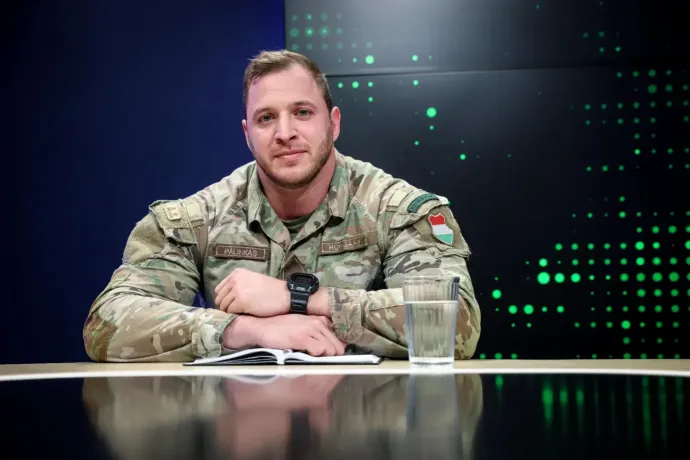


‘Keeping quiet about the truth is not something that can be bought’ – Captain Szilveszter Pálinkás declared in his second interview with Telex, published on Tuesday morning. In the interview, he revealed the offers made by Minister of Defense Kristóf Szalay-Bobrovniczky to dissuade him from going public about the conditions at the Hungarian Armed Forces. We first interviewed the captain last week; the video has already been viewed by more than 1.8 million people, and there have been many reactions to the captain’s statements. In the second interview, he addressed these reactions and recounted how the past few days have been for him.
Previously, Pálinkás was the face of the Hungarian Armed Forces’ recruitment campaign and worked directly under minister Kristóf Szalay-Bobrovniczky at the Ministry of Defense. Last summer, Telex reported that he had submitted his request for discharge, citing at the time that he disagreed with the leadership of the Ministry of Defense and could no longer identify with the organization whose ambassador he had been. His discharge request was denied, citing the state of danger due to the war in Ukraine, so he remains a member of the military to this day. Pálinkás studied at the prestigious Royal Military Academy at the same time as the prime minister’s son, Gáspár Orbán. In addition to discussing the state of the military, he also spoke in detail about the military mission in Chad, which he claimed was initiated by Gáspár Orbán, who shared sensitive information on the matter with him in private.
We made every effort to organize the first interview in complete secrecy, since the captain did not have permission from the ministry to speak to Telex. However, Kristóf Szalay-Bobrovniczky somehow became aware of what we were planning and summoned Pálinkás to his office at the ministry last Wednesday. There, alongside the minister, he was received by Brigadier General Péter Zákány, the deputy chief of staff to the Minister of Defense, who a few days later criticized the captain’s decision and certain claims in a video published on the pro-government outlet Mandiner. Pálinkás does not know how the minister found out that he was planning to go public, but the minister tried very hard to dissuade him from doing so and, to that end, presented him with three offers.
The first offer was to send him to New York for four years on a military assignment. The second offer was that they would create a military organization just for him and appoint him as its commander. The third was the most absurd, according to the captain: he could work in filmmaking in the future if he liked the series S.E.R.E.G. and the movie Dragons Over Kabul, in which he had participated as an actor and military expert. “That was the point where I really felt that we had left complete professionalism behind, and if this is actually how things work within the Ministry of Defense, then the same is likely true in different segments and parts of the government,” Pálinkás said of the ministerial meeting.
“I sensed that the Minister of Defense, Kristóf Szalay-Bobrovniczky, was afraid that certain things might come to light that would reflect badly on him and on his ministry.”
The Captain considered the three offers absurd, but he claimed he tried to come across as neutral so the minister wouldn’t discover more about his intentions. It was long before this point that he had decided to go public, and as he put it, nothing could buy his willingness to tell the truth. “I didn’t tell the truth to get something for it, and I’m not going to keep quiet to get something for it.” In his view, it is in the interest of every Hungarian citizen to learn the truth about the situation in the military.
He is able to substantiate the minister’s offer with an email. Last Thursday, the State Secretariat for Foreign Service sent him a letter stating that he had been nominated for a position at the Hungarian Mission to the United Nations and invited him to attend a face-to-face interview.
He believes that the publication of our interview on Thursday evening made it clear to everyone that he had declined these offers. Since then, his superiors have not contacted him, nor has he received any notification that disciplinary proceedings have been initiated against him for giving an interview without permission. He expects, however, that they will contact him soon after the Easter weekend.
He explained that he was exercising at the time of the interview’s publication to relieve stress. He never doubted his decision for a moment, but he didn’t know what the reactions would be, which made him nervous. He said his family was worried about his physical safety, but he isn’t concerned about that. Since the interview came out, his experiences have been very positive: many people approached him on the street to congratulate him and assure him of their support, but more importantly, over a thousand of his fellow soldiers have messaged him so far. They thanked him for standing up for them and sent him countless photos of their worn-out gear, equipment, their torn uniforms, moldy infrastructure, and their working conditions in general. In his view, these photos further corroborated what he had recounted, and many even told him they were ready to stand up for him if the ministry tried to refute his claims, and would confirm his account with their photos.
Minister of Defense Kristóf Szalay-Bobrovniczky responded on Facebook a few hours after last Thursday’s interview was published: “The Hungarian Armed Forces has always been and will remain an institution independent of party politics. That is precisely why it is regrettable when certain individuals, led by Romulusz Ruszin-Szendi, attempt to use it for political purposes.” (Ruszin-Szendi is the former Chief of Staff who has joined the opposition Tisza Party as a defense expert).
Pálinkás said that if independence from party politics is truly so important to the defense minister, then he doesn’t understand why there were no consequences to platoon leader Gergő Havasi, who has been the face of the reserve soldiers’ campaign, regularly being present in the group obstructing protesters at Viktor Orbán’s campaign events. “This raises the question: why does he still have an active reservist status, and is what he did there an activity independent of party politics?”
Pálinkás expected that the government would try to fit his appearance into its narrative about the Tisza Party or perhaps Ukraine, but in his view, anyone who watched the interview could see that he was actually talking about the situation of the Hungarian Armed Forces. Since “they couldn’t come out and acknowledge that I was right and say, ‘Yes, we accept every statement made by Szilveszter Pálinkás,’ they had to place him somewhere, and that’s how he became Ruszin-Szendi’s man in the pro-government media.” He said, however, that he did not speak with the Tisza Party’s defense expert either before or after the interview, nor did he receive any inquiries from other parties. The attacks in the government media did not upset him, as he had expected them to try to discredit him and link him to the Tisza Party.
“I was prepared for it, so it doesn’t have much of an effect on me.”
Some believe that Pálinkás’s decision to speak out constituted a betrayal of the Hungarian Armed Forces. He disagrees with this view because, in the course of his work, he consistently observed a contradiction between the image communicated to the public and reality, and he believes he merely pointed this out in last week’s interview. “I believe that exposing a lie is not a crime.”
He only said things about Chad that he could prove
The segment of the interview about Chad received the most political attention from the public. Pálinkás spoke about how the Prime Minister’s son, Gáspár Orbán, had begun planning the military mission to Chad based on divine inspiration, and according to him, Orbán had told him in a private conversation that he expects a 50 percent casualty rate during the mission, which means that 50 percent of Hungarian soldiers would die.
The Minister of Defense described these claims as pro-Tisza party alarmist tactics and categorically denied plans for a Chad mission, while opposition leader Péter Magyar called on the Prime Minister to “immediately inform the Hungarian public about the African military operation his son is planning, and to immediately halt any foreign military mission that could put the lives of Hungarians at risk.”
“I shared this information because these conversations actually took place between me and Gáspár Orbán,” Pálinkás responded. He expects that the Ministry of Defense will not be sharing any more details about the Chad mission in the future, but in his view, the information he provided was the most important. He claims: he only shared factual information he is able to prove.
“I can also provide proof of my conversation with Gáspár; I can prove it if the government were to attempt to refute this through official channels.”
According to him, after the interview was published, he was contacted by a soldier who had worked with Gáspár Orbán on planning the Chad mission. This person promised him that if the government were to officially deny the existence of the Chad operation, he would go public and corroborate what he had said. Pálinkás considers Szalay-Bobrovniczky’s complete denial to be inconsistent, given that in 2023, parliament passed a resolution authorizing the deployment of 200 Hungarian soldiers to Chad, and then, in November 2024, through an amendment to the law, the parliamentary majority transferred the decision-making authority on the deployment of the Hungarian Armed Forces abroad and their military operations to the government. Since then, the government has been able to decide on the deployment of Hungarian soldiers abroad in individual decrees. As a general rule, these decisions must be published in the Hungarian Gazette, but if a decision contains classified information, it is not made public.
Pálinkás suspects that this may have been in preparation for the Chad mission, because if the decision about the African operation is made in a classified government resolution, then the public would not know how many soldiers are serving there, what tasks they are performing, or how many may have died during the mission.
Following the publication of last week’s interview, Brigadier General Péter Zákány told pro-government Mandiner that Pálinkás had been his mentee at the ministry, and he was deeply disappointed that the captain had gone public, because in his view, by doing so, he had “tarnished the entire Hungarian Armed Forces.”
"I would use the same word, 'disappointment,' in reference to Brigadier General Zákány, since we always shared the same opinions during our time working together. I don’t understand what made him agree to this interview,"
Pálinkás reacted. He said it is possible that Zákány agreed to the interview because otherwise he would have jeopardised his multi-year military post in New York, set to begin in a few weeks.
Zákány was also present at the meeting where the Minister of Defence tried to dissuade Szilveszter Pálinkás from going public by offering him various incentives. According to Pálinkás, the brigadier general spoke very positively of him at that meeting: he referred to him as the youngest and best-trained officer, whom the Hungarian Armed Forces would be ill-advised to lose. Zákany also tried to influence him on a personal level by saying how nice it would be for them to work together again in New York. Although he afterwards called Pálinkás several times, he did not answer the phone. Now, Pálinkás has asked his former mentor to accept his decision, adding that he regrets that he did not respond to his inquiries the week before.
Chief of Staff Gábor Böröndi responded to last week’s interview with a statement. He claimed that troops’ equipment and weaponry have been modernized in recent years; in his view, there is no ban on demobilization, nor are there crowds waiting to get out. Péter Zákány later also told Mandiner that anyone can be discharged, they are free to go,the gates are open.
According to Pálinkás, however, the reality is that while this is legally possible, the commander in charge of personnel may decline a request for discharge during a state of danger due to war in a neighbouring country by declaring that no one else is available to fill the position. “I have plenty of comrades who have submitted their discharge requests. I also have comrades whose military contracts have already expired, and their contractual relationship no longer exists, yet they cannot leave due to the ban on discharge.
Pálinkás also said last week that he has not seen a single ministerial decision by Szalay-Bobrovniczky with which he could agree professionally. Péter Zákány called the recruitment campaign for reserve soldiers a huge success for the Minister of Defence. According to the brigadier general, a total of 8,000 reservists have signed contracts in recent years. “Even NATO countries are asking for our help to show them how we achieved these numbers when recruiting reservists.”
With regard to this, Pálinkás said that the system of reserve forces had caused serious tension within the ranks of active-duty personnel, because reservists are often assigned ranks that are unrealistically high given their qualifications and expertise. As an example, he mentioned István Veres, the husband of former President Katalin Novák, who was immediately promoted to the rank of lieutenant colonel in 2023 after a five-week training course, while it takes active-duty soldiers 15 to 20 years of service to reach that rank.
“Reserve soldiers are given ranks that bear no relation whatsoever to the knowledge behind them. The main problem with this is that if you look at an active-duty soldier and a reservist, you wouldn’t be able to tell the difference because there is no difference in rank.” According to Pálinkás, this has undermined the prestige of military ranks and has generated significant resentment toward reservists among active-duty personnel. He also said that in other NATO member states, active-duty and reserve soldiers must meet the same criteria to attain, for example, the rank of captain. Here in Hungary, even the training conditions are not the same: reservists receive more comfortable accommodations and better provisions.
We sent a detailed list of questions about the claims made by Szilveszter Pálinkás to the Ministry of Defense last week and requested an interview with Kristóf Szalay-Bobrovniczky so he could respond in greater detail to the claims made by the captain. He has not yet taken advantage of this opportunity. We remain open to this, and are also asking for the help of our readers. If you know of any public events Kristóf Szalay-Bobrovniczky will be attending in the coming days, please send us the details at ugyelet@telex.hu so we can be there to ask him the most important questions.
For more quick, accurate and impartial news from and about Hungary, subscribe to the Telex English newsletter!