Troops see that the defense minister is not up to the task, and they are hoping for change – the former face of the Hungarian military speaks out
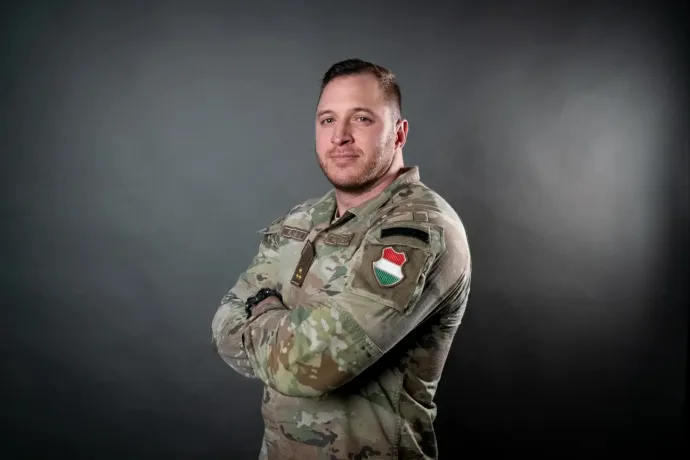


Never before in the history of the Hungarian Armed Forces has morale been so low; never before have so many soldiers wanted to leave the service; the defense minister’s decisions have ruined military profession. Gáspár Orbán ( PM Orbán's son) cannot be dissuaded from the Chadian mission – an idea inspired by divine revelation – where half of the Hungarian soldiers could die. These are some of the strong statements captain Szilveszter Pálinkás made in a video interview with Telex.
This is the first time the 33-year-old soldier has spoken publicly; the former face of the Hungarian Armed Forces’ national recruitment campaign studied at the prestigious Royal Military Academy at Sandhurst alongside the Prime Minister’s son, Gáspár Orbán. Later, as a military expert and actor, he assisted with a TV series about the military, and in the making of the movie Dragons Over Kabul. Last summer, Telex reported that he had submitted his request for being released from service, citing at the time that he disagreed with the leadership of the Ministry of Defense and could no longer identify with the organization whose face he had been. Citing the state of danger due to war, his request was denied, so he remains a member of the military to this day.
He agreed to give Telex a video interview lasting nearly two hours because, in his view, the country’s citizens have the right to receive an accurate description of the current situation in the Hungarian Armed Forces – which operate on taxpayer funds. He said that he did not notify his superiors about the interview in advance. In doing so, he violated the code of conduct and is likely to face disciplinary action. “I think they’re going to terminate my service,” he replied when asked what kind of retaliation he might face as a result. He feels that the Minister of Defense has effectively destroyed the military profession over the past four years, and he believes that under the current circumstances, many soldiers are unmotivated to serve. At the beginning of the interview, Pálinkás also sent a message to Police Captain Bence Szabó, who had spoken out about the secret service operation against the Tisza Party: “We leave no one behind; police and soldiers stand side by side, with one heart, beating in unison”, he said.
Pálinkás graduated from several foreign military academies. In 2023, he was sitting in his office in Szolnok when the phone suddenly rang. It was the press secretary of the Minister of Defense, asking him to come to a meeting with Kristóf Szalay-Bobrovniczky the next day. Neither he nor his immediate superior knew what this might be about.
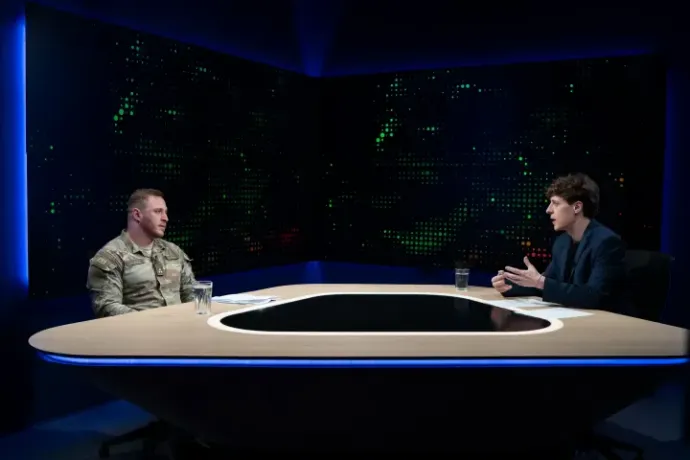
“When I arrived, the military leadership at the time made it quite clear to me that if I refused any request from the minister, my military career would be over,” Pálinkás said, describing how he was received at the ministry. Szalay-Bobrovniczky then asked him to be the face of the Hungarian Armed Forces’ recruitment campaign. He was transferred from his base in Szolnok to the Ministry of Defense as a specialist, and according to him, he was able to sit at the table “where the most important decisions are made.” They produced social media videos featuring him, he gave interviews, and promoted the armed forces at various events.
Two years later, he submitted his request for discharge because due to the minister’s decisions and the harmful systemic changes he had introduced he felt he could no longer serve as an officer. He was more and more bothered by the contradiction between the false, positive image he was required to convey in social media videos as the face of the recruitment campaign, and what he saw among his fellow soldiers, who were preparing to leave the service en masse. “The problem was that, in my opinion, the press office of the minister’s cabinet didn’t have enough military knowledge to keep us from making fools of ourselves.
“I’ve often felt that, due to professional shortcomings in the videos, the most beautiful profession would end up being the subject of jokes,” the captain said about the recruitment campaign.
After we reported that the ministry had refused to discharge Pálinkás, they issued a statement saying that Colonel General Gábor Böröndi had assigned Pálinkás to the position of operations officer at the base in Tata and had entrusted him with an important task, after which he would be discharged by mutual agreement. Pálinkás said that to this day, he does not know what this important task might be; in his view, it was merely a message intended for the media. After our article was published, although he is a reconnaissance officer, he was assigned to an armored brigade, a branch of the military with which he has no connection. “This is actually a form of exile, a kind of punishment.” He regrets that he was not allowed to return to his former unit, the Special Operations Brigade, where he could serve his country in accordance with his training.
“I was told I’m a traitor. They said: Who do you think you are? – the Defense Minister can’t afford to lose the face of the army before the elections,”
– Pálinkás said, recounting details of the conversation he had with one of the defense minister’s close aides after submitting his request for discharge.
According to him, the aide literally told him that he should not dare say he was denied a military career, because he had been given the opportunity to walk alongside the defense minister. Kristóf Szalay-Bobrovniczky interpreted the discharge request of the face of their recruitment campaign as an act of political posturing, and “I was told that I was one of Péter Magyar and Romulusz Ruszin-Szendi’s men, and that I had made a poor strategic decision by choosing a side.” This didn’t make sense to him, given that as a simple captain, he had never made political statements and had never sided with either party while on active duty.“Soldiers shouldn’t talk about politics, and a minister shouldn’t drag politics into soldiers’ lives or judge them based on their political views.”
In his view, one of the reasons why he was not allowed to return to Szolnok is that the defense leadership believes that the soldiers there are still loyal to the former chief of staff, Romulusz Ruszin-Szendi. Ruszin-Szendi is now the defense expert for the Tisza Party and a candidate for the Parliament. Pálinkás also finds it extremely offensive that the military leadership treats the units in Szolnok as a “Tisza Island.” In his view, the defense minister was thrown off balance by Romulusz Ruszin-Szendi’s decision to join the Tisza Party, and since then he has developed complete tunnel vision. “He envisioned Romulusz Ruszin-Szendi’s followers everywhere, wanted to root them out, and he tried to pin every possible violation of the rules (...) on him.”
Pálinkás believes that this was mainly driven by professional jealousy, because Szalay-Bobrovniczky, who was appointed in 2022, had no prior military training or experience, whereas Ruszin-Szendi had worked his way up through the military ranks. As a defence minister, it’s pointless to surround yourself with good military advisors if you don’t even understand the issue you’re supposed to make a decision on.” The captain told Telex that he does not know what benefit the Hungarian Armed Forces derive from Szalay-Bobrovniczky, a businessman, taking the ministerial seat, since he had no understanding of the armed forces.
When we asked him, he was unable to name a single decision from the minister’s past four years that he would agree with professionally. “I don’t think there has ever been such a bad minister in the history of the Ministry of Defense.”
The lowest morale ever
In his view, a good leader must take responsibility, but Szalay-Bobrovniczky failed to do so even when several experienced commanders were dismissed in 2023 as part of a drive to bring in younger personnel. The minister left the dirty work to the then-Chief of Staff, Romulusz Ruszin-Szendi, to whom he handed an envelope containing the names of those to be dismissed and tasked him with announcing the list. According to Pálinkás, the real goal of the Minister’s move to "rejuvenate" the military was to get rid of key senior military leaders and appoint leaders who were loyal to him – leaders whose selection was no longer based primarily on professional competence. In doing so, Szalay-Bobrovniczky was likely paving the way for ensuring that no one stood in his way and that his plans were carried out to the fullest extent.
“Never before in the history of the Hungarian Armed Forces has morale been so low; never before have so many soldiers wanted to leave the service",
the captain said. In his view, the biggest blow to the military came with the 2024 government decree, which redefined the legal status of soldiers and eliminated allowances as well as overtime pay. This measure alone reduced the pay of many soldiers whose jobs simply require them to regularly work overtime and on weekends by 150,000 to 200,000 forints (390-520 euros). “This government decree only took things away from the armed forces, but gave them nothing in return.”
The government decree also abolished time off, so from 2024, it has been up to unit commanders to decide when soldiers can take time off. A tiered pay system was also introduced, which, according to Pálinkás, is unprecedented in any other army in the world. Under the new regulations, the unit commander decides how much a soldier receives within specified pay brackets, but there is no standardised system, so it is unclear how performance is measured. In his view, this gives commanders too much power, and carries the risk of small kingdoms or fiefdoms being formed within the Armed Forces, which I believe is absolutely harmful.”
Pálinkás made a shocking statement when discussing the situation of soldiers.
“This is hard to say, but I believe that there have been so many discharge requests submitted and there are so many disillusioned soldiers that the Hungarian Armed Forces and the country’s defense only exist as long as the state of danger due to war remains in place. As soon as that is lifted, they will all be discharged, and our defense capability will drop to nearly zero.”
The interview also touched on the fact that soldiers received a special incentive amounting to six months’ worth of pay ahead of this year’s election, but according to the captain, this will not have the same positive effect that the same move had in 2022, because the aforementioned decree took a huge amount of money away from them. “Soldiers aren’t stupid; they know exactly why this was done.” He believes the pay will be insufficient to change the general perception of the defense minister. “ I think the soldiers generally think that the defense minister simply doesn’t know what he’s doing, and I think they’re hoping for change.” From what he has observed, everyone within the military is looking forward to the April 12 election.
Zsolt Laponyi, who recently left the police force, previously told Telex that his gut feeling is that 90 percent of police officers will not support Fidesz in the election.
“I think that this 90 percent figure is realistic within the Hungarian Armed Forces as well,”
Pálinkás said in response to our inquiry.
Hungarian soldiers were sent out of NATO meetings
He also spoke at length about the conditions under which soldiers live and work nowadays. After the government introduced a state of danger due to war in a neighbouring country in 2022, they switched to task-oriented service, which in practice means there are no set working hours. This basically means that soldiers can only go home if their commander allows it. Their daily lives have thus become unpredictable, making planning ahead impossible, which has in turn complicated normal family life.
Of course, this was something they signed up for when they took the oath to defend their country, Pálinkás noted. The problem, in his view, is that soldiers aren’t adequately paid either, and they’re forced to work under poor conditions. A prime example is their food. Their rations aren't of adequate quality; according to the captain, it’s not uncommon for a soldier’s bag to loudly rattle during a drill while trying to take out a granola bar. This is something that could cost a soldier his life in a combat situation. But according to Pálinkás, even if they were given uniforms that were flame-resistant and didn’t tear just from taking a seat in the office would make them happy.
He believes that over the past four years, Szalay-Bobrovniczky has focused solely on rebuilding military identity instead of addressing the systemic problems.
“The billboards were useful for getting young people through the barracks' gates, but we couldn’t keep them there because once they got inside, they came face to face with the reality.”
Instead of the state-of-the-art equipment and conditions advertised on the posters, in reality, the barracks’ hallways reek of sewage, and the showers and living quarters are often moldy.
“After seeing the actual conditions, young people often turned around and went to work as stockers at a retail chain instead, where they earn twice as much, get to see their families, get to go home at four o’clock, have a completely predictable life, and enjoy clean working conditions.”
Pálinkás also mentioned that the recruitment campaign caused enormous tension within the military because, after five weeks of basic training, the new recruits were paid twice as much as those who had been working there for twenty years. It’s as if, at a multinational company, an intern would earn two and a half times as much as a middle manager who’s been there for twenty years. The difference is that, due to the state of danger, it hasn’t been possible to be discharged from the armed forces since 2019, so they have no choice but to accept the situation.
In February, Hungarian troops were deployed to critical energy infrastructure, but according to Pálinkás, it is unclear who the infrastructure needs to be protected from, that is, who the enemy is. “If we have an image of the enemy, then we prepare by looking at how that nation fights and what military equipment we’ll have to counter. In the government’s communications these days, Ukraine is the main enemy.” According to the captain, however, this makes no military sense, as Ukraine has no rational reason to start a war against a NATO member state, thereby risking a counterattack and total annihilation. “We don’t understand why the Ukrainians would make a decision that would bring about their own demise”.
“The government's communications about Ukraine are a laughing stock. We’ve been joking about it at work. You simply can’t take this image of Ukraine as an enemy seriously,” he replied when asked if this comes up among soldiers. Pálinkás also added that he doesn’t understand why it’s good for the Hungarian government if Hungary’s role within NATO is weakened due to its pro-Russian stance.
“I’ve participated in several NATO exercises since the outbreak of the Russian-Ukrainian conflict where soldiers from other NATO member states specifically asked us, Hungarian soldiers, ‘Are you actually on the Russians’ side? Because that’s what your communication seems to suggest.”
According to him, there have been instances where American officials did not allow Hungarian soldiers to attend reconnaissance professional's NATO meetings. They reported this to their superiors, but there is no indication that the leadership intends to make any changes based on this.
Then, one day, the prime minister’s son arrived at Sandhurst
In 2019, following a long and complex selection process, as a recipient of a scholarship from the Ministry of Defense, Pálinkás was accepted into one of the world’s best military academies, the Royal Military Academy at Sandhurst. This is where Winston Churchill, as well as Princes William and Harry also studied. He considers the 12-month training program to be an extremely demanding challenge, both mentally and physically. In his view, they received world-class military training here. When he was nearing the end of the first four-month phase of his training, the then-Chief of the General Staff called him to let him know that an important political figure would be arriving soon. “He told me to take good care of him and to make sure he completes this academy, because if he doesn’t, we’ll both lose our jobs.”
At first, he couldn’t imagine who this person might be. Shortly thereafter, the prime minister’s son, First Lieutenant Gáspár Orbán, arrived. Pálinkás felt that during their time at Sandhurst, they had become comrades and friends, even though in the background he was under serious pressure from the military leadership. He said that the academy didn’t give the Hungarian prime minister’s son any special treatment; they treated him just like any other soldier, and Gáspár Orbán did indeed complete the training.
According to Pálinkás, the more serious problem was that, the leadership of the defense forces sent Orbán to Sandhurst after only a brief basic training,
“He didn’t have to go through the official selection process; he was automatically entitled to be sent to the world’s most expensive and best military academy simply because he is the prime minister’s son.”
He doesn’t know whose decision this was, but he believes the military leadership at the time wanted to score points with the Prime Minister. At the same time, this had a demoralizing effect on the soldiers, because they felt that based on his abilities, Gáspár Orbán should not have been admitted to Sandhurst and the only reason he was able to complete the elite academy’s training – worth 30-40 million forints – was because he is the prime minister’s son.
Pálinkás also mentioned that Gáspár Orbán was first exposed to military life in England, because during his basic training back home, he hadn’t been able to experience what real military conditions were like. This is problematic, in his view, “because the British Army is a good 30 years ahead of us,” and the picture that may have formed in his mind of the military was “very far removed from the reality of the Hungarian military.” During the training, he tried to explain to the prime minister’s son that something completely different would await him back home, and that the Hungarian Armed Forces were nowhere near this level. “He didn’t believe me at the time, but later, when he returned home, he came to believe it, and the reality of the Hungarian Armed Forces came as a shock to him.”
He tried to dissuade Gáspár Orbán from the military mission to Chad
According to Pálinkás, his friendship and comradeship with Gáspár Orbán continued after Sandhurst. They agreed that systemic changes and the development of military capabilities were needed in the Hungarian Armed Forces. Later, however, their paths diverged. Pálinkás was preparing for a reconnaissance training course in the U.S., while Orbán “suddenly ended up at the Karmelita (the PM’s office complex), was assigned an office as a first lieutenant, and began planning his mission to Africa.”
According to the captain, the Prime Minister’s son had already spoken to him at length in England about how he had found God during his volunteer Christian mission in Africa, and “God spoke to him from heaven, telling him to come and save the African Christians.” He believes that this is why Gáspár Orbán began preparing the Chad mission, which he would never have had a chance to plan at the strategic level as a first lieutenant “if he weren’t the MP’s son.”
Pálinkás finds it unacceptable that the Ministry of Defense and the military leadership are serving the will of the PM’s son. “In reality, this mission is not in our national interest. Professionally, financially, and logistically, we are not ready to carry out an independent campaign in Africa,” said Pálinkás, adding that even nations far stronger than ours have already withdrawn from the region. According to the captain, at one point Gáspár Orbán shared his analyses with him, as well as the problems he encountered during the preparations for the Chad mission.
"During one of our conversations, he shared the details of the plan with me. He told me that he was expecting a 50 percent casualty rate during the mission. Which means that 50 percent of the Hungarian soldiers in the mission he was to lead would die.”
According to him, Pálinkás personally tried to convince Gáspár Orbán with reasoned arguments and professional military assessments that he should not push for the military operation in Chad at such a cost. “I went to him because I knew that the only way to stop this whole process was by stopping him. There was no point in going to the Ministry of Defense, because if Gáspár Orbán wants it, it will happen one way or another.”
He failed to convince him even by arguing that we shouldn’t risk the lives of Hungarian soldiers if it’s foreseeable that there will be so many casualties, and that there’s actually no national interest tied to the operation. “The response to that was that in order for us to become a developed, experienced army, we’ll have to gain that experience through blood.” According to Pálinkás, the Chad mission was ultimately shelved due to the upcoming election, because they did not want to take on such a significant political risk, but he wouldn't rule out that it might be picked up again in the next term if the current government remains in power.
Ultimately, their professional disagreement over the potential involvement in Chad put a strain on their professional and personal relationship. “I’ve distanced myself from him,” he said of Gáspár Orbán, adding that he can only hope the Prime Minister’s son will change his mind and abandon the idea of the African mission.
Pálinkás also shared that the Ministry of Defense and the military leadership were not necessarily pleased that the Prime Minister's son had joined the Hungarian Armed Forces, as many may have felt that this could pose a threat to their positions.
“Who knows what Gáspár Orbán will say during Sunday lunch at home, or who he will regard as an obstacle to his own plans?”
When Orbán encountered obstacles, he reportedly said on several occasions that he too would leave the Armed Forces. So far, however, he has not done so.
At the end of the interview, we asked Szilveszter Pálinkás what he would do if he were to leave the military. “If there really is going to be a Bureau for the Recovery of National Assets and Protection, I would very much like to join its tactical apprehension unit,” he replied, initially joking, but then added that he was actually serious about it.
The minister responds
We sent a detailed list of questions on Thursday to the Ministry of Defense and, through the ministry’s press office, to Gáspár Orbán about the statements made by Szilveszter Pálinkás in the interview. A few hours after our interview was published, the Minister of Defense reacted to Pálinkás's statements on Facebook.
Kristóf Szalay-Bobrovniczky wrote that the Hungarian Armed Forces is an institution independent of party politics and will remain so; therefore, he finds it regrettable that certain individuals, led by Romulus Ruszin-Szendi, are using it to serve political goals. “Keeping the armed forces free from politics is in all our common interest and is our duty,” he added, before listing the achievements of the defense budget.
He continued by stating that the Hungarian Armed Forces are committed to defending Hungary. “At a time when Hungary’s critical energy infrastructure could become a target of attacks, our country’s energy security is one of the most important concerns of every Hungarian citizen,” he wrote, adding that Ukraine had blown up the Nord Stream pipeline and shut down the Druzhba oil pipeline.
“In such a context, protecting critical energy infrastructure is not a political issue—it is every soldier’s duty.
It is regrettable that this is not clear to Captain Pálinkás.
The Ministry of Defense expresses its gratitude to every soldier and staff member of the Hungarian Armed Forces for their dedicated service. Their work deserves recognition – not political exploitation", the minister wrote.
For more quick, accurate and impartial news from and about Hungary, subscribe to the Telex English newsletter!