“I had absolutely nothing to do with the wiretapping of Szijjártó" – investigative journalist tells Telex
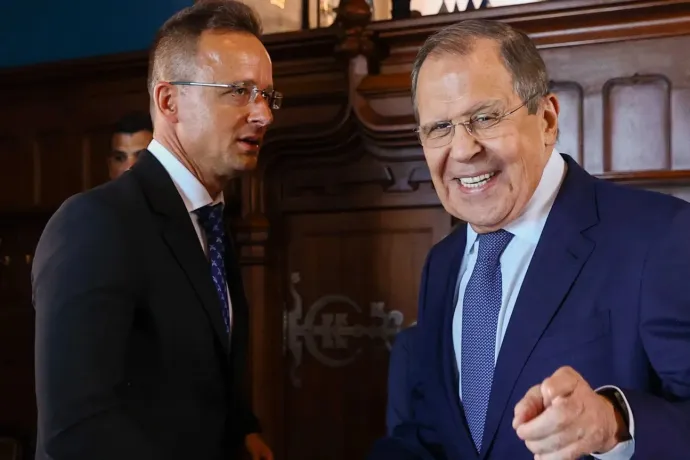


“I had absolutely nothing to do with the wiretapping of Szijjártó – it took me years and a great deal of effort to finally obtain evidence of this communication. Besides, practically everyone knows Szijjártó’s number, even the CEO of the smallest foreign company operating in Hungary has it,” Szabolcs Panyi, investigative journalist for Direkt36 and VSquare told Telex on Monday, after Mandiner (a paper with close ties to the government – ed) published an audio recording intended to expose him.
The recording features Szabolcs Panyi and an unidentified female voice. Among other things, the journalist talks about being in contact with a government agency of an EU country, but the pro-government press was quick to spin the story and claim that it was in fact Panyi who had given Péter Szijjártó’s phone number to a foreign intelligence service.
Szijjártó called it shocking that “one or more foreign intelligence services had wiretapped him with the active cooperation of a Hungarian journalist,” and Viktor Orbán instructed the Minister of Justice to investigate the matter immediately, because this constitutes a serious attack against Hungary. All this happened two days after the Washington Post reported that during the breaks in his EU meetings, Hungarian Foreign Minister Péter Szijjártó regularly coordinates with Russian Foreign Minister Sergey Lavrov by phone about what is happening there.
In the leaked recording, Szabolcs Panyi also mentioned that he maintains good relations with Anita Orbán, (no relation to the Hungarian PM) the Tisza Party’s foreign policy expert, whom he referred to as his “quasi-friend.” The journalist later explained that he was actually trying to “show off and impress” with his connections in the hope of obtaining information, thinking that this might encourage the other party to reveal more; but in reality, he had only met with the Tisza Party’s foreign policy expert on two occasions.
The ruling party labeled Szabolcs Panyi a “traitor,” but according to opposition leader Péter Magyar, if Szijjártó did indeed collude with Lavrov, then it is these consultations that constitute treason, which is punishable by life-long imprisonment. According to Panyi, who was previously monitored with the Pegasus spyware, the incident was merely a “preemptive strike” by Fidesz to try to discredit his upcoming investigative piece, even though there is nothing unusual about an investigative journalist working with intelligence sources.
Someone was listening
Szabolcs Panyi responded to Mandiner’s early morning article within a few hours with a lengthy social media post. He wrote that the published recording contains a conversation between him and one of his sources that “someone had eavesdropped on”. He told Telex that the conversation published by Mandiner took place sometime in the past six months, but said he could not disclose any specifics about who he was speaking with due to source protection.
Instead, Panyi repeated what he had already written in his post: this is a confidential source from whom he had hoped to obtain details about how Szijjártó is leaking sensitive EU information to the Russians during breaks in the meetings. He asked the source for the phone numbers he believed “Szijjártó and Lavrov have used to communicate with each other.” He intended to cross-reference these with information received from the national security service of a European country to determine whether the Hungarian Foreign Minister was only using two phone numbers for these conversations or if there was a third one used for more sensitive “agent-to-agent communication.” When asked if he suspected the conversation might be recorded, Panyi replied, “Of course not.”
Well-founded European suspicion or a preposterous conspiracy theory?
The Washington Post published an article on Saturday, in which they wrote – citing Western intelligence officials and an internal report they had obtained – about ongoing coordination between the Hungarian and Russian foreign ministers, which would essentially mean that the Kremlin has been receiving immediate information on virtually every EU matter for years. The paper also claimed that a unit of Russia’s Foreign Intelligence Service (SVR) “issued an alert” last month due to Viktor Orbán’s plummeting popularity. Consequently, Russian officials suggested turning the tide of the Hungarian campaign by staging an assassination attempt against Orbán.
Péter Szijjártó dismissed the Washington Post’s claims about a staged assassination attempt as “preposterous conspiracy theories” and lies that are part of Ukrainian propaganda. He only reacted to the claims about him holding separate talks with the Russian Foreign Minister after Polish Prime Minister Donald Tusk remarked: “It should come as no surprise to anyone that Viktor Orbán’s people are passing information to Russia.” According to Szijjártó, Tusk is spreading fake news and lies.
However, citing five EU diplomats and officials, Politico reported on Monday that EU decision-makers are looking to effectively exclude Hungary from sensitive negotiations because they fear the Hungarian government is leaking information to Russia.
But how acceptable is it for a journalist to maintain contact with intelligence sources? According to Panyi, being a journalist specialising in national security, he has been working on uncovering Russian influence in Hungary for more than a decade, and although this genre is still not widely recognised here, working with national security sources is part of the job. “Just as the Washington Post reported that Péter Szijjártó is leaking information to Sergey Lavrov, citing a European intelligence source, I too work with similar sources. Mainly those who have information about the activities of Russian spies and agents. That’s how I began investigating Szijjártó’s leaking as well. For example, I obtained national security-related documents detailing the communication between Szijjártó and Lavrov,” Szabolcs Panyi said in response to our question. According to the journalist, one reason why an EU national security service was able to record the conversations between the Hungarian and Russian foreign ministers was that Szijjártó communicated via regular GSM – that is, mobile phone calls – on an unsecured line, even during strictly protected EU meetings.
Szijjártó to Lavrov: We have a rather big favour to ask of you
In the recording published by Mandiner, Panyi also recounted the incident he had previously written about in an article: a phone conversation between Sergey Lavrov and Péter Szijjártó that he claims took place in 2020. In March 2024, the journalist reported in Vsquare’s English-language newsletter that he had learned: Szijjártó helped arrange a meeting in Moscow for former Slovak Prime Minister Peter Pellegrini with the aim of helping the Social Democratic-nationalist president secure an election victory.
On Monday morning, Panyi published the exact transcript of the conversation in question. According to the journalist, among others, Szijjártó said the following to Lavrov at the time (quotation verbatim): “I don’t want to bother you, but the prime minister asked me to do it, because we have kind of a big plea for you. As you know, there are elections coming up in Slovakia on 29.02, and it is of key importance for us that the coalition there would continue. I understand that this may sound strange coming from Hungarian conservatives, but we are hoping for Social Democrats, as they are only rational force in Slovak political landscape, and the only ones who are acting without foreign interference.” Panyi claims that the conversation was recorded by the national security service of an EU country.
The Office of the Slovak President responded to 24.hu regarding the Szijjártó-Lavrov conversation, stating that President Peter Pellegrini “has no intention whatsoever of becoming involved in the Hungarian election campaign.”
“This person has nothing to do with the Tisza Party”
Another thread in the conversation published on Mandiner is that in the leaked recording, Panyi can be heard mentioning that he has a good relationship with the Tisza Party’s foreign policy expert, Anita Orbán, whom he refers to as his “quasi-friend.” In the audio recording, the journalist stated verbatim, “I’m not part of her campaign team, but maintaining my journalistic independence in a situation where I’m on good terms with Anita on the one hand, and I help her with certain professional matters on the other, can be difficult.” He then added that he would be able to make recommendations about who should and should not work at the Ministry of Foreign Affairs in the event of a change in government.
In response to a question from Telex, Panyi explained that he had said all this because he was trying to pretend he had greater influence. “I was simply trying to gain the source’s trust here, in the hope that they might reveal further details about the communication between Szijjártó and Lavrov; I acted as if I had some influence – which, of course, I do not. On my part, it was clearly a mistake as a journalist to try to motivate my source by speaking in this way.” According to him, he couldn’t get anyone fired from the Foreign Ministry; “I was showing off, trying to appear more influential than I am in front of my source, hoping that they might reveal more. As I said, that was a mistake on my part,” said Szabolcs Panyi.
Anita Orbán also spoke up on the matter, with the Tisza politician calling the statements made in the recording lies. According to her, all that happened was that before 2010, there had been talk of Panyi joining her campaign staff when she was running as a Fidesz candidate. However, over the past two years, she had only met the journalist twice. Panyi confirmed this as well, stating that he does not work for the Tisza Party and does not advise Anita Orbán. Following Anita Orbán’s post, we sent additional questions to the Tisza Party, asking whether Panyi assists the Tisza Party’s work either officially or informally, and what documents Anita Orbán would allow journalist Szabolcs Panyi to review in the event of a potential change in government, and on what basis she would do so. The Tisza Party summed up its response in a single sentence: “The person in question has nothing to do with the Tisza Party; under a Tisza government, he would not be allowed to view any documents.”
Two wiretaps
There are, then, two different wiretaps at the center of this complex case. In one, a Hungarian investigative journalist was the one wiretapped; in the other, a foreign minister. In addition, the latter recording reveals that it was actually the Russian foreign minister, not the Hungarian one, who was being wiretapped. As Panyi claims, the Szijjártó – Lavrov recording was then leaked to him by the national security service of an EU member state.
The question arises: how is this possible? This can happen because sometimes even allied countries spy on one another. For example, it came to light this past January that the German Federal Intelligence Service (BND) regularly monitored phone calls made by former U.S. President Barack Obama while aboard Air Force One. According to information from Die Zeit, the German intelligence service did not receive authorization to monitor Obama, and German Chancellor Angela Merkel was not informed of the matter. Obama, however, was aware of Angela Merkel having been previously wiretapped. The U.S. National Security Agency (NSA) had, in fact, tapped her cell phone for years. And in fact, Direkt36 recently published an investigative report revealing that Hungarian intelligence agents working under diplomatic cover had approached several European Commission employees, with the aim of having them rewrite European Commission drafts.
How often are journalists wiretapped, and how legal is this? In justified situations, a government may monitor journalists using intelligence tools, but if a government agency wishes to secretly record a conversation, it requires authorization from a judge or the Ministry of Justice; however, the justification for wiretapping is often handled quite “flexibly.” At the same time, it is very rare for such materials to be made public, as this would require the lifting of legal secrecy.
Szabolcs Panyi was one of the Hungarian citizens whom the government had previously monitored using the Pegasus spyware. It came to light in July 2021 that the Israeli spyware, which can be installed on mobile phones, had been used in Hungary since 2018 to monitor, among others, Hungarian journalists and media owners critical of the government. This software had access to all the data on the targeted phone and was capable of turning it into a listening device. Authorities denied having used the spyware for months, then admitted that the Ministry of the Interior had purchased and deployed the tool, which, as it turned out, had been authorized by then-Minister of Justice Judit Varga.
While the Hungarian government maintains that the program was used lawfully, the Strasbourg-based European Court of Human Rights has condemned Hungary in several rulings, stating that the regulation of secret surveillance does not provide adequate safeguards, particularly because authorization for surveillance for national security purposes is not subject to independent judicial review but is authorized by the Minister of Justice – however, the full execution of these judgments has yet to take place. The Pegasus case, meanwhile, has shown that this is not merely a theoretical problem, but one that exists in practice. In 2023, the European Parliament also called on Hungary to ensure that surveillance for national security purposes be subject to independent, prior judicial review.
An important distinction is that if the recording is made by a private individual – rather than the state – without the other party’s consent, and the recording is made public, then the individual is committing a crime. This notwithstanding, a great many such recordings circulate in the media, and audio recordings are leaked particularly frequently during election campaigns.
A book on the influence of Russian intelligence in the works
According to Panyi, since he has been collecting materials and evidence regarding Szijjártó’s leaking for years, it was actually "unpleasant" for him to not be the first to break the story – that honor went to the Washington Post – but he believes it would be difficult to compete with the author, Russia expert Catherine Belton. He did announce, however, that he has been working on an investigative book since 2022, in which he will attempt to demonstrate “how Russian intelligence services have infiltrated Hungary, the Hungarian state, and the Hungarian political elite.” “I can perhaps reveal this much: the overall picture is extremely alarming,” he wrote in a post, adding that it's not about the Russians having returned to Hungary – because they have in fact, never left – and added that the relationship between Szijjártó and Lavrov is merely the tip of the iceberg.
András Pethő, the editor at Direkt36, also responded to the matter involving Szabolcs Panyi. He wrote: “The background conversation heard in the recording was not part of an article Szabolcs was preparing for Direkt36, but was for an independent project of his, namely a book he is currently writing.”
We sent questions on the matter to the Prime Minister’s Office, led by Antal Rogán, which oversees the intelligence services. We asked them whether the services had warned Péter Szijjártó to use a secure line for foreign affairs-related and diplomatic discussions, and if the minister was indeed wiretapped, why Hungarian counterintelligence was unable to protect him from it. We will report on it as soon as they respond.
For more quick, accurate and impartial news from and about Hungary, subscribe to the Telex English newsletter!