Russia is big, but its resources are not infinite; replacing those who have been expelled from Hungary will be difficult
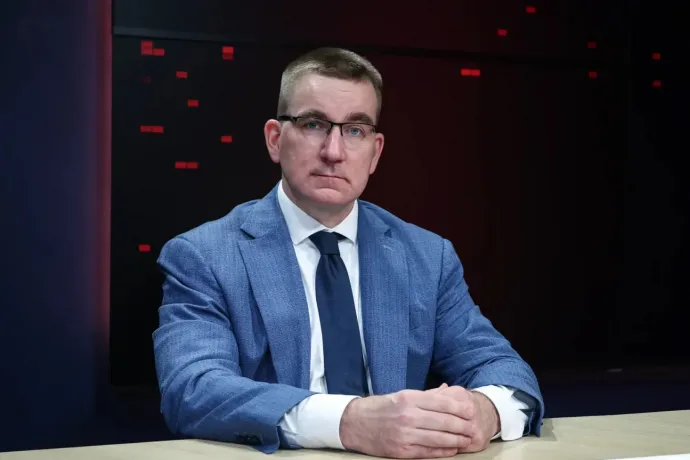


The 1961 Vienna Convention on Diplomatic Relations stipulates that anyone working abroad in a diplomatic capacity is obligated to comply with the laws of the host country and may gather information only using legal means. “That’s usually the diplomatic terminology for talking about a diplomat having been caught spying,” — András Rácz, Russia expert and Deputy Director General of the Hungarian Institute of International Affairs, told Telex when talking about the Hungarian Foreign Minister’s announcement about the expulsion of ten Russian diplomats from the country.
Rácz gave a live interview to Telex the day after Foreign Minister Anita Orbán announced on social media and Prime Minister Péter Magyar announced in Parliament that the Hungarian government would expel ten Russian diplomats from the country because they are suspected of having engaged in espionage in Budapest. This move sends two messages—one to the Russians and the other to our Western allies—but the essence of both is the same: a new era is dawning in Hungary’s relations with Russia. We spoke about this with the expert on Wednesday at Telex’s studio.
Who could they have expelled?
There are many intelligence officers working at every Russian embassy—as András Rácz explained. The SVR handles foreign intelligence, while the GU (formerly the GRU) handles military intelligence, and both have had agents stationed at embassies for quite some time. At one point, the FSB—which had previously focused on domestic counterintelligence—also became involved in foreign intelligence. Thus, bigger Russian embassies have agents from four different organizations working there—including the diplomats. Each of them may have diplomatic cover, but the person in question may also be a driver or a spouse. Spies “recruit human intelligence sources”—at least that’s how it used to work during the Cold War. They may also recruit people based on incriminating information or ideological affinity.
It has not been revealed who the expelled individuals are. It is standard practice that neither Russia nor the affected country publicly disclose the names of those involved, the expert explained. In many countries, of course, the names of those who are accredited can be seen, and changes in this list allow conclusions to be drawn. Someone might become more famous, at which point it may come to light that they were expelled. Of course these names circulate within the information system between NATO countries.
As for the timing of the Hungarian decision, Rácz said he could not say more due to national security concerns. “This is part of the diplomatic toolkit,” he continued. According to him, there are several ways of asking a diplomat suspected of espionage to leave. This can even be conveyed informally—perhaps at a reception. “And then there is a solution […] where the host country’s ambassador is summoned and handed a note stating that Ivan Fyodorovich will have to leave the country.” He pointed out, however, that in U.S.-Russian relations, for example, expulsions are generally accompanied by significant media coverage.
The Russian answer
Rácz also spoke of the professionalism of Maria Zakharova, the spokesperson of the Russian Foreign Ministry, who was the first to offer an “explanation” by invoking Russophobia. The Russian Ambassador to Hungary, Yevgeny Stanislavov also talked about “ideologically motivated anti-Russian rhetoric,” merely rephrasing the Foreign Ministry’s reaction.
“This is primarily intended for their domestic audience, and to a lesser extent for the international community,” Rácz said of the Russian Foreign Ministry’s response. He considers this a boilerplate response, and said that Zakharova’s statement carries no real weight.
Rácz could only speak in general terms about how Russia might react to Hungary's move. The typical Russian response is a tit-for-tat approach: if a country expels ten diplomats, the Russians will expel the same number. He recalled that when the Czechs expelled a large number of diplomats in 2022, the Russians expelled a few more than they had done. Toward the end of Barack Obama’s presidency, several dozen Russian diplomats were sent home from the United States, but following President Vladimir Putin’s intervention, the Russians decided not to expel any Americans.
“As the Russian system becomes increasingly closed (...), we know less and less about how decision-making happens there these days,” Rácz explained. Administratively speaking, decisions must be made within the Russian Foreign Ministry, but under the constitution, the president is in charge of foreign policy. There are cases personally overseen by Putin, but it is unclear whether that is the case here.
“Hungarian taxpayers will have to foot the bill,” the head of the Russian upper house said following the expulsions. As for whether there will be an economic response, Rácz said that what members of the Russian parliament say falls more into the category of entertainment. “If anyone isn’t going to be making decisions about this, it’s the Russian parliament; this statement is intended for domestic consumption alone,” Rácz said of the warning. Parliamentary elections will be held in Russia on September 18–20, so this is a time when “the political atmosphere is more charged.” These statements may serve to show voters that no one should mess with Russia, he opined.
As for the construction of Hungary's second nuclear power plant in Paks, it is governed by detailed international treaties, but the conditions for withdrawal are unknown—that information is classified. It is unclear whether Russia could withdraw from the Paks II project, but according to Rácz, that would not be logical. For them, the Paks expansion is not about the power plant itself. Rosatom is the world’s biggest nuclear industry company, and building a power plant in an EU and a NATO member state serves as a global benchmark for them. “They would be shooting themselves in the foot—with a cannon,” if they were to withdraw from the project.
The limits of Russian diplomacy
Russia is big, but its resources are not infinite; it tends to follow the domestic policies of bigger countries more, and has more scenarios for dealing with them, Rácz pointed out. As far as big countries are concerned, Russia has no shortage of resources. “In the case of smaller, non-Slavic-speaking countries, however, this is a constant problem,” said András Rácz. It is particularly difficult for them to find suitable people in Greece and the countries of the Caucasus.
Losses in such places are always difficult to make up for; most of the staff at the embassy in Budapest don’t even speak Hungarian. If a Russian diplomat has a very high level of proficiency in a lesser-known language, that’s when one might start to get suspicious.
Rácz noted that after February 2022, when hundreds of Russian diplomats were sent home from the European Union within a matter of days, Hungary did not join this process. In the Czech Republic, the Russian embassy’s staff was reduced from over 100 to 18. Rácz does not recall there ever having been a similar large-scale expulsion from Hungary, but said he is not familiar with the data from the period around the change of regime.
According to him, from the Russian perspective, it makes sense to increase their numbers in places where there are no expulsions; and Hungary was such a place for years. Russian spies “make very active use of the Schengen Area,” they travel extensively within Europe, and have conducted many operations outside of Hungary. He also noted that Hungary could, in theory, break out of its previous diplomatic isolation through these expulsions, which could help restore trust with the West, which was lost during the Orbán era. If most members of an alliance take a certain action but one country does not—and then later catches up—this can help strengthen trust.
For more quick, accurate and impartial news from and about Hungary, subscribe to the Telex English newsletter!