New Hungarian President enters office amidst high expectations, with limited powers, yet prepared for conflict
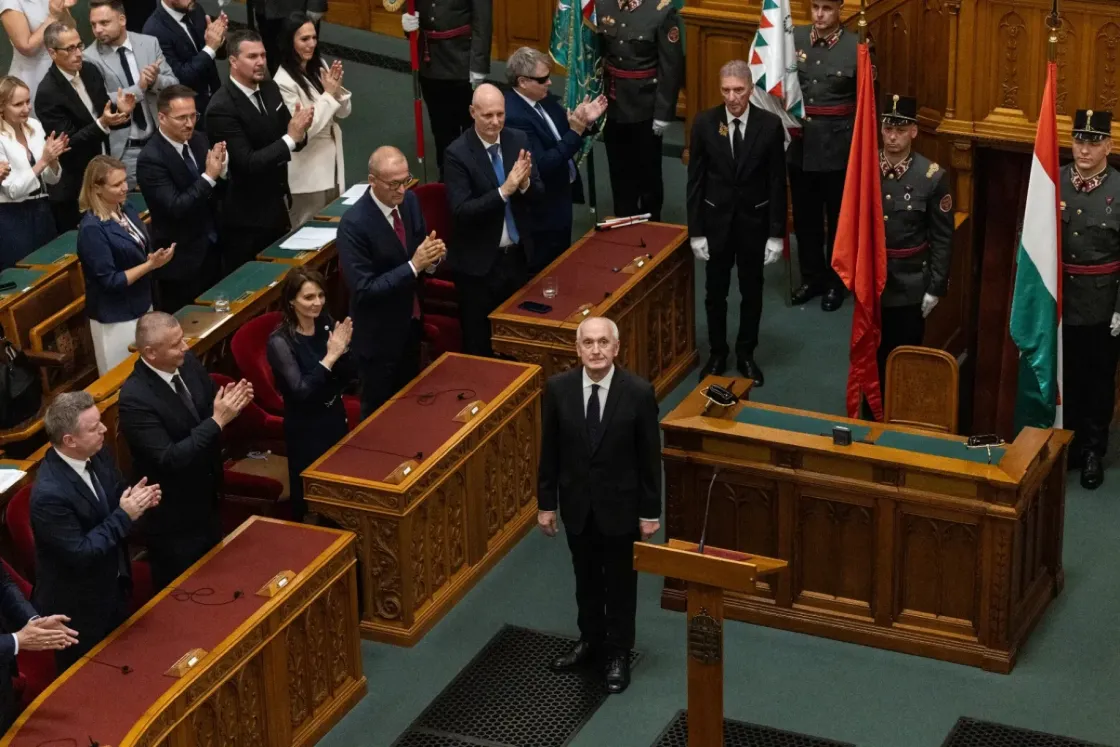


Hungary’s new president, András Baka is taking office on Wednesday. He considers safeguarding constitutionality, fostering social dialogue, helping restore international relations and caring for the Hungarian communities living beyond the country’s borders to be his main tasks. Parliament elected the Tisza Party’s candidate—who previously served as a judge at the European Court of Human Rights and as president of the Supreme Court—with 140 votes last Tuesday. After taking the oath of office, he said that as head of state, he would like to work to ensure that people with different interests and beliefs can live together peacefully and resolve their disputes within a regulated framework rather than through force.
There is no doubt that Baka is facing a difficult task. Both analysts and a broad segment of the electorate are expecting him to restore the institution of the presidency—which has been completely hollowed out over the past sixteen years of Fidesz rule— and to serve as a balance to the Tisza Party’s two-thirds parliamentary majority, as an actor independent of the government. However, the current Fundamental Law does not grant him much authority in this regard; nearly every decision he makes requires either a ministerial countersignature or a parliamentary vote.
“In the Hungarian public law system, the president is more of a symbolic figure—a symbol of national unity and the sole embodiment of national sovereignty,”
—constitutional law expert Péter Stánicz said to Telex, noting that under the Hungarian constitutional system, the President of the Republic isn’t able to define their role as a check or counterbalance, as is the case in France, for example. In Hungary, the head of state is assigned a much more cooperative and proactive role.
However, according to Stánicz, a great deal depends on what understanding of his role Baka chooses to adopt as president and which issues he intends to speak out on. He actually touched on this in his speech last Tuesday. He stated that the authority of a democratic institution does not stem from its operating without conflict, but from its ability to remain true to its mission even in situations of conflict. This suggests that, unlike his predecessors elected by Fidesz, he will be prepared to engage in conflict and speak out if he disagrees with a decision made by the government or Parliament.
While under the current constitutional system, he is unable to intervene in any substantive way, if he, as President, publicly expresses his opinion, it could still carry political weight and have significant implications. The conditions for this are all in place: he can speak at Parliament before the agenda at any time, and he can also exert pressure on the government or on Parliament through interviews, statements, and other public appearances to urge them to change their decisions. In his first speech, he also said that as President, he will not be able to solve every social problem, but he will have the opportunity to direct attention to issues and social groups whose voices are heard less often.
The guardian of constitutionality
According to the Fundamental Law, the primary duty of the President of the Republic is to “embody the unity of the nation and to safeguard the democratic functioning of the state.” Baka said that in his interpretation, this means political neutrality but it certainly does not mean neutrality in terms of values. In his view, as President, he can strive for national unity by always recognizing the legitimacy of differing views, as well as majority and minority positions, and
his duty is not to “create artificial consensus where it does not actually exist, but rather to represent the fact that citizens holding differing views are equal members of the same nation.”
According to Baka, national unity does not mean that we all think the same way, but rather that we all belong to the nation and have equal rights. In saying so, he broke with the previous Fidesz and Orbán-era view that anyone who did not support the previous government—which claimed to represent the nation—was a traitor representing foreign interests.
The truth is that embodying national unity will be difficult for Baka, considering that Fidesz–KDNP views him as illegitimate due to Tamás Sulyok’s removal, and Mi Hazánk also did not support his election. This is precisely why Baka, in addition to criticizing the system built by the Fidesz-KDNP government, and demanding justice, sought to reach out to the opposition voters by calling on the current government and the majority to exercise restraint. He said that the country cannot be built on revenge, and disappointed voters must also be able to feel at home in the country without having to renounce their political convictions or their faith.
While the concept of national unity is rather abstract, the President’s role in ensuring constitutionality is much more clear-cut. One of Baka’s most important duties will be to review and promulgate the laws passed by Parliament. If he disagrees with the content of a bill, he may exercise his veto power to return it for reconsideration once. At that time, he also has the opportunity-either in Parliament or in public-to explain why he considers the decision in question to be flawed. Parliament is not obligated to take the president's concerns into account; it may even adopt the bill again in its original form.
If, however, the president deems the adopted legislation to be contrary to the Fundamental Law, he may refer it to the Constitutional Court for review, which may even annul it. In recent years, this tool has only been used on rare occasions; upon his election, (Fidesz-appointee) Pál Schmitt, for example, vowed that he would be the engine of governance rather than a brake, and said that he would sign every law with a willing heart. And he fully lived up to this commitment.
Baka would also break with this approach, as he previously said that signing laws cannot be a mere formality for the president:
“The president should not consider themselves an extension of the parliamentary majority or the government in power, and should not remain silent when fundamental issues of constitutional functioning are at stake.”
In his view, in recent years, the ruling party took the state hostage, undermining the democratic system based on the separation of powers and checks and balances. “It is the responsibility of all of us to ensure that such a system never emerges in Hungary again,” declared Baka, who, as president, intends to contribute to this by the consistent, transparent, and independent exercising of his own constitutional powers.
His first speech also made it clear that he would, in some form, like to participate in the public consultation and preparation of the new constitution, which is set to begin this fall. As president, his job is not to determine the content of the new constitution, but he believes it is his duty to “encourage public and professional debate, to represent the openness and impartiality of the process, and to consistently advocate that the process of drafting the constitution should not become the exclusive domain of any single political force.”
Stánicz also pointed out that the president has the authority to initiate amendments to the Fundamental Law, as well as the adoption of a new constitution. Furthermore, the president’s symbolic role could take on greater significance during the constitutional process: according to the constitutional lawyer, the president is able to simultaneously embody and represent both the nation’s diversity and unity.
A more active diplomatic role, the nomination of the Chief Prosecutor
In addition to the above, the Fundamental Law assigns the president a number of other tasks, some of which are substantive and others merely formal. Perhaps the most notable of these is the power to grant pardons. The president has the authority to reduce or commute a sentence after a final court ruling. Since July 2024, this no longer requires ministerial countersignature. Previously, a pardon took effect only after being countersigned by the Minister of Justice, but after Katalin Novák’s clemency scandal, Fidesz abolished this requirement and transferred the sole political responsibility to the President of the Republic. Tamás Sulyok did not want to take any risks: in 2025, he only granted four pardons, and in the first half of this year, he rejected all 314 petitions.
The President of the Republic puts forward nominations for the positions of Prime Minister, President of the Supreme Court, President of the National Judicial Office, Prosecutor General, and Commissioner for Fundamental Rights, who are then elected by Parliament. We will soon find out what kind of personnel policy Baka envisions, since-due to the recent resignation of Gábor Bálint Nagy-a new Prosecutor General must be elected at the end of August.
There have previously been examples of the Parliament not accepting a nominee put forward by the President: In 2006, László Sólyom’s nominee, Miklós Horányi, was not elected Chief Prosecutor, so the President was forced to nominate a new candidate. His second nominee, Tamás Kovács, the Chief Military Prosecutor, enjoyed the support of the parliamentary majority at the time. Sólyom was also the one who nominated András Baka for the position of President of the Supreme Court, but the Parliament voted him down twice; in the third round, however, he was elected to the post in 2009, in part thanks to the votes of Fidesz representatives, only to be removed from office by Fidesz two years later.
Under the Fundamental Law, Baka is free to forego prior consultation with the Tisza faction and nominate a person for the position of Chief Prosecutor who is unacceptable to the majority. According to Péter Stánicz, however, the President's goal cannot be to prevent the filling of the position or to hinder the operation of the Prosecutor General’s Office; rather, as the initiator, his duty is to support the proper functioning of the state. “Essentially, he must nominate a person who has a realistic chance of being approved by Parliament.”
In addition to nominating individuals, the President of Hungary may also propose legislation. The only one who has exercised this authority since 1990 was Árpád Göncz, who submitted three bills to Parliament. Only one of these, the one granting a general pardon to the participants in the taxi drivers' blockade was adopted. Baka may also call for a national referendum if he wishes to discuss an important social issue, but no head of state has ever exercised this right since 1990.
As president, he will play an important role in diplomacy and will represent the country at several high-level negotiations. Although shaping foreign policy is primarily the responsibility of the government and Foreign Minister Anita Orbán, Baka believes the head of state has a unique opportunity to help strengthen Hungary’s international relations.
He said he would like to help restore the country's deteriorated relations with its allies, which he considers to be of national interest. As far as his foreign policy orientation is concerned, his first speech indicated that he believes Hungary's place remains in Europe.
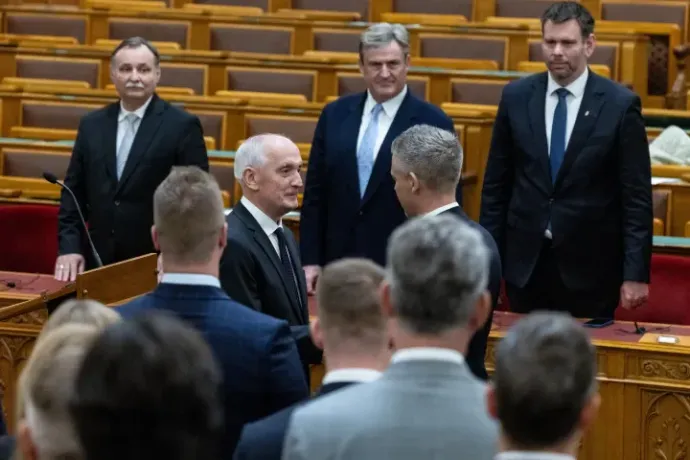
András Baka will be the one to welcome ambassadors arriving in Hungary, and he will also present numerous honors, awards, and titles. One day after taking office, on August 20, he will be awarding state honors alongside Péter Magyar and Ágnes Forsthoffer at the Hungarian Parliament.
The president is also the Commander-in-Chief of the Hungarian Defense Forces, but of course this does not mean that he will be handing down orders to the military from now on. It is more of a formal role, just like the appointment of ministers, state secretaries, judges, university rectors, generals, and the governor of the central bank. The president schedules elections, convenes the inaugural session of Parliament, and, under the Fundamental Law, also has the authority to dissolve Parliament. However, he or she may do so only if the body fails to elect the Prime Minister proposed by the President within forty days at the beginning of the legislative term, or fails to adopt the budget for the given year by March 31. Given the Tisza Party’s two-thirds majority, however, this scenario is highly unlikely.
A residence, a driver, and a private plane
András Baka will take over the Presidential Palace (Sándor Palota) from House Speaker Ágnes Forsthoffer on Wednesday, since she has been temporarily performing the duties of head of state after Tamás Sulyok was removed from office.
According to the law, the President of the Republic is entitled to
permanent personal protection, a presidential residence, a secretariat, a car, a driver, a telephone, and free health care.
The president's salary is 1.1 times that of the House Speaker, currently amounting to 4.19 million forints gross, and this amount will increase next March in line with the average wage.
When travelling abroad on official business, he may use a private aircraft, and if travelling on a scheduled flight or by train, he may only travel in first class or its equivalent in terms of travel comfort. As President of the Republic, Baka will also be entitled to use the government's lounge at the airport and the government’s official holiday resort.
He will also receive an annual allowance from the central budget for charitable donations and contributions, which amounts to 73 million forints this year.
András Baka’s wife, Katalin Kövesdi, may also request a two-person secretariat at the Presidential Palace if her participation in public life warrants it. In addition, she is also entitled to using an official vehicle. In the event of the President’s death, the widow is entitled to a one-off payment equal to the President’s six months’ salary, after which she receives a widow’s pension.
Upon leaving office, former presidents are entitled to numerous benefits for the rest of their lives. The law provides them with a residence managed by a housekeeper, with the state also covering the maintenance costs. A former president may keep a three-person secretariat and is entitled to free health care, a car and driver. For the rest of their life, former presidents receive the same salary as the current president. For official trips abroad, even after their term ends, they may travel first class by plane and train, but they may no longer use a private plane.
According to Amendment 17 of the Fundamental Law, the 73-year-old András Baka’s term of office will last until the new Constitution enters into force, but for no longer than five years.
For more quick, accurate and impartial news from and about Hungary, subscribe to the Telex English newsletter!