Orbán: Young people see Fidesz as old, tired, and boring
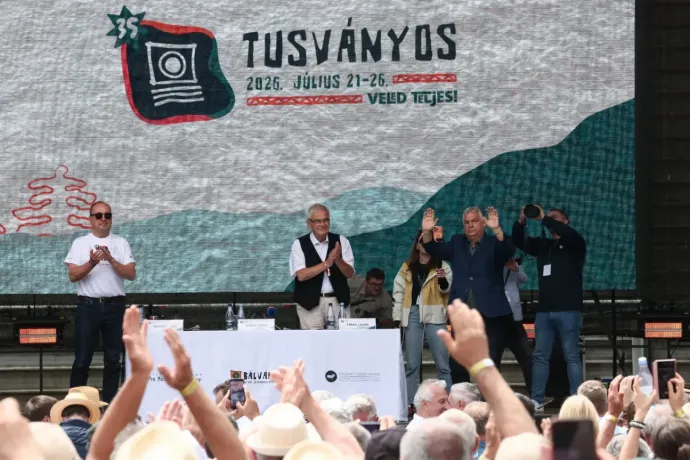

The Bálványos Free Summer University and Student Camp (more commonly known as Tusványos) has been organised in Băile Tușnad (or Tusnádfürdő) Transylvania since 1990. Over the years it became a large-scale intellectual workshop of the Carpathian Basin, with tens of thousands in attendance. It was originally intended to promote cross-border cooperation, Romanian-Hungarian dialogue and a cultured political exchange between Hungarians with differing opinions. According to critics, during the four consecutive Orbán governments after 2010, it had become a place where members of the Orbán government and representatives of the intellectual establishment close to the regime were able to express their ideas without substantive debate. It was here that Viktor Orbán first spoke about building an “illiberal democracy’ in 2014, and his speeches have become the highlight of the event and are largely considered to be marking the direction of Fidesz’ politics for the year ahead. This year, for the first time in sixteen years, Fidesz's longtime leader spoke as an opposition politician before a crowd eager for direction following the party's historic election loss in April.
Orbán began his speech with a nostalgic comment: “We’ve been meeting here for 35 years; this is a special place—a place of understanding”, he said. According to the former prime minister, this year’s event is particularly special, because he was again invited to participate as a member of the opposition.
Turning to the current situation in Hungary, he noted that the approach they have taken so far needs to change, and that instead of focusing on understanding the current global situation, the emphasis needs to shift back to understanding Hungary’s situation. “Let us understand what this unusual, new Hungarian phenomenon is,” Orbán said.
Still finding it hard to describe the new reality in Hungary
He characterized the reality that has unfolded in Hungary since April 12 as “hard to describe”. According to him, Hungary is barely recognizable these days, but-as he put it-we love it just the same.
Referring to the recently adopted, seventeenth amendment to the Fundamental Law, which introduces a 12-year limit for serving as a member of Parliament, he said: “They have barred us from running in future elections”, adding that this spells “the end of democracy.” He argued that with the departure of the President of the Republic, the President of the Constitutional Court, and the Chief Prosecutor, the rule of law has been dismantled, which amounts to a criminal offense, in his opinion.“This is not significant just yet, but once we restore the rule of law, it will matter a great deal,” Orbán said, his words prompting loud applause.
He then turned to his experiences during his recent trip to the United States. In his view, certain political practices currently seen in Hungary are reminiscent of South American left-wing regimes rooted in communist traditions.
“Hungary is the new Venezuela, only without the oil wealth”.
He explained that as he sees it, this is an accurate description of the situation, because the processes used to marginalize political opponents and the legally questionable procedures currently seen in Hungary are quite similar to the events which occurred in Venezuela under the communist regime.
In his opinion, the creation of a new state authority to crack down on political opponents is reminiscent of the 20th century. He was likely referring to the National Agency for the Recovery and Protection of State Assets (Nemzeti Vagyonvisszaszerzési és Védelmi Hivatal-NVVH), which the Magyar government intends to set up to investigate and recover misused state assets during the past sixteen years of Fidesz governance. According to Orbán, “only the communists and Hitler have done something like this before. We know how that ended.”
Viktor Orbán believes that a virus has attacked Hungary. There are many ways to describe it, he said, but he would stick with the terms “autocracy” and “authoritarian regime.” In his view, the government’s actions will have serious economic consequences. “This is a bad system that calls into question things on which there used to be a public consensus.”
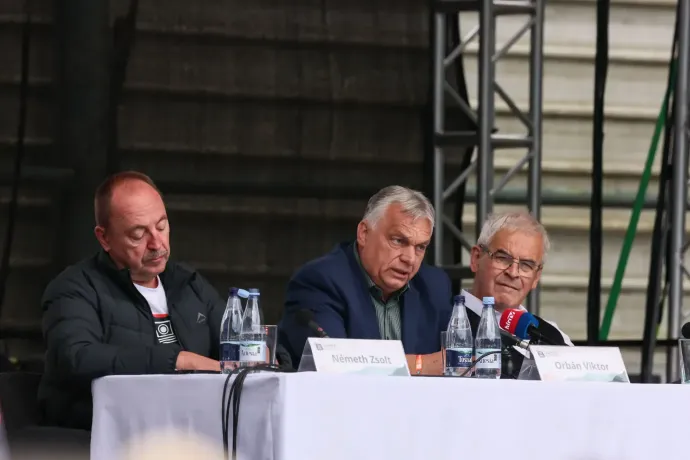
According to him, the government is targeting small and medium-sized enterprises which have had dealings with local governments, and it will now be possible to subject any economic actor to legal proceedings based on a single citizen’s complaint. This was likely a reference to several lower-ranking Fidesz politicians having been detained or arrested by Hungarian police in recent weeks, after authorities have uncovered a more than a decade-long ring which used various methods to divert public funds into their own companies. Police are also investigating complaints about embezzlement and budgetary fraud linked to the last Orbán government’s minister of culture. The former minister’s assistant was placed under arrest just a few days ago.
“This is a fantasy”
The former prime minister said that it has become difficult to distinguish between reality and fiction, and many people are convinced that everything will be better now. “They think they’re seeing reality, but they’re sitting in a movie theater. This is a fantasy,” Orbán said, adding that, just as this was true under the old communist regime, no one can feel safe in Hungary today. He concluded by saying that, in his view, Tisza is building an authoritarian system and is looking to eliminate political alternatives by making “illegitimate decisions.”
“The roughly 3.5 million people who voted for Tisza still believe that this authoritarianism will only be used against Fidesz supporters, but they are mistaken,” he said. “I don’t think those who voted for change this spring voted for such abuse of power.”
He believes there is a place for critical self-reflection after the election, but there has been little time for that in this case. Consequently,
“instead of the opposition engaging in self-reflection, we must shift to a strategy of political resistance,” Orbán said.
“The prime minister who is now turning the country upside down came from our ranks,” he said. “If there is anything I need to apologize for, then it is this, because Péter Magyar is the one responsible for the rampage we are now seeing,” he said.
“We must not allow those in power to continue lying to the people without consequences. We must tell people the truth about the looming economic crisis. I did that during the campaign, with little success,” the former prime minister added.
“What we are seeing is governance via Facebook, it's like a movie, a dog and pony show” he said. In his view, talking about the introduction of the euro is code for austerity measures, which is why speculators and banks support the euro’s introduction in Hungary, according to him.
The youth are being misled
In Orbán’s view, young people have been led to believe that anything European is good, which poses hidden dangers. As an example, he mentioned that we have previously been made to believe that the green transition is a good thing, “even though we now know that it’s a tragedy,” he said. In his view, the EU's foreign policy is “leading us into war.”
The Fidesz chairman believes that the reason why it is so easy to make young people believe all this is that they have not yet witnessed Brussels’ failures. “We saw this even before 2010, but to a newborn, every joke is new,” Orbán said. According to him, it must not be forgotten that over the years, Hungarian voters have on numerous occasions reaffirmed their support for Fidesz with a two-thirds majority.
“People only found problems with the last four years, which is what they said no to,” he said, noting that, in his view, in April's election, voters did not reject all 16 years of Fidesz governance.
“We must push back against the smug accusations of the Tisza Party,” he said, adding that, in his opinion, Fidesz has accomplished great things.
He believes that the younger generation currently sees Fidesz as “old, tired, and boring,” but when hard times come, it is precisely these qualities that will make them an attractive alternative. He said that this is why János Bóka must continue to lead the parliamentary group well in the meantime, so that people can see that “if necessary, we can be called upon at any time.”
What is next for Fidesz?
Fidesz's community must stick together, but unfortunately, “they cannot protect everyone", he said. “Once democracy is restored, we will provide full redress to the victims and to those who have incurred losses,” he said. He then turned to what Fidesz must do now.
“Our most important task is to stand up against autocracy. Let’s build up the resistance. After all, we come from a history of being underground; I, too, have been taken in by police under an autocratic regime before,” Orbán said.
In his view, Fidesz must do something new, something different from what it has done over the past 16 years. The faction's traditional political approach is necessary, but according to Orbán, that alone is not enough; Fidesz must do more.
“We shouldn’t be preoccupied with questions of power. Fidesz’s role is to serve the national resistance. The goal is to restore freedom; Fidesz must not function as a party, but rather as a service center, an incubator, and a nursery. We must support communities that love freedom,” Orbán said.
“The only question is when it will become clear that the Tisza's system is unsustainable,” Orbán asked, before revealing what he believes the answer is: What will happen to the new government will become clear on the 134th day.
“Resistance will grow day by day, the camp of freedom will grow." Until then, he believes Fidesz must stand by its voters.
While having nearly 2.5 million voters behind them was a good result, it’s not enough for a majority. Orbán believes the masses needed for victory will eventually rally behind Fidesz due to widespread dissatisfaction.
He cited examples from Slovenia, Poland, and Austria to illustrate that a defeated leader can make a comeback—which is why he believes there is a chance for that in Hungary as well. In the meantime, we must stand with those who are speaking out. “Tough times are coming, and we are going to fight,” Viktor Orbán said, concluding his speech, which was followed by a storm of applause from the audience.
For more quick, accurate and impartial news from and about Hungary, subscribe to the Telex English newsletter!