Orbán was stalling for time, now Kyiv hopes that Péter Magyar is genuinely seeking an agreement
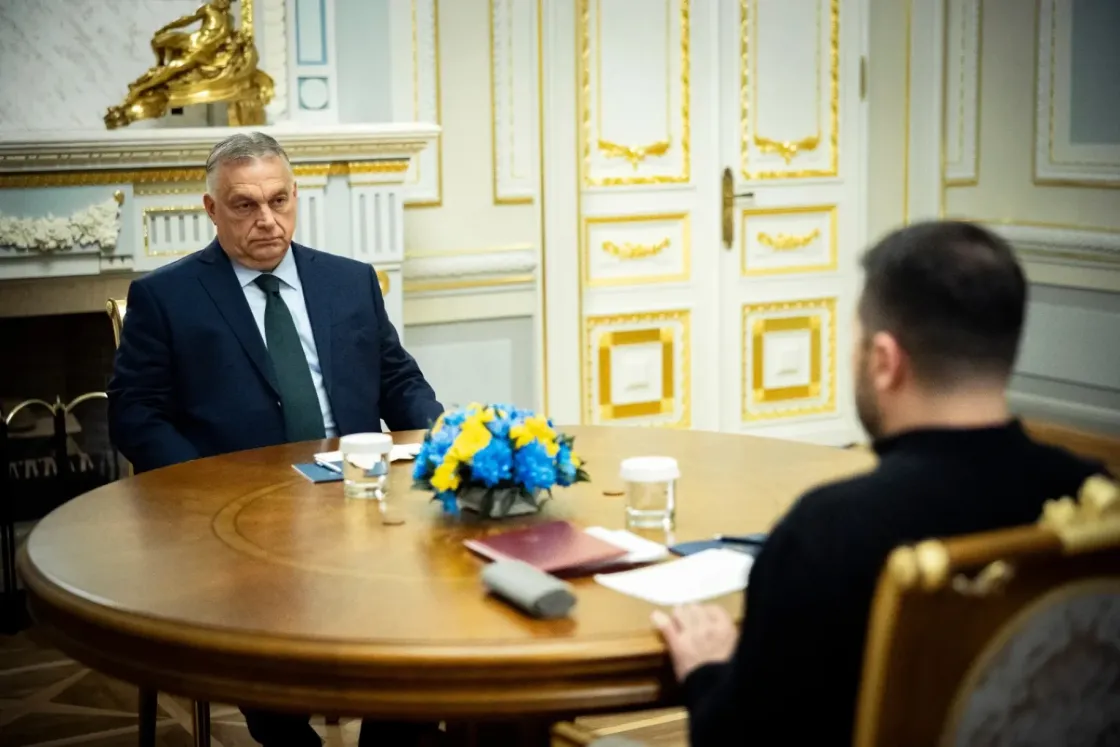


Ukraine has not yet provided a definitive answer to Péter Magyar’s proposal to meet with Volodymyr Zelensky as soon as possible after he has assumed office, but it has indicated a willingness to engage in dialogue with the new Hungarian government. Despite the wait-and-see approach, the Ukrainian president is cautiously optimistic that relations between the two countries can finally be mended; the relationship had been steadily deteriorating under the Fidesz government during a decade-long dispute over the language rights of the Hungarian minority in Transcarpathia. The relationship hit rock bottom with Russia’s 2022 invasion, as Viktor Orbán regularly threatened to veto European Union aid to Ukraine, citing the shortcomings of the minority law—and later the suspension of the since resumed crude oil deliveries on the Friendship pipeline.
Although the Deputy Prime Minister responsible for Ukraine’s European integration indicated on Wednesday that he supports establishing contact with the new Hungarian government as soon as possible, Taras Kachka did not mention a specific date. A swift positive response from Ukraine, which is necessary for a high-level meeting, may be somewhat hampered by the fact that Magyar published a post on Facebook in which he – taking a relaxed approach to diplomatic protocol – formulated a preliminary demand which has not been relevant for years.
“Higher education remains monolingual in Ukraine, high school graduation exams are in Ukrainian, and there have been no substantive changes in other official areas of language use,” – Magyar wrote, even though it is actually possible to take the high school graduation exam in Hungarian, what's more, a university degree can even be earned in the natural sciences through a program taught in Hungarian. Changes have also occurred in regard to using Hungarian in the official and cultural activities of the Hungarian minority.
There is no doubt that more can be done when it comes to the use and visibility of the Hungarian minority’s language, but Magyar’s post, which listed demands that had actually already been met, may have caused some uncertainty among the Ukrainian leadership, which—during the term of the outgoing Hungarian government, especially in the last three years—felt that Orbán had no real desire to reach an agreement. After all, in the last few years, neither the amendment of the language provisions in the controversial education law, nor the postponement of the law’s implementation, or even its complete repeal did anything to improve relations.
In fact, regardless of amendments to the controversial law, the Hungarian government kept growing increasingly dismissive of Ukraine’s EU integration. And yet, as recently as March 2022, it had supported the accelerated launch of accession negotiations; but later came to reject such talks in any form. In Fidesz's 2022 election campaign, Ukraine was portrayed as an enemy, and by this year’s election, the outgoing government’s narrative presented it as a neighbour that could even pose a military threat to Hungary.
Neither the increasingly absurd accusations, nor covering the country in billboards with Zelensky's face could save Fidesz from a crushing election defeat in 2026. By this point, with his constant vetoes, objections, statements condemning Ukraine and refusing to treat it as a state, all the remarks accusing the EU of warmongering, and the leaked, subservient-toned conversations with the Russian leadership, the suspicion that Orbán was acting as Russia’s Trojan horse within the EU continued to grow. We reported on what Members of the European Parliament think of Orbán in this on-site video report.
Thus, Kyiv is still unsure as to what can be expected from the Tisza Party’s government, which is set to take office in the coming days. This likely explains why there has been no public response yet to Magyar’s proposal to meet with Zelenskyy in early June “in Berehove, a town with a Hungarian majority.” Hungary's incoming prime minister said the purpose of the meeting would be to address the situation of the Hungarians in Transcarpathia and to help them remain in their homeland. However, there seems to be a positive outlook within the Ukrainian leadership, which Zelenskyy’s statement hints at as well: “We may not have resolved everything yet, but to be honest, I don’t see any real problems,” the Ukrainian president told Bloomberg.
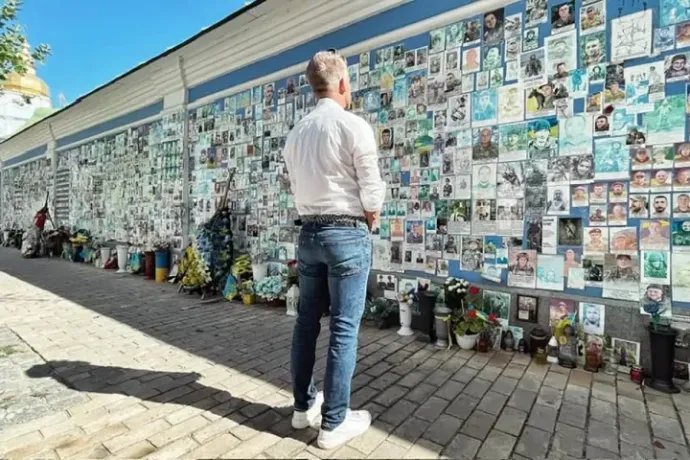
The fact that Magyar visited both Kyiv and Bucha in July 2024 may also bolster confidence. Orbán had visited the Ukrainian capital shortly before, but he did not visit the site of one of the bloodiest war crimes committed by Russia. It may also build up trust that the soon-to-be-inaugurated prime minister has never downplayed Putin’s responsibility for the war, unlike Orbán, who once even referred to the attacked neighboring country as a “territory called Ukraine” and suggested that it also bore some responsibility for the war.
Ukraine has been a punching bag long enough
Over the past three years it had become clear in Ukrainian diplomatic circles that Orbán had decided to focus his election campaign not only on criticising Brussels but also on portraying Ukraine as an enemy, which is why he refused to negotiate about the Ukrainian education law passed in 2017. However, this does not mean that the Hungarian objections were entirely unfounded; after all, the text of the law did indeed imply that, over time, the scope of education in Hungarian would become gradually restricted in Transcarpathian Hungarian schools.
At first, Ukraine did not take these objections seriously enough. They argued that the real goal was to reduce the influence of the Russian state, and that other ethnic minorities had nothing to fear. In practice, however, there was cause for concern. For minorities speaking an official EU language—Hungarians, Poles, Romanians, and Slovaks—the proportion of classes taught in Ukrainian would have gradually increased from 40 percent in fifth grade to 60 percent by the end of high school. Under the law, students would have been required to take the final high school exam—which also counts toward admission to university—entirely in Ukrainian.
The Ukrainians were soon forced to amend Article 7 of the Education Law, which dealt with language provisions. First, following a review by the Venice Commission, non-state—that is, private and church-run—schools had to be excluded from the scope of the law. In practice, this change affected very few people: of the nearly one hundred Hungarian-language schools in Transcarpathia, only five—accounting for barely 3–4 percent of students—fell into this category, plus the requirement to take the final exam in Ukrainian would have still remained.
The frequent use of the conditional here is no coincidence. The implementation of Article 7 of the 2017 law was postponed several times, and at the end of 2023, the article itself was repealed. Part of the Hungarian objection, therefore, was related to a law that ultimately never came into effect—though it is true that the Hungarian government’s advocacy may have played a role in this. This means that currently, in schools providing education in Hungarian, only Ukrainian language and literature, Ukrainian history, and civics must be taught in Ukrainian; everything else is taught in Hungarian. The national high school graduation exam is also administered in Hungarian.
As a result, it is still possible to take entrance exams in Hungarian for the II. Ferenc Rákóczi College and the University of Uzhhorod, where students can not only study Hungarian language and history but can also pursue natural science majors in Hungarian. In other words,
Hungarian-language education is currently guaranteed in Transcarpathia from elementary school through university.
However, although this was never part of the Hungarian side’s objections, the quality of classes designed to help students learn Ukrainian has remained very low. At first glance, this may not seem important for sustaining the Hungarian community in Transcarpathia, but in reality, it represents a disadvantage. A lack of proficiency in the official language of the country isolates the minority in question, reducing its opportunities to advocate for its interests and succeed economically, and ultimately accelerates emigration from an already dwindling community.
This is not only true now, five years into the war started by Russia, but also in peacetime.
Legislative initiatives have never substantively addressed this, despite the fact that the effective teaching of the Ukrainian language itself would not be a bad thing. The education law cited this as a reason for increasing the proportion of classes taught in Ukrainian. However, this approach touched a sensitive nerve among the minority and, on top of that, would not have helped achieve the desired goal. Ukrainian legislation and education policy were reluctant to accept that the Ukrainian language should be taught as a foreign language to the national minority, with an adequate number of lessons. It is also true that there are not enough qualified teachers for this either.
In other words, the main demands had been met, but Hungarian-Ukrainian relations remained just as tense as before. In fact, they may have even become worse, because the Hungarian government did not truly acknowledge the substantive change. Not only did it downplay the changes, but it also shifted the focus of its criticism of Ukraine: the emphasis was no longer on the language use of the Hungarian minority, but on Ukraine’s EU accession in general, which culminated in Alexandra Szentkirályi’s (Fidesz politician) iconic video, warning of Ukrainian organ-trafficking kidnappers to instill fear.
The Orbán government wasn't that interested in their own 11-point list
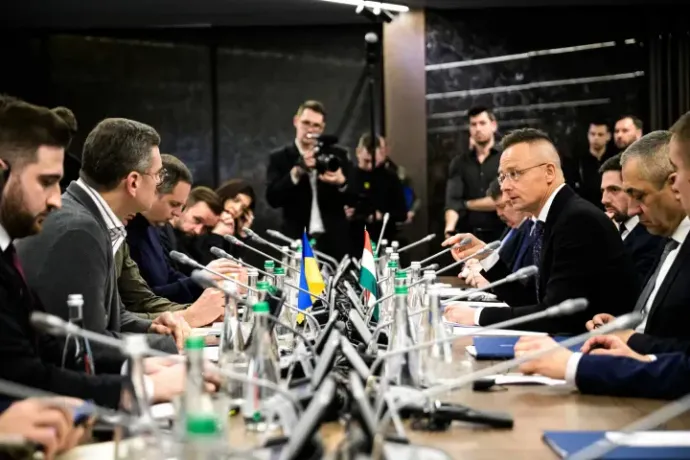
Péter Szijjártó held talks with his Ukrainian counterpart at the time in Uzhhorod in January 2024. The Minister of Foreign Affairs and Trade handed Dmitro Kuleba an 11-point list of demands and said that it was not the 2017 status quo that needed to be restored, but the one from 2015: that is, the rights guaranteed by the language law adopted in 2012—which was repealed three years later following pro-Russian President Viktor Yanukovych’s flight to Russia, Russia’s annexation of the Crimean Peninsula, and the establishment of Russian-backed breakaway states in eastern Ukraine—must also be guaranteed.
The controversial law was proposed by Yanukovych’s once-powerful party, the Party of Regions (PR). One of the two members of parliament who spearheaded the initiative, which was financed by Russia, now lives in Russia. The law elevated the Russian language to the status of an official language in most of the country—in some places essentially replacing Ukrainian—effectively granting it a much broader scope of use than the languages of other national minorities. In 2012, the Venice Commission—which, in line with the Hungarian government’s objections, had already compelled amendments to the 2017 education law discussed above—stated that the language law ultimately does not protect the Ukrainian language itself against Russian.
Clearly, Moscow’s objective with the law was to maintain and strengthen Russian influence, but only Ukraine’s post-Yanukovych parliament, which sought Western integration, was able to repeal it. Although the initiative was launched as early as 2014, it was not implemented until 2015, and it was not until 2018 that the Constitutional Court ruled that the 2012 language law itself was unconstitutional. Incidentally, Russia invaded Crimea and brought much of the Donetsk and Luhansk regions under its control through separatists specifically referencing the 2014 parliamentary initiative.
Kövér sought help from the Speaker of the Russian State Duma
However, while the 2012 law was created in the interest of the Russian language, it also sought to involve minorities: it set the ethnic minority threshold at 10 percent, in which case it would have allowed for the minority language to be used in the region in question instead of Ukrainian. It also defined the concept of a “region” quite broadly, even breaking it down to individual villages, so the Hungarian minority would have had the right to use their language in more places. Moreover, all of this was based on data from the census in 2001, according to which there were 150,000 Hungarians in Transcarpathia, a region of 1.2 million people, so the Hungarian language was granted regional status even at the county level. Today, this proportion is likely below 10 percent, due to the influx of settlers from other parts of the country because of the war and the emigration of members of the Hungarian community: the size of the Hungarian community is currently estimated at 80-90,000.
The Hungarian side was so committed to this law—which remained in effect for barely three years—and to the rights it was intended to guarantee based on 2001 data that in 2017, László Kövér wrote a letter to the speaker of the Russian Duma asking for assistance. The Fidesz House Speaker asked Vyacheslav Volodin to ensure that Russia does everything in its power to restore the language law in Ukraine. It is also no coincidence that in a 2024 interview with Tucker Carlson, Russian President Vladimir Putin stated that the Hungarian minority in Ukraine yearns for unification with Hungary, and that Hungary’s territorial claim, while perhaps not legally justifiable, is “at least understandable.” In doing so, the Kremlin sought to give the impression that it was not alone in its claims on Ukraine.
The Hungarian government drafted the aforementioned 11-point list, which Szijjártó presented in Uzhhorod in 2024, based on the repealed language law. Ukraine did not reject it outright, but no progress was made. According to Ukrainian government sources, this is because the Hungarian side did not actually want to reach an agreement, as it seemed more useful to Orbán’s camp—even during the 2024 EP campaign—to portray Ukraine as an enemy than to secure an agreement guaranteeing the protection of the minority.
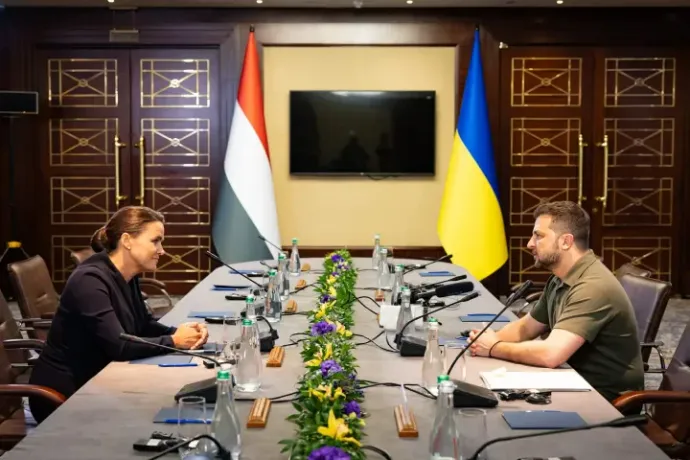
Nevertheless, there was a brief period when the Ukrainian government also felt that there was, after all, a willingness on the Hungarian side to reach an agreement. Admittedly, the signal did not come officially from the government, but from the President of the Republic, Katalin Novák, who traveled to Kyiv in August 2023 and held private talks with Zelenskyy. The Ukrainian President had reportedly feared beforehand that Novák was merely playing the “good cop” alongside the “bad cop,” Szijjártó. After the meeting, however, he concluded that Novák was acting independently and genuinely wanted an agreement. Six months later, however, she was swept away by the clemency scandal.
Since then, there has been virtually no substantive progress, not even during Orbán’s visit in July 2024, when the Ukrainians would have been willing to discuss the 11-point list of demands they received in January. There were no serious behind-the-scenes discussions during the visit to Kyiv.
On the contrary, it was a cordial conversation, which was followed by nothing at all. And the little bit of optimism the visit had sparked was completely shattered by the fact that Orbán went straight to Putin for talks after Kyiv. In Kyiv, they concluded that Orbán is still just stalling for time and has no real plan about the 11-point list submitted by his own government.
Szijjártó said one thing, but then snubbed the Ukrainian delegation
Yet, according to the Ukrainian side, the willingness to take the 11 points seriously is documented as part of the discussions with the EU. Even so, it was all for naught that Olha Stefanyishyna, the Deputy Prime Minister responsible for EU integration met with Szijjártó’s deputy, Levente Magyar, last April and acknowledged that there was a rational basis for the Hungarian government’s objections pertaining to minority rights. It was also to no avail that Stefanyishyna’s successor, Taras Kachka visited Hungary last fall and held talks with Minister of Foreign Affairs and Trade Péter Szijjártó. According to Kachka, the discussions were constructive, and Szijjártó reportedly showed willingness about the possibility of an agreement; yet that very same day, the Hungarian Minister of Foreign Affairs and Trade posted that Ukraine alone was responsible for the poor relations between the two countries. “I can’t say that we’ve reached the lowest point in our relationship, because who knows whether it can get any worse—unfortunately, that can’t be ruled out,” Szijjártó said.
“He essentially told us to go to hell,” a Ukrainian diplomatic source remarked about Szijjártó’s post. There has been no official response to the willingness for an agreement, which was received positively by the Hungarian side during the one-on-one talks—although it has at least become clear that there won’t be one until after the election.
According to the Ukrainian side, all that is needed is to clarify exactly what kind of arrangement the Hungarian side—that is, the soon-to-be-formed Tisza government— now expects. Ukrainian officials have indicated that it could easily be resolved to have the law recognize ethnic minority schools again, rather than ethnic minority classes, as is currently the case. This would provide a more convincing institutional guarantee that Hungarian-language education can be maintained, provided there are enough children among the rapidly dwindling, emigration-prone ethnic Hungarian population.
“The current legal framework for minorities makes no reference to national cultural autonomy,” noted László Zubánics, pointing out a glaring shortcoming. However, according to the president of the Democratic Alliance of Hungarians in Ukraine (UMDSZ) and a lecturer at Uzhhorod University, the old regulations also failed to fill the concept itself with meaningful content. According to Zubánics, defining cultural autonomy would be the primary task. He believes there is a willingness within the Ukrainian leadership to make this a realit; at most, they are averse to the term “autonomy” itself, since this was the very term Russia used as a pretext when it ultimately launched a war of conquest against Ukraine. Significant progress has been made, however, with regard to the use of minority symbols.
“The Hungarian flag can now be displayed, and the Hungarian national anthem can be sung at any event,” said Zubánics.
There is also no obstacle preventing the Hungarian community from holding official events in its own language. The current language law, adopted in 2018, no longer automatically requires that organizers provide interpreting into Ukrainian, the financial and technical arrangements for which would have had to be provided by the organizer. Now this obligation is much more limited. Simultaneous interpretation is required only if a sufficient number of people request it in writing in advance.
According to Zubánics, it is justified to object to the part of the law stating that placing bilingual street and city name signs is not automatic even in areas where the Hungarian population officially reaches 10 percent. In such cases, the consent of the local government is still required. He said that this should not depend on such specific consent. The Ukrainian side appears ready for this; and progress has hitherto been hindered precisely by the lack of substantive responses from the Hungarian government.
There are also rules that are fine in and of themselves, but there may still be legitimate expectations. One example Zubánics cited is the regulation and description of the content of vocational education conducted in minority languages, which complies with EU regulations but does not yet impose sufficient obligations on the government to adequately publicize the opportunity and properly inform potential applicants. In the absence of this, Hungarian-language vocational education may not materialize in practice, even if the opportunity is nicely described on paper.
“There is no issue that the Ukrainians would be unwilling to agree on from the outset,” said Zubánics, describing the current favorable moment. However, progress requires a mutual willingness to reach an agreement and genuine dialogue. The practical forum for this at the present time would be the loosely defined Hungarian-Ukrainian education working group, but the Hungarian-Ukrainian Joint Committee established between the two states to guarantee the rights of minorities would be even more suitable for the purpose. However, it has not met even once since its founding in 2011—that is, for 15 years.
For more quick, accurate and impartial news from and about Hungary, subscribe to the Telex English newsletter!