The Sovereignty Protection Office, which spent billions on communication, took two and a half weeks to speak up after the election
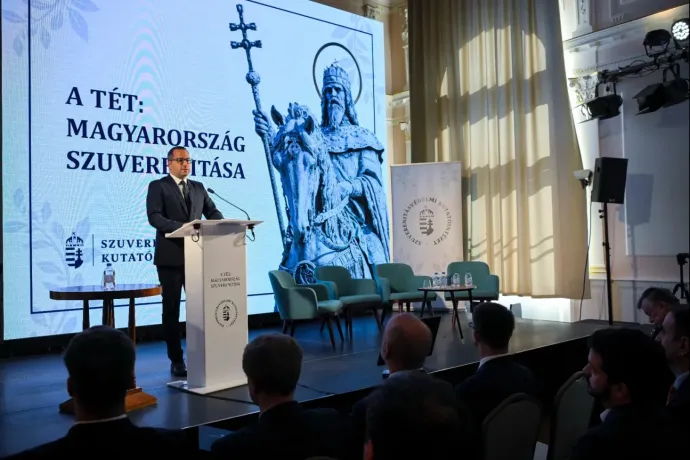


Hungary’s sovereignty could be in serious trouble since the elections, as its appointed protector, the Sovereignty Protection Office, has been completely silent for two and a half weeks. The office, led by Tamás Lánczi, last posted on its social media page on April 11, the day before the elections, and then 18 days later, its head, Tamás Lánczi attempted to substantiate his claim that Fidesz lost the election due to foreign intelligence interference by falsely interpreting a quote from a Telex article, as well as that for the same reason, the protection of Hungary's sovereignty, as well as their office have been “under attack” from the very beginning. What's more, Lánczi posted this on Wednesday shortly after Telex contacted him.
Péter Magyar was quick to comment, shortly after arriving in Brussels: “We will immediately abolish the Sovereignty Protection Office, which has served as a political cudgel and financial drain. By doing so, we will save six billion forints worth of public funds.”
The initial post-election silence of the Sovereignty Protection Office could still be attributed to shock, but 18 days of silence certainly raised questions. For example, why did the office sign a contract for communication services worth 1.289 billion forints for the period between October 2024 and June 2025, and then another one worth 865 million forints from July 2025 to the end of January 2026 with New Land Media and Lounge Design, if its communications capabilities only lasted until April 11? Both companies are linked to Gyula Balásy, who, even weeks prior to the elections, had signed contracts worth billions of forints with the Prime Minister’s Office headed by Antal Rogán.
The Sovereignty Protection Office is a unique creation of the Orbán-regime. The office, billed as an independent state agency, effectively served two functions. On the one hand, the government used this organization to try to legitimize its political narrative that NGOs, journalists, and papers critical of the government actually pose a threat to the country’s sovereignty. This is why the Office launched investigations against the parties of the opposition coalition, Transparency International Hungary, and Átlátszó, and why Lánczi claimed that Telex was serving foreign interests.
In December, the Budapest Metropolitan Court of First Instance had already ruled against the Office for violating the good reputation of the investigative portal Átlátszó. Meanwhile, in a completely absurd turn of events in this lawsuit, the Sovereignty Protection Office attempted to argue that the “reports” they published were not facts, but merely opinions. Moreover, their truthfulness cannot even be examined. And this is no joke. Átlátszó published the appeal filed by the Sovereignty Protection Office, in which they wrote: the lawsuit against them must be dismissed, and in their view, the court should not even be able to examine the factual accuracy of their claims (!), because “these actually constitute professional opinions that cannot be empirically proven.” Some examples of how the SPO worked are discussed in our previous video report on the subject.
It is, however, clear that the office functions as a kind of payment center. They have entered into contracts with law firms close to NER for legal advice, and until September 2028, they are renting the premises on Budapest's Rákóczi út for a gross total of one billion forints, with the rent indirectly flowing to István Szeivolt, a major entrepreneur associated with the circle of Lőrinc Mészáros and István Tiborcz. And then there is also the billion-forint communications contract that the office signed.
The Sovereignty Protection Office does not even have a public phone number.
This is particularly interesting in light of the fact that, since its establishment in February 2024, the office’s activities have largely consisted of regularly attacking actors who are independent of the government but are critical of it, accusing them of lacking transparency.
In contrast, almost nothing is known about the people working at the Sovereignty Protection Office. All we know is that it has three leaders who are all, in one way or another, linked to Fidesz and who receive salaries in the millions for working at the office. In addition to Chairman Tamás Lánczi, Deputy Chairman Gergely Berzi is also a Fidesz cadre, as is János Szablics. None of them can be reached, and all three have the same email address listed as their contact information at the office. The executives receive generous compensation. Tamás Lánczi’s gross monthly salary, for example, is 5.483,520 forints, (15 thousand euros) and he also receives other benefits. The other two executives also earn over 3.7 million forints (10 thousand euros) per month.
Given these salaries, it is even more surprising that Tamás Lánczi has also disappeared from the public eye. The last time the chair of the SPO last posted on his social media page prior to his statement today was twenty days ago, on April 9. This is particularly unusual because up until then, he had been posting something almost every day. Not only has Lánczi disappeared from social media, but he has also not appeared in Fidesz-aligned media outlets since the election.
Although the law on the Office for the Protection of Sovereignty stipulates that the head of the office may not be a member or official of a political party or party foundation, may not engage in political activities on behalf of or in the interest of a political party, and may not speak in public in the name of or for the benefit of a political party, Lánczi has even joined the digital civic circle founded by Defense Minister Kristóf Szalay-Bobrovniczky.
Meanwhile, the SPO was spending more and more money, and it clearly was not skimping on expenses.
- While 1 billion 81 million 155 thousand forints were spent on salaries at the office before the end of June last year, according to data uploaded on October 30, this figure had increased to 1 billion 678 million 676 thousand forints.
- Of this, the amount spent on wages rose from 957.6 million to 1.4656 billion forints.
- Other payments increased from 61.9 million to 106.5 million forints.
- Non-wage benefits went from HUF 29.9 million to HUF 70.2 million, clothing and transportation allowances from HUF 4.25 million to HUF 6.73 million, and other benefits from HUF 27.5 million to HUF 29.6 million.
Or, for example, they paid Áron Máthé 10.7 million forints for writing a book. This amount is equivalent to the advance for a bestseller on the book market. Máthé did write the book, entitled "The Origins of Hungarian Sovereignty" I. – From the Beginnings to 1437.
József Horváth, Fidesz’s in-house intelligence expert also works at the Sovereignty Protection Office; he began his career in the late Kádár era at Subdivision III/III-4-b of the Ministry of the Interior. This sub-department was tasked with counterintelligence operations against former and active party members, Trotskyists, and pseudo-leftists classified as “sectarians.” After the 1989 regime change, Horváth successfully transitioned into the secret service of the democratic regime, but he did not remain in this role for long. A long-time Fidesz-sympathizer, he has in recent years morphed from a national security expert into a propagandist for the government. He, too, has not made any media appearances since the elections.
For more quick, accurate and impartial news from and about Hungary, subscribe to the Telex English newsletter!