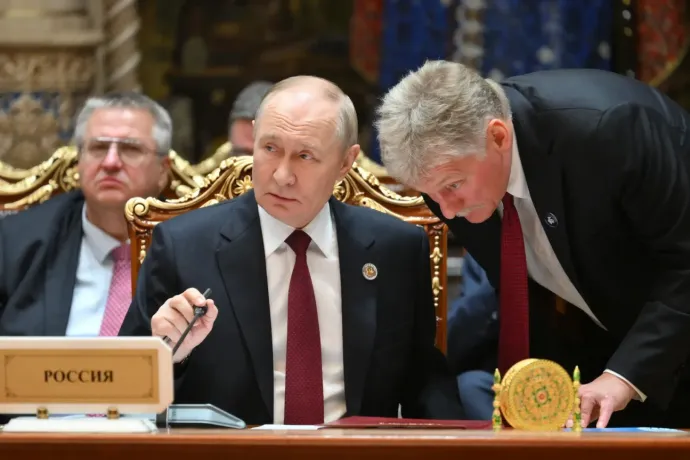


“We have never been friends with Orbán”-this statement, attributed to the Kremlin spokesperson, has been making the rounds in both the international and Hungarian press. Most of those citing it have referenced The Guardian as a source, but it was in fact not uttered in exactly this form, even though Dmitry Peskov’s words about the nature of Russian-Hungarian relations until now and their expected future course certainly carry this meaning.
It is nevertheless significant whether the Kremlin spokesperson actually made a statement of this exact nature with regard to a friendship or its absence, because far-reaching conclusions have been drawn from it about the swift and dramatic rejection of Orbán, whom many European politicians have regarded as Putin’s Trojan horse.
Peskov has made several statements in recent days, but nothing like the above quote can be found anywhere. He has consistently spoken of the possibilities for continuing practical relations, thereby defining the nature of their relationship with the Fidesz government as well.
The leaked telephone conversations between Péter Szijjártó and Sergey Lavrov, as well as between Orbán and Putin, however, indicate a more informal relationship, which raises serious questions. According to the leaked materials, the Hungarian Minister of Foreign Affairs and Trade spoke to his Russian counterpart in a rather subordinate tone, and even offered his immediate assistance in obtaining an EU document. It is unclear what the classification of this document was, but if it was publicly available, Lavrov's requesting it constitutes a rather spectacular display of servility on the part of the Hungarian diplomat; if, however, it was a document containing classified information, the matter could be subject to even more serious scrutiny. And the fact that Orbán likened Hungary to a mouse offering assistance to Russia, which was portrayed as a lion, is quite unusual in diplomacy.
At any rate, regardless of the statements made by the Tisza Party chairman, Peskov did indicate that they are ready for dialogue with Péter Magyar’s government. At the same time, the fact that Magyar clearly stated Putin’s responsibility for the war in Ukraine was not exactly widely reported in the Russian press, which is under state control.
“In politics, there is a difference between making statements before one takes a country’s helm and after one has done so. Once one sits in that chair, a more practical approach—so to speak—comes into play. And that is what we will hope for”, TASS quoted the Kremlin spokesperson as saying. “We are open to dialogue and relations based on goodwill, and we will monitor what direction [the formation of the Hungarian government] takes. Whether the direction will be as pragmatic as before is hard to say at this point,” he said.
Where did the “We were never friends” quote come from?
The quote at the beginning of the article, ultimately attributed to Peskov, appears to have been pieced together from several statements published in the press: One was made by Georgy Bovt, a political scientist and journalist—formerly an active member of several opposition parties permitted by the authorities—whose article was published under this very title. “It was never a friendship with Orbán; the dialogue with Budapest continues”—however, this is not a quote from Peskov, but Bovt’s own summary, stating that matters have always been handled on a practical basis and this will continue to be the case; there was therefore no emotional plus in the past, the absence of which would pose an obstacle to a similar approach with the new Hungarian government.
The other source was a post by journalist Alexander Yunashev, in which he quoted Peskov as saying: “We do not send congratulations to countries that are not our friends. And Hungary is not a friendly country, because it supports the sanctions currently in place against us.” Hungary was added to this list in March 2023; the list has been continuously expanding since the war launched by Russia against Ukraine in 2022. (The first two countries on it were the United States and the Czech Republic, though the Kremlin made an exception for Donald Trump, congratulating the Republican president on his return in November 2024.)
Yunashev also wrote: “In response to my follow-up question asking whether this meant that Moscow had made friends exclusively with Orbán, Peskov replied: ‘We engaged in dialogue with him.”
The word “friendship” was thus indeed mentioned in the question—though Peskov did not use it himself—but the summary combined it with the title of Bovt’s analysis. The emphasis throughout was that the relationship had always been pragmatic and, if Budapest so desires, it will remain so.
Until now, Russia has sought to present its relationship with the Hungarian government as a model for EU member states, with the message that there may be disagreements, but there can still be specific issues where cooperation is possible based on shared interests. Hungary’s usefulness lay precisely in the fact that the Kremlin was hoping that the model provided by its relationship with Hungary would allow it to undermine the unity of the EU and NATO on a broader scale, which could have potentially been used to reduce Western support for Ukraine.
However, this did not come to pass, and with the departure of the Hungarian government—which had previously threatened to veto further financial aid to Ukraine—this scenario now seems even less likely. Admittedly, the suspension of oil and natural gas shipments through the Strait of Hormuz—closed by Iran in response to U.S. intervention—could trigger a global shortage, which might in turn change the EU’s stance toward Russian energy sources currently subject to sanctions. All of this, however, extends far beyond the question of whether there was ever a friendship between Orbán and Putin, and even beyond what the Kremlin’s relations with the new Hungarian government might look like.
For more quick, accurate and impartial news from and about Hungary, subscribe to the Telex English newsletter!