Szijjártó says Putin didn't ask for anything in exchange for releasing POWs
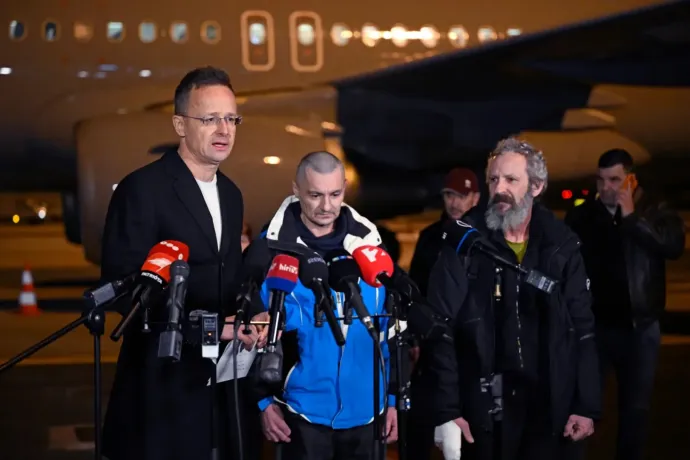


Early Thursday morning, two prisoners of war who hold both Ukrainian and Hungarian citizenship arrived in Budapest from Moscow after they were released on Wednesday. They flew to Hungary with Foreign Minister Péter Szijjártó who had been in Moscow for a meeting with Vladimir Putin on Wednesday. Speaking at Liszt Ferenc Airport after arriving, Szijjártó said that Russian President Vladimir Putin had not asked for anything in exchange for releasing the two men.
In response to a question from RTL, Szijjártó said that it was the rational foreign policy which stands with both feet firmly on the ground that had led to the unconditional release of the prisoners of war.
The Foreign Minister said that they contacted the Russians after one of the POWs had appealed to Viktor Orbán in a video message and the mother of the other POW had contacted them. Orbán spoke to Vladimir Putin on Tuesday and asked him to consider releasing the two POWs. "We have decided to release the two prisoners of war, as requested by the Prime Minister [Viktor Orbán], and they will be able to take them along on the plane they came with and will take them back to Budapest," Vladimir Putin announced on Wednesday.
The ethnic Hungarians from Transcarpathia who fell into Russian captivity have been the subject of the Hungarian government's communication and pro-government media for some time now. For example, in its program entitled The Horrors of War, the public television recently broadcast videos in which ethnic Hungarians from Transcarpathia held captive by Russia expressed their gratitude to their Russian captors for allowing them to survive. Tamás Hoffmann, a lawyer specializing in international law and associate professor at the Department of International Relations at Corvinus University of Budapest, told Telex that broadcasting such videos could be interpreted as a violation of international law, because making and broadcasting such videos violates the Geneva Convention, which regulates the legal status of prisoners of war, their treatment, and the manner of their detention.
For more quick, accurate and impartial news from and about Hungary, subscribe to the Telex English newsletter!