Hungarian POWs from Transcarpathia recite Russian narrative, which Hungarian public TV broadcasts unscrutinized
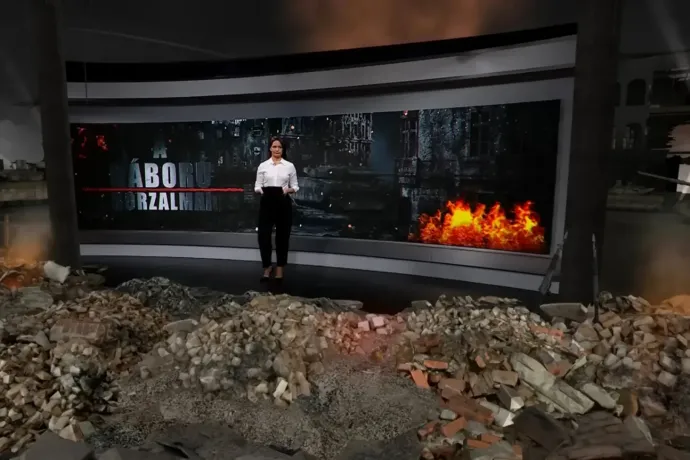


In its program entitled The Horrors of War, the Hungarian public broadcaster showed videos in which Hungarians from Transcarpathia, while being held as prisoners of war by Russia, express their gratitude to their Russian captors for their survival. This alone could be considered a violation of international law, as Tamás Hoffmann, international lawyer and associate professor at the Department of International Relations at Corvinus University of Budapest, explained to Telex.
The recordings, filmed in Russian captivity and available on social media, were broadcast in their entirety by the state-owned MTVA, as 444 pointed out. According to Hoffmann, the messages’ broadcasting itself constitutes a violation of the Geneva Convention. The convention, established in 1945, regulates the legal status of prisoners of war, their treatment, and the manner of their detention. Making such recordings of prisoners of war in such a vulnerable position where they clearly have virtually no freedom of choice is difficult to reconcile with this.
"What the public broadcaster has done could potentially incur international legal liability for Hungary,"
said Hoffmann, who believes that despite the violation of the convention, no immediate legal consequences are to be expected, but "other states could still condemn the violation." The incident also raises questions about the responsibility of the Hungarian state, given that it is the owner of the broadcaster. This is true even though the men in the videos are asking for the assistance of the Hungarian state—or, specifically, the intervention of Prime Minister Viktor Orbán—in order to secure their release. If this happens, there is no doubt that the violation of the law, i.e., the full publication of the recordings, would "have positive consequences," according to Hoffmann. However, the international lawyer emphasized that it would be "unreasonable to expect a serious violation of international law in order to improve the situation of prisoners of war or secure their release." In any case, the captors could release the prisoners at any time, with or without a prisoner exchange.
Considering that critical evaluation of sources is a fundamental element of journalism, it is also worth noting how the messages sent by Transcarpathian Hungarian prisoners of war ended up on MTVA's program: they came from a private TikTok account named niamhedwards198, which also links to a Facebook profile under the name Niamh Edwards. The profile under the Irish female first name mainly features photos of women, with nothing similar to the content of the prisoner of war videos. In its article, 444 also pointed out that Niamh Edwards' Facebook profile also “shared the same videos in large Fidesz Facebook groups, which were later uploaded to TikTok as well.”
Informing the public without resorting to propaganda is actually possible
Reporting on prisoners of war and even mentioning the fact that the recordings were made is one thing, but distributing them verbatim is quite another, the international lawyer said, adding that these recordings and the profiles distributing them should be banned by the operator of the social media platform in question due to serious violations of the law.
In the recordings, ethnic Hungarians from Transcarpathia – who, according to their statements, in some cases have both Ukrainian and Hungarian citizenship – talk about having surrendered in order to survive and express their gratitude to the Russian soldiers: "They gave me food and drink, I received first aid, I thank the 5th Division of the Russian Federation’s Army for saving me, for helping me survive this war, thank you, guys," said one of them, who introduced himself as Albert Román.
"I wouldn't have survived if Russian soldiers hadn't taken me prisoner. I had no other choice, otherwise I would be lying somewhere in a ditch," said the man from Berehove, who introduced himself as László Margitics and who claims to only have one family member, his Hungarian mother. "She doesn't even know what happened to me, whether I'm alive or lying somewhere." If this is indeed the case, then even this violates the Geneva Convention, as the Russian side should have notified Ukraine about the capture of the man.
“I thank the Russians for letting me live, they did me a favor,” said a man who introduced himself as Emil Horvát, who claimed that he was taken to the front as cannon fodder: “They sent us to the meat grinder.” The man is referred to as “Emil Farvard” on a Russian-language website. There, Emil talks about how he was rounded up during the mobilization, how they beat him up, and how they took him to the front. "Give yourselves up, guys, everything will be fine in captivity. They won't hurt you, they'll feed you, everything's okay," the Russian site quoted Emil as saying, but the post disappeared from the page during the writing of this article.
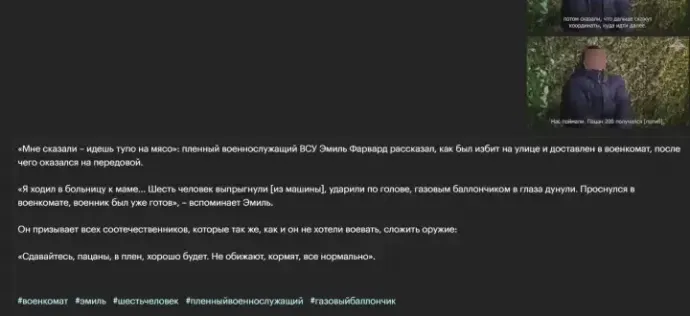
"Anyone who doesn't speak Ukrainian is pushed to the front," Ruslan Minya, a third Hungarian man from Transcarpathia said in one of the recordings. He appealed to Viktor Orbán to stop the war. "There are many Hungarians here in Ukraine, and then they take them to war, push them into cars, and bring them to fight," he said.
These statements directly correspond to the main line of Russian propaganda, which claims that Ukraine is discriminating against its minorities when sending its soldiers to the front. However, the same MTVA program, which otherwise obscures Russia's responsibility for the war, has itself refuted this: they mentioned that there are currently 700 individuals of Hungarian descent from Transcarpathia on the front lines, and 100 individuals of Hungarian descent have died so far in the war—which was started by Russia, something that is never mentioned in this program or any previous ones. Based on the army's one million-strong troop strength and an estimated 600,000 casualties (which includes both the wounded and the dead) the proportions are not higher than the proportion of ethnic Hungarians in the population of Ukraine. (The Russian army's losses in the war it started, including the seriously wounded and dead, are estimated at 1.2 million.)
Prisoners of war also have human dignity
Although the Geneva Convention, created after World War II, obviously did not specifically take social media platforms into account, it did stipulate that prisoners of war should not be used as propaganda tools. They cannot be exposed to "public curiosity," meaning they cannot be put on public display, humiliated, or portrayed in a way that violates their human dignity.
The intention to use the footage shown in the program called The Horrors of War for propaganda purposes is obvious, and this violates even the broader interpretation of the convention. The broader interpretation means that in a neutral situation, if it can be proven that there was no coercing, and mutual consent existed, then footage may be made. It is important to ensure that "the prisoner of war is not motivated by anything, they can speak freely, and without fear of retaliation," said Hoffmann. However, based on the accounts of Ukrainian soldiers who have returned from Russian captivity, this is not the case.
Incidentally, Hoffmann argues for a narrower interpretation of the Geneva Convention, namely that the portrayal of prisoners of war should be avoided altogether, precisely because it cannot be known with certainty whether their consent to be filmed or the content of their statements is the result of free will.
At this point, we must digress to Telex's previous report from a Ukrainian prisoner of war camp for Russian soldiers. This is always shaky ground, but in this particular case, we were able to ascertain that the prisoners spoke to us voluntarily, without coercion. This was also evidenced by the fact that some of them stood by their opinions against Ukraine in their statements, justifying their own role in the war, i.e., they were not under any pressure to show remorse.
This same broader interpretation, the absence of coercion, and the absence of humiliating situations also make it acceptable to review the Ukrainian materials about the accounts of North Korean and Chinese soldiers who were taken prisoner on the Ukrainian front. In contrast, the accounts of soldiers who were held captive in Russia and have returned home reveal that the torture of prisoners and disregard for the Geneva Convention are systemic practices there.
The Horrors of War essentially adopts the narrative promoted by the Russian and Hungarian governments by emphasizing the humane treatment of prisoners of war by the Russian side, which is refuted by countless personal accounts, whether from prisoners of war, civilians, or even children.
Forced conscription on state television
Each episode of The Horrors of War focuses primarily on the suffering caused by the Ukrainian state, discussing the injustices of "forced conscription" in addition to the direct suffering caused by the war. The term itself is misleading, as it is actually referring to mobilization, which is, by definition, compulsory, just as it would be in any country, including Hungary, in accordance with the law in the event of war. By its very nature, this is not voluntary – that would be recruitment – but compulsory. Incidentally, it is not conscription, as that is the peacetime mode of operation in countries where such a system is in place, as it was in Hungary until 2003. In wartime, there is mobilization.
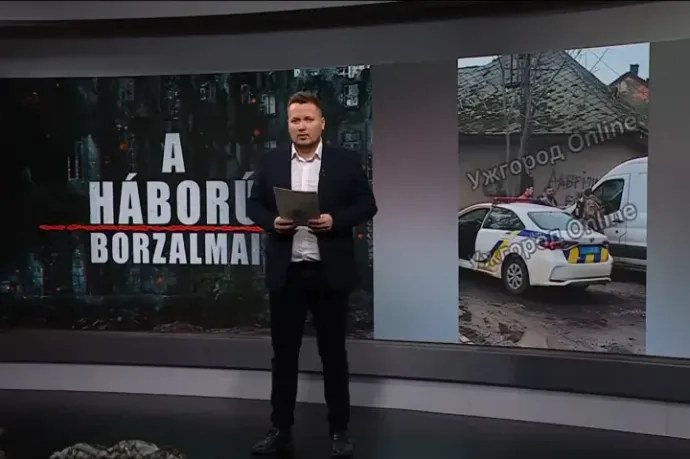
There may be, and certainly are, abuses in mobilization that need to be addressed. However, the report broadcast on the Hungarian public television is rather propagandistic in that it implies that the institution of mobilization itself is illegitimate in the event of war, and makes no mention of the fact that all this is necessitated by a war started by another country, in this case Russia.
"While preparations for peace talks are in full swing, Ukraine's forced conscription continues unabated," begins the main segment of the program, suggesting that Ukrainians are preparing for war despite the prospect of peace. The reality, however, is that to date Russian forces have not eased the pressure during the talks that have happened, and Russia essentially views the intensification of attacks as part of the negotiations. The co-host introducing the segment made no mention of this.
According to their report, “conscription is becoming increasingly brutal in Ukraine, with Ukrainian military commandos roaming towns and villages in groups. Masked gunmen often get into conflicts with civilians [...], who often confront the kidnappers in order to protect their loved ones.” The program claims that the people responsible for military conscription “have been given free rein by the state to carry out street kidnappings,” so “the manhunt has now reached the Ukrainian capital, where previously there had been no violent acts similar to those in the provincial areas.”
And to make the leadership of war-torn Ukraine appear even more in favour of war, the programme states that "Kyiv has announced that Ukraine will continue its forced conscription after the war" in order to preserve its 800,000-strong army, "which it expects the European Union to finance".
This would, by the way, be necessary in the event of a peace agreement, partly because Russia must be kept from starting another war in the future. For this to happen, in addition to international guarantees, independent defense capabilities are of utmost importance – especially since Ukraine cannot realistically expect NATO membership, which Hungary opposes anyway, but more importantly, Washington does not support it either. However, the MTVA program makes no mention of any of this.
A little bit about Russia, but it's mostly all about Ukraine
The program downplays Russia's responsibility for the war, placing instead the emphasis on Ukraine's failure to resolve the situation that is causing suffering to the country's population. True to its title, it does indeed talk about the horrors of war, but it conspicuously minimizes references to Russia being the aggressor.
It shows the real suffering of Ukrainian civilians caused by "drone attacks." There is no water, electricity, or heating due to "damage to the "infrastructure." The fact that this damage and the attacks causing it are not the result of some kind of natural disaster, but rather Russian aggression, is mentioned only occasionally. In the 21-minute episode, for example, the word "Russian" is heard only twice, once as follows: “People are struggling to survive in the bitter cold. The weeks of massive Russian attacks have taken their toll.”
"This is all that remains of one of Kyiv's most important power plants, which used to provide heat for more than a thousand buildings across the capital," the narrator says at one point. Surprisingly, this is followed by the presenter talking about the self-sacrificial work of the maintenance workers: “Experts are working day and night to repair one of the vital power plants. Maintenance workers are trying to restore energy production in the severely damaged power plant under extremely difficult conditions, in the cold and snow. In order to be able to work at all, they first have to clear away the debris from the building.”
These remarks stand in stark contrast to the Hungarian government's handling of the situation around the Friendship oil pipeline. Hungary and Slovakia – and the Czech Republic, which ultimately switched from Russian oil before the scheduled date – were granted a grace period for the use of the pipeline that transports Russian crude oil to them, by being temporarily exempted from European sanctions prohibiting the import of Russian oil. A section of the Druzhba pipeline on Ukrianian territory was damaged by a Russian drone attack at the end of January, but the Hungarian side has been blaming the Ukrainians, saying they are not repairing the pipeline quickly enough. Last Friday, Hungarian Prime Minister Orbán went so far as to say that Ukraine had "attacked us and had subjected us to an oil blockade." On Monday, he also released satellite images which, according to him, prove that the Friendship oil pipeline was not damaged at all.
For more quick, accurate and impartial news from and about Hungary, subscribe to the Telex English newsletter!