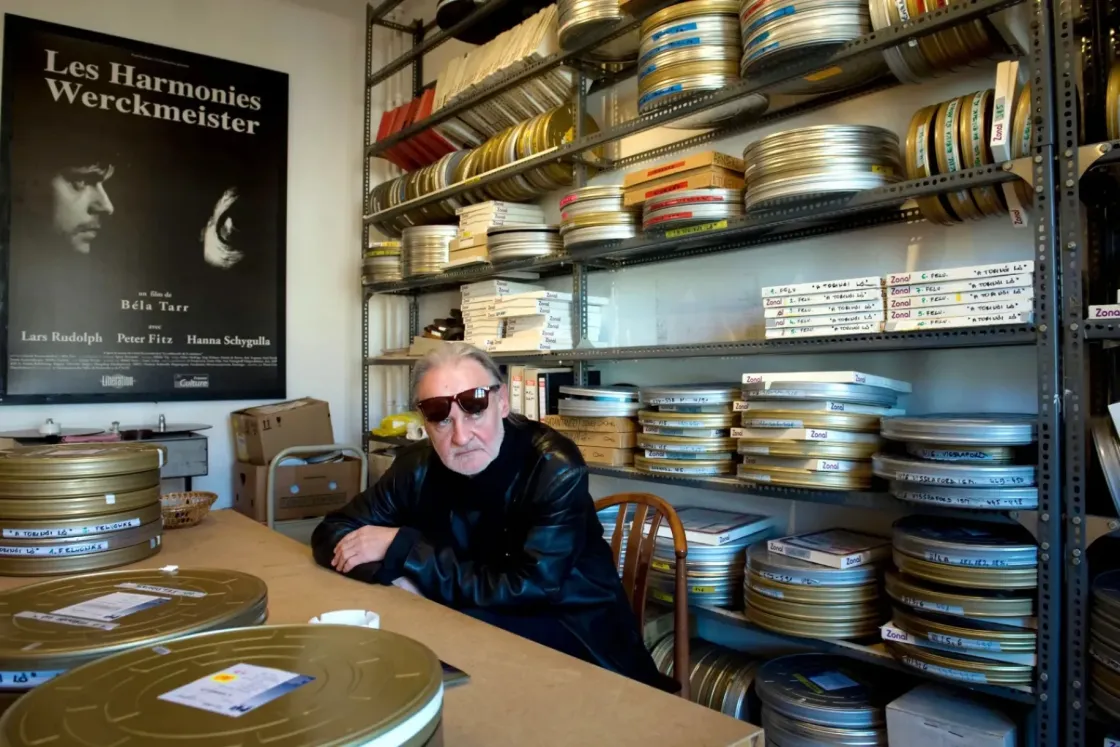

"It is with deep sorrow that we inform you that film director Béla Tarr passed away early this morning after a long and serious illness. The bereaved family asks for the understanding of the press and the public, and requests that they not be approached for statements during these difficult days," Béla Tarr's family wrote in a statement sent to our editorial office.
Film director Béla Tarr died at the age of 70 after a prolonged illness. He was an indelible figure of Hungarian film culture, the most internationally revered Hungarian director, and the creator of films that have taken on a mythical status, including Satantango and Werckmeister Harmonies. He retired from filmmaking in 2012 after making The Turin Horse, but remained active in the world of cinema, creating installations as a part of various art projects and teaching filmmaking courses around the world.
There is no denying his international fame and unanimously positive international reputation. In addition to his appearances at various film festivals and his numerous awards, two of his films were featured among the 250 best films of the world on the list created every ten years by the authoritative film magazine Sight & Sound, based on opinions of filmmakers, experts, and journalists. Werckmeister Harmonies ranked 243rd, and Satantango ranked 78th on the critics' list.
He received the Béla Balázs Award in 1983, the Kossuth Award in 2003, and was awarded the Middle Cross of the Order of Merit of the Republic of Hungary in 2005. In 2010, he was awarded the title of Ambassador of Hungarian Culture, and in 2012, he received the B. Nagy László Award given by Hungarian film critics. From 2011 to 2023, he was president of the Hungarian Filmmakers' Association, after which he was elected honorary president. His art has been recognized through several honors abroad, including the Konrad Wolf Prize from the German Academy of Arts, the French Order of Arts and Literature, and numerous lifetime achievement awards from international film festivals.
Honestly and truthfully
"I cannot answer the question about why I keep making films in the midst of a seemingly meaningless world, at the age of thirty-two. I don't know. All I know is that if I can't make films, if I'm not allowed to do so, if I don't receive the trust and money I need to do it, I feel like I don't exist,"
he replied to a question from the French newspaper Liberation in the 1980s.
Tarr was born in Pécs in 1955. His father, Béla Tarr Sr., was a set designer, and his mother, Mari Tarr, was a theater prompter awarded with the Silver Cross of Merit of the Hungarian Republic. He worked as a shipyard assistant and a doorman, and made his first feature film a few years after graduating from high school, at the age of 22, making him the youngest first-time filmmaker in Hungarian film history at the time. The documentary-feature film entitled Családi Tűzfészek was shot at the Béla Balázs Studio and it had no script. It was filmed with amateur actors and was about the everyday life of a multi-generational working-class family living in a shared apartment. During the shooting, Tarr was admitted to the College of Theatre and Film Arts, (Színház és Filmművészeti Főiskola) as it was called at the time.
"...I don't believe in the honesty or authenticity of Hollywood films, only in the idea that real people should be portrayed honestly and truthfully on the silver screen," Tarr told Filmvilág magazine in 1981, when he was preparing his second feature film, Szabadgyalog (The Outsider), in which he also worked with amateur actors and explored the mobility of socialist society and the everyday life of the working class. It was on this film that he first worked alongside his future wife and co-director, Ágnes Hranitzky, who was his assistant director and editor. Tarr was still in college when he made The Outsider. After graduating with a degree in film directing, he founded Társulás Stúdió.
"I think that throughout my whole life I only had one obsession: I won't rest until the character's personality is transferred onto the screen. In this respect, it is completely irrelevant whether the actor is an amateur or a professional. Cserhalmi was good in Macbeth when he was the way Cserhalmi is, not when he was playing Macbeth," he told Filmvilág in the 1990s.
In his next feature film, Panelkapcsolat, he stuck with the working-class milieu but replaced the actors with professionals: Judit Pogány and Róbert Koltai played the married couple whose miserable everyday lives we were able to observe in long, black-and-white scenes. Koltai told Telex that although Tarr came up with the situations during filming, the dialogues were improvised by the actors. Panelkapcsolat was Béla Tarr's last documentary feature film, and although his fourth film was not a departure in terms of subject matter, it was a major change in terms of its execution compared to the first phase of his oeuvre.
Almanac of Fall still focused on the claustrophobic, housing crisis-stricken drama of a community, but was even more confined, more intense, more stylized, and, last but not least, it was filmed in colour, with actors such as Hédi Temessy and Miklós Székely B.
The Almanac of Fall was still produced under the auspices of the association founded by Tarr, but the studio was eventually closed down by the Hungarian state, and Tarr and Hranitzky moved to Berlin for a short time. In the 1980s, Tarr appeared as an actor in two films made by his colleagues: Kutya éji dala (directed by Gábor Bódy) and Szörnyek évadja (directed by Miklós Jancsó). He and Hranitzky then made the film that gave birth to the style most closely associated with his name.
Let's get to know each other
The 1988 film Damnation brought together the crew that defined Béla Tarr's films practically until his retirement: Gábor Medvigy's contrasting black-and-white images, Mihály Víg's music, and László Krasznahorkai's prose, as well as the melancholic and oppressive atmosphere, the constantly pouring rain, the hopeless destinies and the landscapes that disappear into nothingness.
"The phone rang one morning during Easter in 1986, and an unknown voice told me that he had been reading Satantango for two days and thought he could make it into a film. He asked if I would agree to it being made into a film. I replied that I agreed, and since that was the case, we should get to know each other,"
László Krasznahorkai told Filmvilág in 1988 about how they met and how their collaboration began, first with Damnation, then with Satantango.
The ultimate expression of the mood that first appeared in Damnation is a truly monumental work of Hungarian and perhaps universal film history: the seven-and-a-half-hour long Satantango. Based on Krasznahorkai's novel, shot over three years, consisting of long takes, this perhaps incomparable cinematic monster, with its long, repetitive scenes, cruel humor, and apocalyptic atmosphere, shows how a small community disintegrates when it falls for a con man who came from afar. Watching Satantango may seem like a test of courage until one starts watching it—ideally in a movie theater.
In 2000, Werckmeister Harmonies, based on Krasznahorkai's novel The Melancholy of Resistance, premiered in Cannes outside the official competition, in the section called Directors' Fortnight. The two-and-a-half-hour film was more concise, more fantastic, and even more monumental than Satantango, especially its long, violent procession scene. This was the first time Tarr's wife appeared in the credits as a co-director. Werckmeister Harmonies won the main prize at the film festival in the same year that Szabolcs Hajdu, Benedek Fliegauf, and Kornél Mundruczó, all young filmmakers at the time, also received awards.
Tarr made his only foreign film after Werckmeister Harmonies. The Man from London, based on the novel by Georges Simenon, was made with the participation of Tilda Swinton and was shot in Corsica, among other places. It was one of the few Hungarian films ever to debut in the competition program at the Cannes Film Festival. Despite its international pedigree, it became Tarr's least noted, least frequently screened and least frequently shown film. A year later, he was already talking about making one more film about the end of the world, and then retiring from filmmaking.
The End of the World
The apocalypse was indeed depicted in The Turin Horse, which is a chronicle of a hopeless, unpredictable, and definitive end of the world, in which wells dry up, lights go out, human relationships cease to exist, and in the end, only darkness remains. Tarr more or less kept his word, and while he did make short films and installations for Austrian and Dutch exhibitions afterwards, he never made another feature film. No matter how many times he was asked about it abroad and at home, Tarr always said that he had said everything he ever wanted to say.
After retiring from making feature films, he remained politically active in the industry, criticising, among other things, the Hungarian government’s appointment of Andy Vajna as film commissioner, and also criticised the Hungarian Film Fund while it existed, although he did not pass judgement on filmmakers receiving state support, but did say that he would never ask "them" for money.
"The steamroller is on its way, and it will run over anyone who gets in its way," he said shortly after the government dismantled the Hungarian University of Theatre and Film Arts. In 2025, he gave a speech at the opening of Pride, an event which had been banned by the government.
In the 2020s, with his collaboration, the Hungarian Film Archive restored several of his films, which were screened at festivals and cinemas around the world, and several of his works are available for purchase in international editions. In 2023, he received the European Film Academy's Honorary Lifetime Achievement Award. In February 2025, he received the Lifetime Achievement Award at the 44th Hungarian Film Review, which had returned after a long hiatus, and in November, he became an honorary citizen of Budapest.
"Film is still the seventh art and is part of Hungarian culture, and as such, it is the duty of the government in power to support it and to help create normal working conditions," he said in an interview with Klubrádió after receiving the Film Review Award.
Towards the end of his life, Tarr supported several Hungarian filmmakers, often appearing in the credits as executive producer. He collaborated on the feature films Árni and Minden csillag (Every Star), as well as the short film Élő kövek (Living Stones). He was a founder and instructor at FreeSZFE, which was established after his former university underwent a model change. His last appearance on screen was in the music video for the song of the Hungarian musician Beton.Hofi, which was directed by Jancsó Jákob Ladányi, who also directed Living Stones.
For more quick, accurate and impartial news from and about Hungary, subscribe to the Telex English newsletter!