QS Higher Ed Summit: the World’s Universities Must Reinvent Themselves
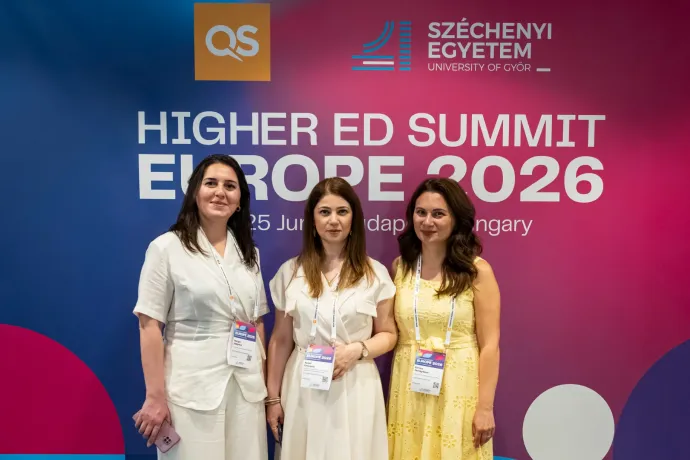
This year, Széchenyi István University in Győr hosted the QS Higher Ed Summit: Europe 2026 – a conference on the future of higher education, held partly in Győr and partly in Budapest – bringing together around six hundred decision-makers from around the world, drawn from universities, policy and industry. The focus was on the opportunities AI presents and the higher-education challenges that come with it: how artificial intelligence will reshape university teaching in the years to come.
The annual summit examines the future of higher education. At its heart lies a question: how can institutions hold on to their standing and keep up with fast-shifting demands and rapid technological change, so that their graduates leave with knowledge that is genuinely competitive? QS – one of the world’s best-known higher-education analysis and rankings organisations – convenes the field’s experts in a different major city each year to survey the latest trends and to discuss the particular difficulties each of them faces.
Széchenyi István University
Alongside its main campus in Győr, the university also teaches and conducts research in Mosonmagyaróvár, Zalaegerszeg and Budapest. Across nine faculties it covers a broad range of disciplines, from economics, public administration and law to engineering, education, social sciences, the arts, health and sport sciences, and agriculture and food science. What sets the university apart is its deep embeddedness in business and industry: its strategic model is built around corporate partnerships, applied research and practice-oriented education. Among its best-known partners is Audi Hungaria, where roughly half of all staff in technical, business and legal roles studied at Széchenyi István University. The institution also works with numerous Hungarian and international companies across the automotive, IT, healthcare, agricultural and sport sectors.
This year, Széchenyi István University in Győr hosted the QS Higher Ed Summit: Europe 2026 – held partly in Győr and partly in Budapest.
Rethinking the Value of a Degree
European higher education is in a tough spot: demographic decline means there are fewer and fewer young people, while competition between institutions worldwide has grown intense. In a constantly shifting environment that demands quicker, deeper adaptation, strengths such as institutional stability and long-term planning can become liabilities. As Ben Sowter, vice-president of QS Quacquarelli Symonds, underlined in his opening keynote in Budapest, political, economic and technological transformations are reshaping the higher-education landscape all at once, and institutions must respond proactively if they are to stay afloat. At the same time, the stricter visa rules of the traditional English-speaking destinations – the United Kingdom, the United States, Canada and Australia – are opening up a fresh opportunity for Europe to attract more students from around the world than ever before.

While the contest for international students is fierce and the ascent of Asian universities undeniable, an equally important question is what a degree is really worth, and how an institution can provide genuine, competitive opportunities within particular sectors, attuned to regional needs. Here, artificial intelligence is unavoidable: a force with both risks and rewards for higher education and the labour market alike.
Experts say universities have been slow to respond so far, and it doesn't help that they must prepare students for jobs that may not even exist yet. To help institutions integrate AI strategically rather than in a rush, QS has developed a framework that lets stakeholders gauge how far a university has come in its AI maturity and where the more pressing areas for development lie.
Critical Thinking and Problem-Solving in Focus
One of the summit’s central messages was that the real bottleneck in today’s labour market is not a shortage of jobs but a shortage of skills. As panellists put it in one discussion, universities will have no choice but to come down from their ivory tower and step outside their comfort zone to keep up with the disruption AI is driving.
The challenge is not that knowledge has become inaccessible – thanks to large language models, quite the opposite – but rather how to make the most of what these tools offer. We have to learn to ask good questions and refine our prompts in an environment where even a simple search now serves up an AI-filtered summary that's hard to avoid. Representing Harvard Business Impact, Gabriela Allmi put it bluntly: if we hand everything over to AI, we become mere administrators. The way to break through that uniformity, she said, is by asking questions.
Critical thinking and problem-solving – indispensable leadership skills – came up again and again across the various panels, chiefly around how vital they are in a world dominated by artificial intelligence. Chess grandmaster Judit Polgár likewise stressed the importance of preserving and developing our critical faculties. AI is capable of making us unlearn this very skill, even though it is precisely what helps us filter the sheer volume of information we encounter day after day.
Eszter Lukács: We Must Become Visible on the International Stage
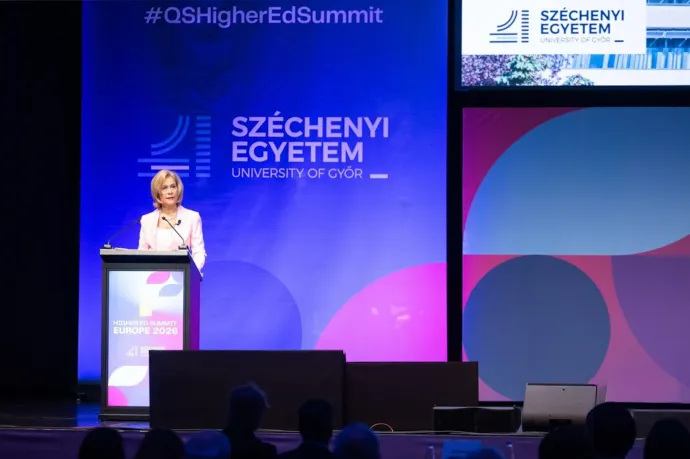
In her welcome address in Budapest, Dr Eszter Lukács, Vice-President for International Affairs and Strategic Relations at Széchenyi István University, emphasised that hosting the conference is especially significant for the institution, because what Hungarian higher education needs most is to become more visible within the international higher education landscape. „During our discussions with QS experts, we received two key recommendations: to further strengthen our international research collaborations and to showcase the quality of our education and research more prominently on the international stage. This is precisely where the value of this summit lies: it provides a platform for the exchange of ideas and for building partnerships between institutions that share similar ambitions,” she stated.
With Great Power Comes Great Responsibility
Higher-education institutions are grappling not only with demographic trends and a transformed labour market, but also with the need to overhaul their long-established teaching methods. The QS Higher Ed Summit highlighted that coursework has to be approached differently now that students can produce essays and assemble presentations in a matter of seconds. This can create an odd loop: an assignment generated with AI, completed by students with AI, and then graded by a professor who also leans on it for help. To keep testing young people and pushing them to think, universities need projects that can't be knocked out in minutes.
There is no question how much AI can speed up the pace of work, or how much of a task we can outsource to it. It is often said how remarkable a partner AI can be for routine chores, and how much these models ease our workload. But this also means that students and employees alike can take on considerably more: a workload we may not be ready for. As with the other changing trends, this too is something higher-education institutions will have to confront.
Will AI Take Our Jobs?
The million-dollar question is who has the most to fear from AI, who can consider themselves safest, and who would do well to pick up new skills. In his closing-day keynote, the QS vice-president singled out a number of largely human-centred fields that are gaining value as AI advances. He also pointed to QS's own research showing that in 51 percent of the countries surveyed, demand for certain skills now outstrips supply.

Although the value and necessity of a degree are under constant fire, in the United Kingdom 80 percent of jobs in sectors critical to growth still require a higher-education qualification. The point, then, is not whether a degree is needed, but whether there is real value behind it. The most sought-after competencies, after all, are not necessarily technical but human: communication, adaptability, leadership and cognitive skills, precisely those that are hardest to automate. Acquiring them is a shared responsibility of political, institutional and corporate leaders and of students themselves: together they must ensure that young people entering the labour market find their way to the skills that are genuinely in demand.
The more AI knows, the more human curiosity, critical thinking and the ability to work with others come to the fore. And those at the conference in Győr and Budapest seemed to agree on this much: universities will remain relevant not by competing with technology, but by strengthening precisely those capabilities that algorithms cannot replace.
The publication of this article was supported by Széchenyi István University
