Magyar: Reconciliation means not allowing the wounds of the past to generate further hostility
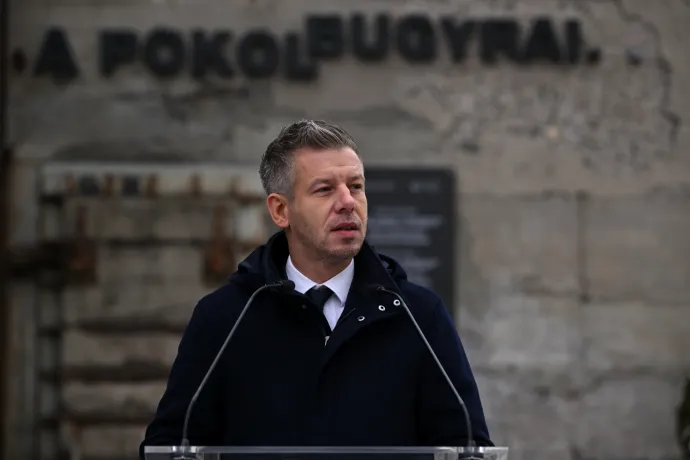


“Reconciliation is not the same as forgetting. It does not mean that a crime was not a crime, or that the pain was not pain. Reconciliation means not holding each other accountable for the actions of our ancestors, and not allowing the wounds of the past to generate further hostility,” – Hungarian Prime Minister Péter Magyar said at the Málenkij Robot Memorial in Ferencváros at the ceremony marking the Day of Remembrance in honor of Hungarian political prisoners and forced laborers deported to the Soviet Union.
According to the Prime Minister, there is hardly a Hungarian town or village which didn't see people deported to Soviet camps at the end of World War II, “The ruthless foreign power that imposed itself on our country destroyed the lives of hundreds of thousands of Hungarians and their families.” He noted that the memoirs of those victims who, by some miracle, were able to return home later can help us as we remember them.
He recounted the stories of young people from Transcarpathia, Cluj-Napoca, and Budapest in his speech, singling out Sándor Rózsás, who was imprisoned alongside the Nobel Prize-winning Russian writer Aleksandr Isayevich Solzhenitsyn. After nine years in a forced-labor camp, Rózsás was allowed to return home, where he was kept under surveillance and recruited as an agent. According to Magyar, this also shows that “history is rarely black and white,” because Rózsás used his knowledge of Russian to help hundreds of his fellow prisoners write their applications for rehabilitation.
According to the Prime Minister, the story of Rózsás also illustrates that the freedom of those who came home could never truly be freedom; many were sent to internment camps or imprisoned, treated as enemies of the state, and kept in a state of fear. “In the shadow of the dictatorship, the victims were further oppressed by the repressive regime. It was only after the regime change that telling the truth became possible for the first time.”
He also said that the end of World War II did not mean the same thing for every Hungarian family: for those freed from forced labor camps or the ghettos, the Soviet soldiers marching into the country brought life, while others were deported, raped, and killed. This all left deep scars on society for decades to come.
According to Magyar, today, it is up to us to decide what we do with this legacy:
“We can choose to pass on the resentment and suspicion, or to speak the truth and then reach our hands out to one another.”
At the end of his speech, he said that we should speak about the history of our ancestors even though it is not always glorious. “And we should listen to those whose families experienced something different from what ours did. That is how we can live in peace, and that is how we can together, build a country in which oppressive foreign powers have no place, and where the state always protects its own citizens, where there is no room for pitting Hungarians against one another, where we live together in peace, and where together, we can build a homeland we have all dreamed of.”
For more quick, accurate and impartial news from and about Hungary, subscribe to the Telex English newsletter!