Magyar: From a logistical standpoint, Hungary will play a key role in rebuilding Ukraine
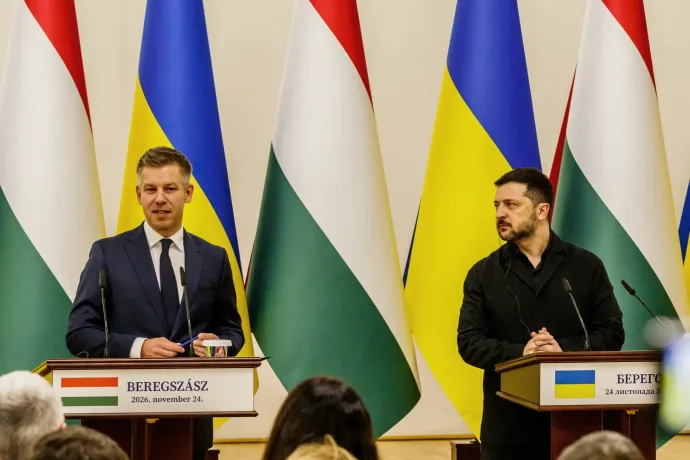


Hungarian Prime Minister Péter Magyar and Ukrainian President Volodymyr Zelensky held a joint press conference following their meeting in Berehove, Ukraine. Earlier in the day, the two leaders laid wreaths at the memorial to soldiers who have fallen in the war against Russia at the Calvary Cemetery in Uzhhorod, Ukraine. Zelensky began the press conference by stating that Ukraine is ready for constructive dialogue with Hungary, and then thanked Prime Minister Magyar for condemning Russia’s aggression in the Hungarian Parliament on Monday.
The Ukrainian President announced that they had reached agreements with regard to several key areas, including energy. He said that they spoke about diesel fuel, as Ukraine is facing a shortage of it and is counting on support from its partners, including Hungary. He also noted that Ukraine supports the rights of the Hungarian ethnic minority and those of other communities as well. According to Zelensky, their meeting also covered joint local healthcare projects, food security, and Ukrainian exports.
He mentioned that Russia is blocking the Black Sea grain corridor, so they will request help from neighboring countries. “Ukraine is able to supply some corn to Hungary", Zelensky said, noting that they know that this year’s harvest was low in Hungary. They also discussed security issues and the “brutal attacks” against Ukraine carried out by the Russians. Being friendly with Vladimir Putin leads nowhere, Zelensky said, and spoke about his expectation of a partnership based on mutual respect with Hungary. He also noted that EU accession is irreversible for Ukraine—“this is the choice of our independent nation.”
Péter Magyar spoke next, and he started by expressing his gratitude for the meaningful day, and went on to say that Ukraine has a duty to defend itself, its territorial integrity, and its sovereignty. He also emphasized that Hungary has been supporting Ukraine in every imaginable humanitarian way since the outbreak of the war. They also brought a donation worth one billion forints this time as well, which included medical equipment, energy-related equipment such as generators, vaccines, and supplies needed for mobile shelters to Transcarpathia.
Magyar noted that maintaining a good relationship is in the interest of all neighbors, and said that
the two countries now have an opportunity for a fresh start.
This is especially true because there are many Hungarians living in Ukraine and there are many Ukrainians living in Hungary. “Of course, there is a long road ahead,” and, in his view, “we must continually work to build trust.”
Magyar is pleased that the ten-point package for the protection of ethnic minorities has been adopted and that the Ukrainian parliament has acknowledged the crimes suffered by the local Hungarian community during the Soviet era. “I have asked the president to accelerate the implementation of the program as much as possible,” for example, by allowing the use of national symbols. According to Magyar, in the EU, it is natural for members of minority groups to be able to speak to one another in their own language-in this case, that is Hungarian. Magyar mentioned that he had spoken with a few local Hungarians during the day, and they are pleased that the two countries are improving their relations; “we have stopped a completely unnecessary escalation", he said.
The Hungarian PM also mentioned that they are seeking mutually beneficial agreements in the energy sector, the agricultural sector, and in infrastructure development. He mentioned that due to the drought, Hungary’s corn harvest was two million metric tons less than needed, which is why several agricultural organizations have called on the government to temporarily open the market to Ukrainian corn. Magyar announced that the Hungarian and Ukrainian agriculture ministers will be holding talks on this matter soon.
“If I were in the Prime Minister’s shoes, I would invite me to Budapest”
The two leaders then took questions from the press. The first question from the press was directed at Magyar: Would he support opening all accession clusters with Ukraine, as well as what his thoughts on longer-term financing for Ukraine are? With regard to funding, Magyar said that Hungary has been supporting Ukraine with very valuable humanitarian supplies since the outbreak of the war. His government has made it clear that, given the country’s current budgetary situation-having taken over governance in difficult circumstances-it cannot accept having the EU’s seven-year budget directly linked to funding for Ukraine. The EU does have the option to agree on a new package, and the same 23–24 member states could proceed with this as before, he said. “We would like to have the freedom to help in whatever way we can. And we will fight for this."
As for the closing of EU clusters, he said there are six clusters, and opening them is a technical step toward beginning substantive accession negotiations. Four clusters have already been opened with Ukraine and Moldova, “but there is a very, very long road ahead” to reaching negotiations; this took Hungary 13 years.
According to Magyar, they had made it clear from the very beginning that no cluster could be opened until an agreement was reached on ethnic minority issues. The adoption of the new law has strengthened trust. If the Ukrainian side’s responses on several issues prove to be satisfactory, then the clusters can be opened.
“EU accession is merit-based, which is a difficult process, and there is no fast-track procedure.” The Western Balkan countries have been waiting for this for a long time, even though Hungary supports them in this endeavor. Trust must now be built with Ukraine.
The next question was for the Ukrainian leader about why Ukraine passed the education law now, and what guarantees the Ukrainians could provide for its implementation. Zelensky replied that Ukraine is aligning its legislation with that of Europe. “We would like to join the European Union, and perhaps we’ll succeed a little sooner than Péter thinks,” he said. The sooner the language laws are implemented, the better. Ukraine's relationship with Hungary is a historic one, but
“the old political elite showed no respect; they were only inciting people.” Everything is now in place to build relations that will hopefully be constructive.
When asked how Hungary would contribute to a future peacekeeping body in Ukraine, Magyar cited the Budapest Memorandum and then said that Ukraine has a legitimate demand for security guarantees in the event of a peace agreement. He brought up the Yugoslav Wars, noting that it is thanks to UN and NATO peacekeepers that there is peace in the region today. He said that for a Hungarian, supporting peace efforts is an honor, adding that he wished Hungary was at a place where it could participate in a UN-led peacekeeping mission. He also opined that from a logistical standpoint, Hungary will play a key role in the rebuilding of Ukraine.
Magyar was finally asked why Hungary didn’t join the Carpathian Eights. According to him, there had been a misunderstanding about the Carpathian Eight: “Just because someone is invited doesn’t necessarily mean they’re part of something.” There will be more meetings in the future though, and cooperation is in the interest of all the countries in the region. There are many groups in the area, he said, bringing up the Visegrád Four and the Slavkov Three as examples.
“The more partnerships like this there are in Europe, the more prosperous and secure Europe will be for us all,”
Magyar said. In his view, if the Carpathian Eight becomes a forward-looking platform, Hungary will find its place there.
Zelensky said they had spoken about the Carpathian EIght, which he believes is good for the business sector. 444 finally asked him whether he would visit the Hungarian capital if an invitation were extended to him. He responded: “If I were in the Prime Minister’s shoes, I would invite me to Budapest, because one ought to reciprocate, after all”. Magyar responded by saying that he’d respectfully like to invite Zelensky to Hungary. “If his schedule allows,” he added.
Both leaders mentioned several times that prior to the press conference, they had joined local students at the Kossuth Lajos High School in Berehove in a game of volleyball. According to Zelensky, it was a friendly match, but Magyar said he had noticed that “the President is quite a competitive person.” The Ukrainian President, on the other hand, mentioned that, of the two of them, only Magyar had brought sneakers.
After the joint press conference, they toured the recently renovated hospital in Berehove together. Zelensky shared a short video of the visit, and wrote that doctors there have already performed more than 100 surgeries. As he noted, the hospital’s wards are equipped with modern operating rooms, intensive care units, diagnostic facilities, and outpatient rehabilitation services.
Contingent on the language law
Magyar's visit was preceded by lengthy negotiations, followed by the Ukrainian parliament's adoption of a legislative amendment guaranteeing the use of the Hungarian language for the ethnic Hungarian community in Transcarpathia. While en route to Transcarpathia, on Tuesday morning, the Hungarian PM announced that he would be bringing specific requests to the Ukrainian president. “I will ask the President of Ukraine to move up the deadlines for their commitments and ensure that they are carried out as quickly as possible,” said the Prime Minister.
As an example, he mentioned that they would like to ask Ukraine to introduce regulations allowing Hungarians to use their native language—for example, when receiving hospital care or attending a sporting event—as early as this year or, at the latest, by the beginning of next year. They are also asking that Ukrainians first implement regulations permitting the use of Hungarian symbols.
The last time Péter Magyar visited Ukraine—specifically Transcarpathia and Kyiv—was in the summer of 2024, while he was still a Member of the European Parliament. At the time, along with members of the Tisza Party, he delivered donations to a children’s hospital that had been hit by a Russian missile shortly before.
Without specifying a date, Péter Magyar first hinted that he would soon be traveling to Transcarpathia on Monday in Parliament. In his remarks made before the agenda items were addressed, he spoke at length about the Russian-Ukrainian war and the situation of the people of Transcarpathia. “Ukraine and our fellow Hungarians living there have been enduring unimaginable suffering for nearly five years,” he said, adding that it cannot be ruled out that the war’s most brutal winter is just around the corner. Magyar made it clear again that in this war, Russia is the aggressor and Ukraine the victim.
Ukrainian Foreign Minister Andrii Sybiha announced on November 18 that Péter Magyar and Volodymyr Zelensky will be meeting later this month. The two countries’ foreign ministers agreed last week at the European Union Foreign Affairs Council meeting in Brussels that, building on the positive developments in bilateral relations, they would finalize arrangements for a summit-level meeting before the end of November.
For more quick, accurate and impartial news from and about Hungary, subscribe to the Telex English newsletter!