Sikorski: Poland will also represent Hungary at Russian-Ukrainian peace talks
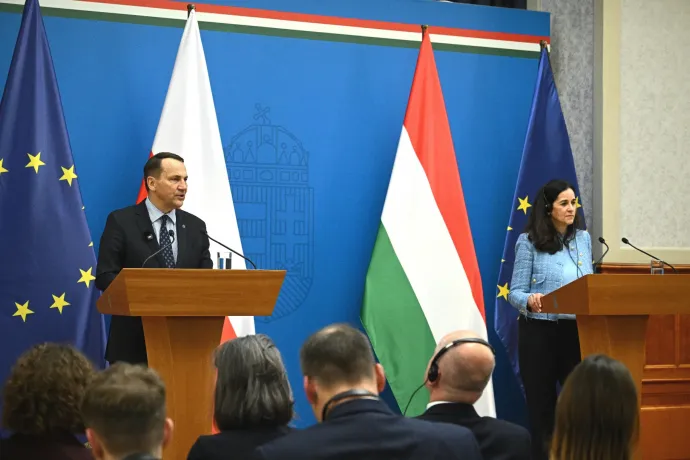


Poland will represent the entire region at the talks on Ukraine in the Middle East, Polish Foreign Minister Radosław Sikorski said at a joint press conference with Hungarian Foreign Minister Anita Orbán in Budapest on Thursday. Before their official meeting, the two ministers laid wreaths at the statue of József Bem located in front of the Ministry of Foreign Affairs (Józef Zachariasz Bem was a Polish military general who led military campaigns on Hungary’s behalf during the 1848-1849 Hungarian revolution).
There is much more than just tradition that connects the two countries, and security is only one of many such subjects. The ministers discussed opportunities for bilateral cooperation. “I brought representatives of the Polish business community with me,” said Sikorski. According to him, bilateral trade amounted to 15 billion euros. He and Anita Orbán spoke about cooperation on infrastructure, the Visegrád Group, and strengthening security and transportation infrastructure—with a particular focus on rail connections.
On the subject of the war in Ukraine, Sikorski opined that “The peace talks could be used to divide the West; that is what Russia would like to achieve,” and they would also like to weaken NATO. He noted that a lasting ceasefire, such as those already seen locally in Zaporizhzhia and Olesky, is a prerequisite for an agreement. However, Russia seems unwilling to halt military operations, at least in the Black Sea, even though, for example, Egypt is waiting for grain shipments to resume.
Sikorski noted that Hungary supports the admission of new candidates into the EU if they meet all the conditions. He then turned to the subject of Poland’s gas terminals, which could be put to use for Hungary. He expressed his hope that the U.S. military presence in Poland will strengthen and said that cooperation has already intensified due to the Russian threat. “Pressure must be placed on the aggressor, not on the aggressor’s victim,” said the Minister, who believes that pressure through sanctions must be maintained and loopholes must be closed. Finally, he said he was pleased that progress is being made on contentious issues between Budapest and Kyiv.
Anita Orbán noted that this was Sikorski’s first visit to Budapest in 12 years. They had met during his last visit as well; at that time, Ms. Orbán was a member of the delegation led by then Foreign Minister János Martonyi. “I never would have thought that I’d be the one welcoming him here 12 years later.” She spoke about their shared desire to restore Polish-Hungarian friendship. The two countries are linked by historical ties, which are symbolized by the annual summit of their heads of state, which will be held for the 20th time next year.
“We are delighted to see that Hungarian-Polish relations are flourishing”,
she said, stressing that it was no coincidence that Péter Magyar chose Warsaw as the destination for his first trip abroad.
The Hungarian Minister of Foreign Affairs noted that lower-level meetings between the two countries are also a regular occurrence. There is also an important tradition of Hungarian-Polish civil society ties, with a joint civil society program having been established in 2014. The V4 cooperation is also of paramount importance to Hungary, and both countries are also members of the “Friends of Cohesion” EU interest group, which is committed to maintaining EU funding.
She said that both parties are interested in having “the core of the V4” help maintain relations with Central Asia and the Western Balkans, and they agreed that Poland will represent Europe during negotiations on the Russian-Ukrainian settlement process.
The two countries will also cooperate and exchange information with regard to hybrid threats. “Poland also plays a key role in the region’s energy supply,” primarily because of its LNG terminal used for unloading liquefied natural gas. They discussed how Hungary could gain access to the terminal and agreed that in order “To facilitate this, we need infrastructure developments and cooperation between our companies, which we both clearly want to encourage”, Anita Orbán concluded.
There will be no Hungarian arms shipments to Ukraine
In response to a question from Magyar Hang about what the EU leadership should do to have a real say in the negotiations on Ukraine, Sikorski replied that what is lacking is not the opportunity to speak up, but Russia’s willingness. He is hoping that the U.S. and China will pressure Putin to stop during the APEC summit in Shenzhen. Ukraine is asking for a ceasefire, but according to Sikorski, Russia does not want one. Orbán added that a process has begun in Abu Dhabi, and while in Dublin last week, the EU heads of state and government agreed on who will represent Europe. Poland is one of the members of the negotiating group and will represent the interests of the region-including those of Hungary.
“Without Europe, it is impossible to conduct peace negotiations that affect Europe,” explained the Hungarian Foreign Minister.
Poland’s TVP asked whether U.S. President Donald Trump had crossed a line by calling Russian President Vladimir Putin his friend. “One can tell their friend who they really are,” Sikorski responded. This, however, gives Putin the false impression that he holds strong cards, even though he is an “economic dwarf” in Europe, he said, and pointed out how much stronger the economies of the EU and India are. There is hope that Putin will be told face-to-face to end his adventure. He recalled that the Russians and Ukrainians have already held talks in Abu Dhabi five years ago, so negotiations are ongoing, mediators are involved, and “if Putin wants peace, he’ll make a deal.”
Hungary’s public TV station M1 asked what the two countries could learn from each other. According to Anita Orbán, “the economic growth that Poland has achieved is impressive.”
The Poles have taken advantage of the opportunities offered by the EU and EU funds. Now that we’ve managed to secure these funds, we can learn from the Poles how to put them to use.
She also highlighted the infrastructure developments in Poland: railways, highways, and internet networks are being built. “We are lagging behind in this area as well,” she said, adding that they spoke about this at length. Orbán also noted that the Polish diaspora has started to return to their homeland, which is also a priority for the Tisza administration.
Sikorski added that it is a good thing that 4.5 million Polish citizens are voting with their feet and returning home. “I, too, was once an emigré in Great Britain, and I don’t regret coming home,” he recalled. The Polish economy has grown by 1,400 percent since the fall of communism, and they would like to continue driving the entire region forward, as they believe it is not properly valued.
When asked by Polish radio whether, given that Russia is on the verge of winning the war, Sikorski would persuade the Hungarian government to provide military aid to Ukraine—and whether Hungary could be convinced to change its stance—Sikorski responded that there had been no major Russian offensive this year, adding, “I would find it difficult to call this a Russian victory.” He argued that Russia is attacking civilian targets, noting that the Nazis did the same when they bombed Coventry and London in England during World War II. “Attacking the civilian population does not constitute a victory,” he said, criticizing the Russians.
In the end, he also answered the question, and said that he had not tried to persuade the Hungarian government to provide military support to Ukraine. Anita Orbán then said that Hungary’s position remains unchanged: we do not support the transport of weapons through our territory. Instead of allowing such shipments, we are helping Ukraine with sanctions packages; the goal is to achieve peace as soon as possible by exerting pressure. Orbán also considers the escalation and attacks on civilian infrastructure unacceptable.
Sikorski’s past criticism of Viktor Orbán
In an interview with HVG published the day before his arrival, the Polish minister said that, in his view, Hungary’s behavior toward Russia during the Fidesz administration “was more reminiscent of a subordinate party”. He believes Poland owes Ukraine support and hopes “that people in Hungary will no longer be brainwashed by anti-Ukrainian propaganda, and that, like the Poles, they too will recognize that Russia’s brutal attacks against Ukraine actually affect them as well.” Sikorski said that their dialogue with the Hungarian Foreign Ministry is already intensive and cordial, and they would like to see Polish-Hungarian cultural and economic relations return to normal. Anita Orbán and her Polish counterpart have met on several previous occasions since May.
A statement of Radosław Sikorski made the rounds in Hungarian media just over a month ago after he said that there are references and recordings which prove that Moscow had cooperated with the Orbán government. Sikorski brought up Viktor Orbán’s government in response to a question that proposed that Russian-backed European populists might be Moscow’s “fifth column.” It was in this context that he said that “the Russians supported and cooperated closely with Viktor Orbán’s government.”
The Polish Foreign Minister did not specify exactly which recordings he was referring to, which is relevant because shortly before the Hungarian parliamentary elections in April, several audio recordings of conversations between the former foreign minister Péter Szijjártó and his Russian counterpart Sergey Lavrov were leaked. It remains unclear whether Sikorski was referring to these or other recordings in the interview.
For the past several years, Sikorski was one of the most vocal critics of Viktor Orbán and his government. The Foreign Minister most often spoke out against the pro-Russian policies of Viktor Orbán and Péter Szijjártó; on one occasion, for example, he said that Viktor Orbán deserved the Order of Lenin.
Radosław Sikorski also regularly criticized the previous government because Hungary had granted political asylum to Marcin Romanowski, the former Polish deputy justice minister who had fled his homeland after he was accused of corruption . The Polish Prosecutor's Office suspects the politician of the nationalist-conservative Law and Justice (PiS) party of, among other things, of embezzlement of public funds and corruption. Former Justice Minister Zbigniew Ziobro is also implicated in this case and is currently also wanted in Poland. In January of this year, both he and his wife had received asylum from the Orbán government.
After Hungary's change of government in May, authorities officially revoked the political asylum granted by the previous Hungarian government to Zbigniew Ziobro, Marcin Romanowski, and Ziobro's wife. The two Polish politicians had already left Hungary shortly after the elections.
For more quick, accurate and impartial news from and about Hungary, subscribe to the Telex English newsletter!