Hungary opens database of communist-era informer files



A portion of the state security files from Hungary's communist era was made publicly available on Wednesday in a searchable online database. The files contain the names of approximately 55,000-60,000 state informants recruited by the state security services between 1945-1989.
Their publication was one of Péter Magyar’s promises during the campaign leading up to April’s parliamentary elections, and a law allowing for the move was eventually passed in September. Although there have been repeated calls to make the “agent files” public over the past nearly four decades, until now, there has never been a government with a genuine political will to make this happen.The director general of the Historical Archives of the State Security Services (ÁBTL), Gergő Bendegúz Cseh previously described the move as “unique even globally”.
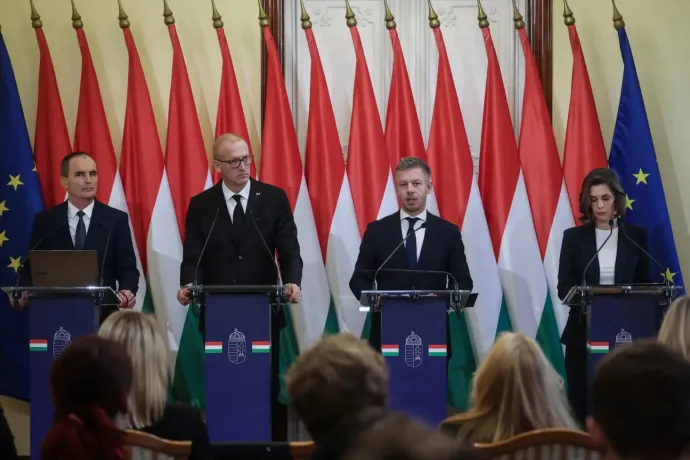
Coinciding with the database going public, a press conference was held in the storage facility of the Historical Archives of the State Security Services in Budapest, where the recruitment files are stored. Prime Minister Péter Magyar was joined by Gergő Bendegúz Cseh, director general of the ÁBTL, as well as several ministers of the Hungarian government.
At the beginning of the press conference, Magyar recalled that today marks seventy years since the Soviet troops crushed the Hungarian revolution in 1956 and said that in his opinion, their predecessors should have made these files public 36 years ago, or 16 years ago. He also noted that his government’s goal with the publication was to try to make up for a major oversight that occurred during the 1990 regime change. Magyar said that today’s event is the first important step, and additional files will be made available on February 25.
The Prime Minister stressed that many of the people recruited into the network of informants by the dictatorship were themselves victims. In his opinion, the files should have been made public when most of the victims and perpetrators were still alive, as it would have been possible to ask them questions. He stressed that the goal with publishing the files was not to pass judgment, but to allow questions to be asked about each specific case and called on everyone to handle this belated transition to democracy and belated act of reparation with dignity.
Magyar sees the publication of the files as part of a process of healing and reconciliation.
The Prime Minister cited a few examples to illustrate just how deeply the Rákosi and Kádár regimes had permeated the whole of Hungarian society. He recalled that a trainee teacher was recruited simply for complaining about the quality of the food at his dormitory. A miner in Kisterenye submitted reports on his family and coworkers for 30 years. “The network of the dictatorship was present in schools, factories, agricultural cooperatives, churches, and families,” he said.
The Director General of the ÁBTL said that the files, known as ‘the no. 6 files’ contain the person’s real name, their mother’s maiden name and their citizenship, as well as the name(s) of the recruiter(s) and the basis for recruitment, as well as the person’s code name within the network and the field in which they were employed. Gergő Bendegúz Cseh noted that in a dictatorship, countless people were simultaneously victims and perpetrators. The secret police blackmailed many by blocking their family members’ career advancement, preventing the delivery of medication ordered from abroad, or by threatening to make their sexual orientation public.
During the Rákosi and Kádár eras, a total of 150,000 informants worked for the Hungarian secret services, according to the director general of the ÁBTL. Cseh added that a considerable number of documents were lost in 1956, and another large number of them were destroyed in 1988-1989. At the time, the regime sensed its impending collapse, which led to a vast number of recruitment files being shredded.
Cseh explained that the pressure to deliver results existed even within the state security, and though some individuals may be listed as informants, they may have never filed a report. The director of the ÁBTL found it important to stress that one should not pass judgment based on a single entry in the database.
“If someone comes across the name of an acquaintance or a relative, they should be curious and inquisitive rather than judgmental. The archives will then be able to help with many other sources to provide deeper insight into a person’s life story.”
In a video shown during the press conference, historian János Rainer M. explained that the situation that had developed after 1945 allowed the secret services to do whatever they wanted. He also explained the meaning of the term “network.” He said that the term “network” was used to refer to those who assisted the secret service apparatus during the Rákosi and Kádár eras, whose primary tasks were to gather and deliver information.
The network registry, Rainer M. added, contains the names of those employed by the secret service for various purposes between 1945 and 1989. The role of those in the network may have been to infiltrate circles of friends, groups of artists, or even school classes, and to report the information obtained from them. The historian emphasized that with the launch of the searchable database, a more comprehensive registry of the members of the network is becoming available than ever before.
On the website where the database can be reached, it is stated: “This website was created to help people learn about unique resources related to Hungarian history. The political police, which operated between 1945 and 1990, served as one of the most important tools for controlling society. The daily activities of the professional staff were aided in hardly noticeable ways by a large network of informants. These individuals are commonly referred to as “agents”. Our goal is to enable the general public to take the first step toward understanding this chapter of our recent history, with the help of the sources now being made available." The paper-based and computerized files stored in the political police’s official record-keeping system can now be searched digitally.
Our intention is to face the past head-on so that we can make peace with ourselves and our respective communities, Zoltán Tarr said at the press conference. The Minister for Social Relations and Culture noted that in many cases in the past, information that had come to light ended up being a tool in political battles. Tarr expressed his gratitude for the creation of the legal framework which governed the release of the files. The minister also announced that in conjunction with the released data, the government has also launched a support network, through which a team of experts will provide psychological assistance to anyone that might need it.
For more quick, accurate and impartial news from and about Hungary, subscribe to the Telex English newsletter!