I think we need to distinguish between a political prisoner and a politician who is in prison. They are not the same
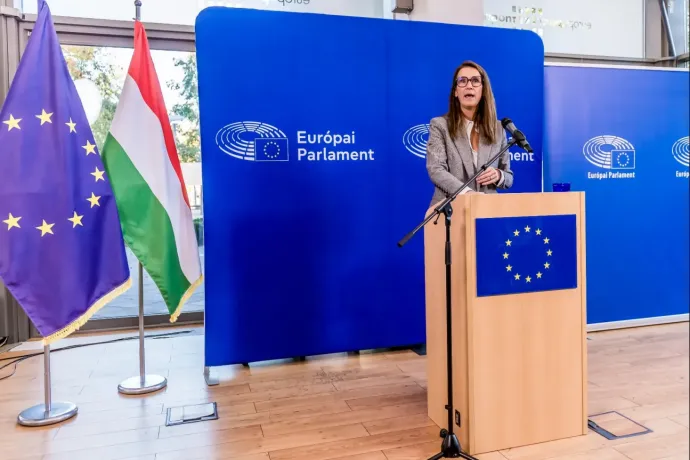


“I can really feel the change” in Hungary, Sophie Wilmès, a member of the Renew Europe group in the European Parliament, told Telex. The liberal lawmaker led the delegation that arrived in Budapest last week from the European Parliament (EP) to examine the state of the rule of law in Hungary.
According to the official statement of the EP, the delegation of seven reviewed the developments that have taken place since the April 2026 elections. Members of the group represented seven different political factions. Fidesz's András László was the only Hungarian member of the delegation. Among others, the far-right faction also sent a delegate, while the Greens were represented by Tineke Strik. The delegation of the European Parliament visited Budapest before the plenary set out to adopt a resolution on the state of the rule of law in the country, which may well end up being a recommendation to close the Article 7 procedure. At the press conference concluding their visit, Wilmès spoke of noticeable changes but also noted some shortcomings. We spoke with both her and András László afterwards.
Wilmès had visited Budapest last year as well, with a similar delegation. When asked by Telex what she felt was the main difference compared to that visit, she highlighted the changes, which she said had not merely taken place on paper. They met with lawmakers, civic society representatives, and other stakeholders, who explained to them how drastically the situation had changed and how much less pressure they were under now. She said that, in their view, the situation is not yet 100 percent how they would like it to be, and they still have concerns, but time is needed, and based on her impressions, the Hungarian authorities are committed to returning to the rule of law.
“We proposed that the delegation should not only meet with left-wing NGOs, organizations, and media outlets,” but also with ousted heads of institutions and “right-wing experts or those closer to the right,” said András László. Despite this, “during the three days, only one right-wing journalist was included in the program.”
The sole Hungarian member of the delegation said that they would have wanted to include on the agenda the cases of Balázs Hankó, the former Minister of Culture and Innovation; one of his state secretaries, Veronika Varga-Bajusz; as well as Balázs Bús, a former Fidesz member of Parliament and former deputy chair of the National Cultural Fund (NKA), potentially in conjunction with a visit to the prison. The three were taken into custody in connection with the NKA case. “This was rejected without explanation. The double standard previously applied by the European Parliament toward Hungary continues to remain in effect.”
According to Wilmès, during their visit, there were those who spoke to them on several occasions about political prisoners, but “I think we need to distinguish between a political prisoner and a politician who is in prison. They are not the same.”
A change compared to last year’s delegation was that this year, Mi Hazánk's and Fidesz's parliamentary groups, as well as the Europe of Sovereign Nations (ESN) and Patriots for Europe (PfE), also sent delegates. When asked about the communication and cooperation within the group, Wilmès emphasized that everyone behaved according to the rules of procedure, as is customary in good families. They were polite and respectful with each other, even though they had strong disagreements on some subjects.
“Obviously, just as in the European Parliament, political divisions were evident during these three days as well, but the mission leader allowed everyone to ask questions,” András László said. He added, however, that (in addition to the PfE) neither the ESN nor the group of the European Conservatives and Reformists (ECR) endorsed the final press statement because their conclusions were not in alignment with what Wilmès had said at Wednesday’s press conference. According to László, what she said did not reflect the concerns, conclusions, and the responses they had received.
According to Wilmès, opposition lawmakers in parliament primarily cited the limitations on terms of office among their concerns. She said that introducing a limit on how many terms someone can serve as a prime minister is something they have seen before, but limiting the maximum time someone can serve as a representative to twelve years was also brought up to them, as this means that a lot of their representatives cannot be elected any more. The fact that with a two-thirds majority allows for changing laws so fast, without much consultation was also discussed. “We will always look after the respect of the rule of law regardless of who is in power. But we found it very interesting that the concerns that are raised now were not concerns before, when they were in the governing majority”, she said about the former governing parties’ concern regarding the Tisza Party’s ability to fast-track legislation. Nevertheless, she did consider it “a question mark” that a representative could only serve a maximum of three terms.
“Although the program was heavily biased towards one side, the 12-year restriction still came as a shock,” as did the National Office for Asset Recovery and Protection,(NVVH) “and the very weak remedies available against its decisions—but they didn’t say anything about those either,” stated András László.
According to Wilmès, opposition parties outside parliament mainly had concerns about the modification of the election law, which she considered normal, as their visibility and funding are in question. “If the electoral process is built in a way that is not favourable to smaller parties, that would created a problem", she said, adding that a more proportionate approach would be needed. “Not at all,” she replied when asked if she was concerned that this might lead some to claim that the majority in the European Parliament was trying to interfere with the electoral system, thereby helping the parties that hold the majority there.
There has traditionally been a loose “grand coalition” in the European Parliament consisting of the center-right European People’s Party, the Socialists, and the Liberals; the Tisza Party joined the former’s faction, while neither of the member parties of the latter two made it into Parliament at the 2026 parliamentary elections. According to Wilmès, the more proportional system is “not about giving extra room to one party in particular”. She considered it a good way to reinvigorate democracy to have alternatives to the two major parties and for smaller factions to reach compromises, but that does not mean they would say that another system cannot be implemented or would be unlawful.
As Wilmès stated at her closing press conference, their report will not directly address the “Article 7” procedure on the rule of law in Hungary, which the European Parliament initiated in 2018. In response to Telex's inquiry on the matter, she said: “I believe it will contribute significantly” to the committee’s opinion on whether to request the termination of the procedure". The final document will be drafted after the delegation's return which she expected to be a largely positive report.
András László said that the position of Fidesz–KDNP on the Article 7 procedure has not changed. “We have always said that this is a political attack against Hungary.” “We demanded its immediate and unconditional suspension before the election, and we continue to demand it now—even though we have expressed concerns about the measures introduced by the new, ‘Tisza parliament’ or the government, which run counter to the principles of democracy and the rule of law.”
For more quick, accurate and impartial news from and about Hungary, subscribe to the Telex English newsletter!