"The whole city looks like a battlefield, the statue of Stalin has been dragged away"
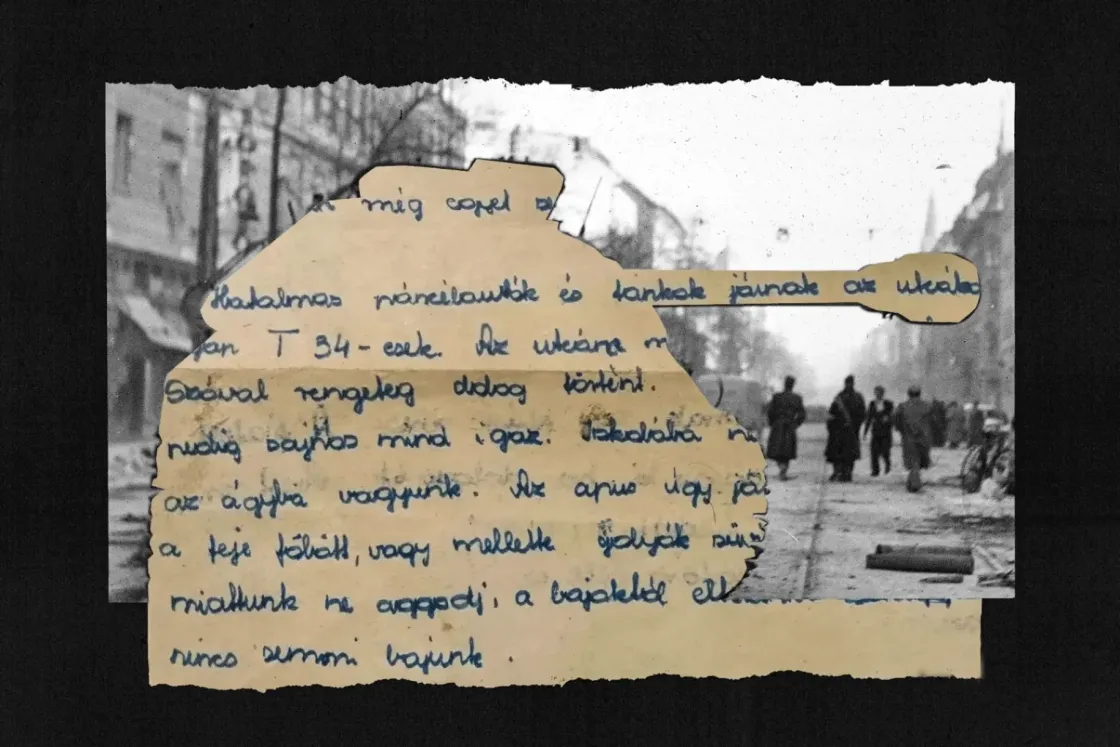


The events of the Hungarian revolution of 1956 are well documented; countless memoirs and historians have chronicled the very intense, brief three-week period. However, we know less about how ordinary people, who suddenly found themselves in the thick of these events experienced it all. Our reader, Alexa Tamás, sent our editorial office a letter written by her grandmother, Judit Patke, two days after the outbreak of the revolution, on October 25, 1956.
Judit Patke, who was 15 at the time, found herself in the midst of the crowd filling the streets of Budapest as a schoolgirl. According to her family, she recounted her experiences in a letter to her mother, who was on vacation at the time. The letter was likely never mailed because, as her postscript revealed, the family was running out of money, and by the time they could have sent it, her mother had already returned from vacation. In any case, the letter was preserved as a historical document, which, in addition to capturing moments of the revolution, also offers a glimpse into the hardships of everyday life at the time.
We published the letter verbatim in Hungarian, below is its English translation.
Dear Mom! October 25, 1956
I’m sure you’re wondering what’s gotten into me to be writing even though we haven’t received a single letter from you yet. But big things have happened! So I’ll start from the beginning.
On Tuesday, the whole school was in an uproar because they called from Association of Working Youth (DISZ, the state-run communist youth organization at the time) saying that college and high school students must gather in front of their schools at 2:30 p.m. and should then meet up at Margit Bridge before proceeding to the Bem statue. We went, since we didn’t know what to expect. We set off and walked quietly as far as Váci Street. But then a large crowd joined us, and the chanting of slogans began on Rákóczi Road. Before we left the school, Ms. Mária had told us to stay quiet and to not initiate anything, lest we get into trouble. So, back to the slogans. If we’d shouted these on May 1, people wouldn’t have thought we were counterrevolutionaries—they would have thought we were all idiots, every single one of us. For example: “Put Imre Nagy in government and Rákosi into the Danube”; “Down with the Stalin statue, heave-ho!”
"Every country's soldiers should go back to their own country!” The most popular among us was: “We won’t learn Russian,” and there were many other slogans we shouted. Of course, only the ones dictated to us by the DISZ propagandists marching alongside us.
People were stunned, but then—since they weren’t faint of heart either—they came with us. We finally reached our designated destination. By then there were flags hanging in the windows everywhere, with the coat of arms cut out. Because, among other things, we also shouted, “We want the Kossuth coat of arms!”
Bem Square opens from Frankel Leó Street, and there’s a barracks there. We greeted the soldiers with applause and chanted, “Hungarian soldiers, Hungarian uniforms,” and “Leave for the soldiers.” Then someone started giving a speech in the square, but I have no idea who it was or what they said, because I couldn’t see a thing—and I couldn’t hear a thing either!! I only knew it was over because they started singing the national anthem and the “Kossuth Song!!” We finally set off for home. Using transportation was out of the question, since the huge crowd had blocked all traffic. We finally made it across Kossuth Bridge, and were already dead tired by then.
At that point the crowd swept us towards the Parliament, but by then we were mostly surrounded by adults. That’s where the commotion began. They started shouting, “Down with the red star!” and other things too. People were acting like they were out of their minds. We tried to get out of there and after we finally managed to make it out, quite miraculously, we spotted a trolleybus. Ancsi and I jumped on, but we could have waited forever for it to start moving! It wasn't going anywhere. We rested for a bit, but then we got even more tired. We set off on foot. There was a sea of people everywhere. We didn’t have the faintest idea where we were going or which way to turn, suffice it to say that we eventually ended up at Nyugati. There, we hopped on the number 73 trolleybus and made our way home.
A pleasant surprise awaited me at home. I got home at 7, which meant we’d spent four and a half hours rushing around on foot, like those eighteen-year-old boys who take such long strides—while we took six steps, they took one giant one. But enough about that—that’s just the introduction.
No sooner had we gone to bed than the commotion began; they started shooting like crazy, and it went on like that all night, but it didn’t bother me much—I slept soundly.
I woke up at 6:30 in the morning, got dressed, and went out to the gate. The fog was so thick you couldn’t see your hand in front of your face, and the morning silence was only occasionally interrupted by bursts of gunfire. We could barely make it back through the gate each time, because there were soldiers on motorcycles and AVO officers constantly zooming around, huge barricades had been built on the boulevard out of cobblestones and the tram tracks that had been torn up.
Going to work was out of the question. People were without bread. The bravest ones ventured into the 24-hour grocery store, but it was so chaotic there that Pubi was given two packs of cigarettes instead of 1 kg of bread. Fortunately, we had some food, because Dad brought home 10 strudels, 10 dkg of salami, and a loaf of bread the evening before. We also had a little bit of bread left over. Everyone was extremely anxious. No newspapers were published. The building of Szabad Nép had been seized by counterrevolutionary forces; we saw later that all the windows had been shot out. The whole city looks like a battlefield, the statue of Stalin has been dragged away by crane and placed in front of the National Museum, and everyone who can get close to it gives it a few kicks, while it’s constantly being chiseled away at. The horizon is ablaze; Russian books are being burned. The National Museum caught fire three times. It’s barely possible to walk on the streets because of all the trams that have been overturned and the burned-out cars; the grocery stores have been completely looted, and the Hungária and the Híradó have been wrecked.
You can’t even get into the Sörszanatórium (a popular pub at the time). One of the company’s managers was shot twice. But he hasn’t died yet. You know, the one who has that little girl.
There’s a curfew, but there are still tons of people out on the streets. They lock the gates at 6 p.m. and they stay that way until 6 a.m. There are tons of dead bodies; they’re hauling them away in buses. I haven’t seen a single one myself, but I don’t want to either.
Huge armored vehicles and tanks—T-34s—are moving through the streets. You can see their tracks on the road.
So a lot has happened. It’s almost unbelievable, but unfortunately, it’s all true. When dad goes shopping, bullets whizz over his head or right beside him. But don’t worry about us—apart from the troubles, we’re fine.
Hopefully, the situation will soon calm down, Imre Nagy is now the Chairman of the Council of Ministers.
Gerő has been removed from office and people are shouting all sorts of things about him in the streets, calling him a murderer. János Kádár is currently the party’s General Secretary.
I could write more, but that’s enough for now; I hope you’re satisfied with my letter. Don’t judge my handwriting—I’m writing this in bed, and it’s already a quarter past 10. I’m sleepy too. Take care and please don’t worry about us—after all, as the saying goes, “A bad penny always turns up".
I’m signing off now.
Lots of kisses: Dad, Muci, Öcsi
P.S.: – Dad doesn't have a penny to his name. They'll only pay him if he works. But don't worry—as soon as he gets paid, I'll take it straight to the post office and mail you some money.