Magyar: Now it's our turn to stand up for freedom

On the 70th anniversary of the Hungarian people’s uprising against Soviet oppression, commemorations were held throughout the country. One of the main events was a commemorative meeting of Parliament, followed by the Prime Minister's speech and concerts in Kossuth Square. In addition to Hungarian public officials, those present included András Baka, President of the Republic of Hungary; António Costa, President of the European Council; Ursula von der Leyen, President of the European Commission; and Jens Stoltenberg, Norway’s Minister of Finance and the former Secretary General of NATO.
Ágnes Forsthoffer, Speaker of the Parliament presided over the session which began with a viewing of original footage and photographs from October 23,1956, followed by a minute of silence in honor of the fallen heroes of the revolution.
Hungarian President András Baka spoke first: “On October 23, 1956, the Hungarian people said ‘no’ to oppression, but the crowds that gathered in front of Parliament had no idea that oppression would follow just a few days later”. The head of state noted that even today, the tension on the faces of those who participated in the revolution can still be seen in the surviving photographs from that time. The President recounted the events from 70 years ago and stresed that during those difficult days, Hungarians relied on one another.
András Baka noted that the presence of foreign guests at the commemoration made it a particularly meaningful occasion, as the 70th anniversary of the Hungarian Revolution holds universal significance and the uprising contributed to the creation of European unity. “Seventy years later, we Hungarians must also express our gratitude,” the head of state said before thanking the foreign nations which showed solidarity by taking in fleeing Hungarians in 1956.
Turning to today, Baka said that political debates are a natural part of freedom. According to him, a nation cannot be the exclusive property of a single political community. The president noted that he is aware that fostering national unity is one of his responsibilities. According to him, 1956 was a moment of grace in Hungarian history. “If we have a society that supports us, then we will find a way towards each other,” he said, concluding his speech by noting that these memories need to be preserved so that future generations may draw inspiration from them.
Overcoming fear is possible
Ursula von der Leyen, the President of the European Commission, spoke next. She noted that overcoming fear is possible, and referred to the fact that the Hungarian people voted for change six months ago. She spoke of the new Hungarian government having strengthened anti-corruption regulations, Hungary having joined the European Public Prosecutor’s Office, and Hungarian students having returned to Europe through the Horizon and Erasmus programs in the past few months. “We missed them so much,” said the President of the European Commission, and concluded her speech with a quote from Albert Camus.
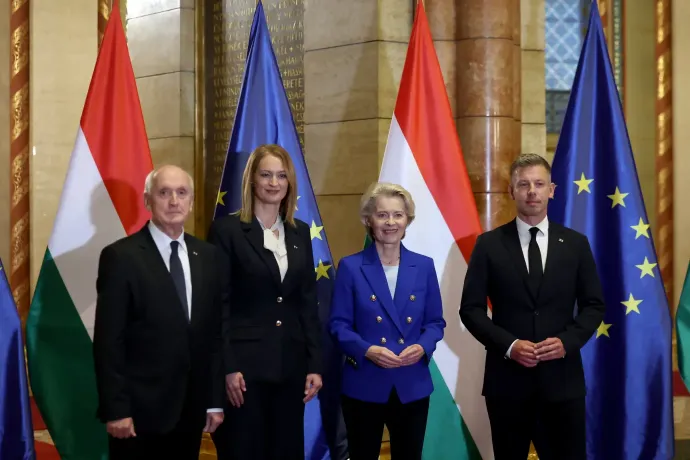
“Seventy years ago, the Hungarian people decided to launch an uprising against the communist dictatorship and the Soviet Union’s response was brutal,” the President of the European Council said in his speech. According to António Costa, the Hungarian people’s desire for freedom never faltered, and he noted that this was also the driving force behind the transition to democracy in 1989. Costa noted that Hungary’s accession to the European Union in 2004 also demonstrates that Europe’s strength lies in its diverse languages and cultures; in his view, this in no way threatens national identity, but rather allows European nations to strengthen one another. He noted that the Hungarian economy has nearly tripled in size since then and spoke about the close connection between prosperity and freedom. According to Costa, the European Union provides security, prosperity, and freedom for Hungarians as well.
Magyar: The heroes of 1956 left behind a legacy for Hungarian leaders
The official part of the program concluded with a speech from Hungarian Prime Minister Péter Magyar on Kossuth Square.
At the beginning of his speech, Péter Magyar greeted the strong and “now truly independent Hungary” and welcomed the foreign leaders attending the state ceremony. He also paid tribute to the surviving heroes of ’56 and thanked them for their courage. They showed what Hungarians are capable of when they stand up for one another. He described 1956 as perhaps one of the most important revolutions of the 20th century. Seventy years ago, university students, followed by factory workers and young men and women from Budapest marched side by side, though they did not yet know what the coming hours would bring. He believes that even if they had known what awaited them, they still wouldn’t have traded their fate for anything else.
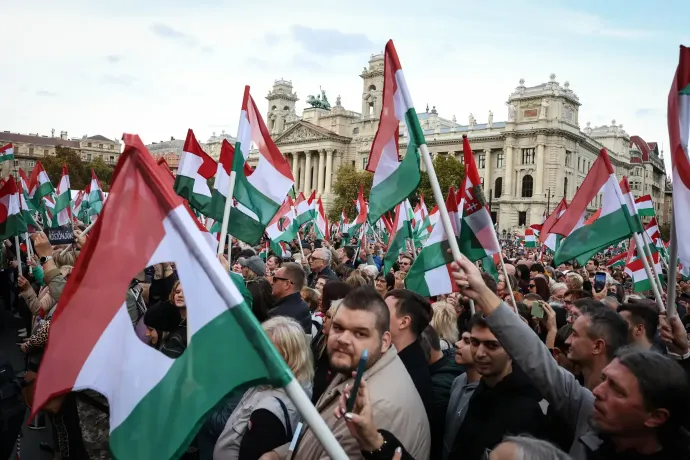
Péter Magyar noted that in retrospect, every university remembers that it was their students' idea to join forces. He recalled the brutal massacre of protesters which happened during the revolution at the square and said that “There is nothing more moving and uplifting than being able to freely stand in this very same square exactly 70 years later". The Prime Minister spoke about the thirteen glorious days when Hungarians unanimously shouted,
Russians, go home!
“Those 13 days were a testimony to a clear conscience,” said Magyar. It took the army of a world empire—foreign weapons and tanks—to crush the revolution. He spoke of the days when the Soviet army crushed the fight for freedom. The overwhelming military force may have crushed the revolution, and they may have executed Imre Nagy and the other heroes, but they could never again take away from the Hungarian people the realization that we are capable of taking our destiny into our own hands. After the Hungarian Revolution, no decent person could ever again claim that communism would serve liberty and the people, because the workers themselves had risen up against the regime.
According to Magyar, the heroes of 1956 also left behind a legacy for Hungarian leaders: namely, that their rule cannot be more important than their country’s freedom, no matter where they seek support. Let 1956 serve as a warning to them, for while power can be maintained for a time with foreign support, the freedom of the Hungarian people cannot be broken!-he said.
“Those who make excuses for an aggressor have understood nothing of the message of 1956, whether they are Budapest or at a Parisian sidewalk café.”
With this, the Prime Minister was referring to Viktor Orbán, who was photographed in Paris while the 1956 commemorations were going on in Hungary.
“For many years, we were told the lie that the national holiday only belonged to one political side, but that’s over,” Magyar said, adding that Hungary is not a country of compromisers but wants to become a strong, independent, and intelligent nation.
“Now it’s our turn to stand up for freedom,” Magyar continued. “We know what needs to be done: Hungary cannot be a country caught in the middle; it must not drift between East and West. We belong to a free, democratic Europe, and we want to be reliable allies who are sitting at the table with our heads held high. We want to become a wise, forward-looking nation.” He promised that they would never use the power they have been given against their own people, because governing is not about ruling, but about serving.
He called on Hungarians to pull together. “We have so much to do together,” he said, adding that it would be good to leave our children a country we can be proud of. “This is our homeland, and we are willing to do anything for it,” Magyar said, concluding his speech with “Long live Hungarian freedom, gloria victis.”
For more quick, accurate and impartial news from and about Hungary, subscribe to the Telex English newsletter!