It turns out the Carpathian Eight are only Seven, and the Ukrainians got a taste of Magyar's "diplomacy by commenting"



A Ukrainian initiative involving several countries, a memorandum of understanding about a reservoir near Hungary’s border with Ukraine, late-night messaging between Hungarian Prime Minister Péter Magyar and MOL Chairman-CEO Zsolt Hernádi, and the Hungarian PM commenting under the Ukrainian Foreign Minister’s social media post are all part of the diplomatic back-and-forth between Ukraine and Hungary, which has rapidly escalated in recent days.
The full context is still unclear, but at the center of it all is Volodymyr Zelensky’s regional initiative, which the Ukrainian president claimed Hungary was a member of. But on Monday, Magyar clearly stated that this is not the case. According to the Hungarian Ministry of Foreign Affairs, however, this should not be interpreted as a rejection of regional cooperation or of constructive relations with Ukraine.
No nameplate, no flag
The brief history of the Carpathian Eight (Seven?) began last Friday with Zelensky's announcement of a new cooperation initiative between Ukraine and seven (six?) European countries, as well as the EU as a whole. This initiative aims to strengthen economic cooperation among the member states in several areas. As reported by Zelensky himself and the Ukrainian press, the first summit took place on Friday.
Writing about the initiative, the Ukrainian President noted that this is the first time such a summit-which brings together all the states of the Carpathian region-has been held in Ukraine, specifically in that part of the Carpathians. According to him, the Carpathian Eight (C8)—which he said includes Hungary—is a movement that brings member countries closer together. “The goal is to significantly expand cooperation in the areas of security, energy, logistics, and economy across borders, as well as to provide substantial support to our communities,” Zelensky wrote about the C8.
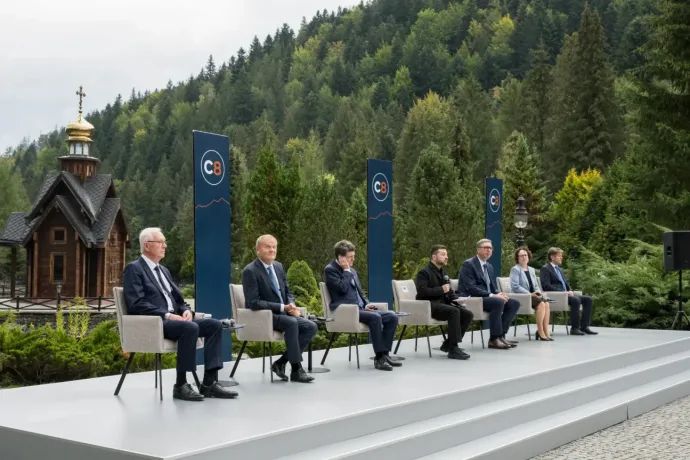
The Ukrainian President first welcomed the leaders and representatives of the Carpathian Eight publicly on social media. In another post, he then specifically named Romania, Serbia, Poland, Slovakia, the Czech Republic, Austria, Hungary, and, of course, Ukraine. However, the photo shared on his X-account only features the leaders and politicians of six countries.
From left to right: Czech politician Jiří Drahoš; Polish Prime Minister Donald Tusk; Romanian President Nicușor Dan; Olena Zelenska, the wife of the Ukrainian president; Ukrainian President Volodymyr Zelensky; Serbian President Aleksandar Vučić; and Christine Schwarz-Fuchs, President of the Austrian Federal Council. In other words, member states were represented at varying levels, and there was no one from Slovakia or Hungary present at this initial gathering. In response to our inquiry on Friday as to whether anyone was representing Hungary, the Ministry of Foreign Affairs stated that the head of the Hungarian Embassy in Kyiv was attending the event on behalf of Hungary.
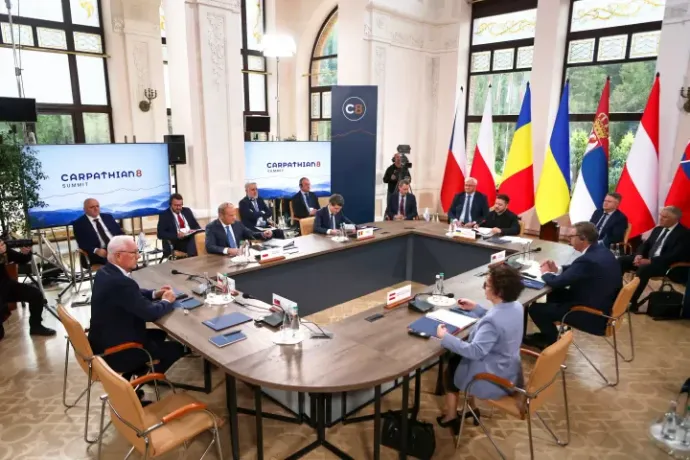
In a video subsequently shared by Zelensky, it was evident that representatives of the member states were seated at a table listening to the Ukrainian president’s welcoming remarks. However, there were only seven nameplates visible here: those of the six politicians mentioned earlier, who were in attendance, and that of Marek Eštók, the Slovak State Secretary for European Affairs and Foreign Affairs, who was also visible in subsequent photos and videos. Of the flags of the alleged member states in the hall, only the Hungarian flag was missing.
On Saturday, Zelensky again mentioned Hungary among the members, although it was quite striking that when he listed the countries in his video, there was only one country-Hungary-for which they were unable to show the face of a single participant.
In his subsequent reports on the event, the Ukrainian President consistently wrote about the leaders of the C8. Incidentally, when he addressed the press, there were only politicians from six other countries seated next to him. “During the Russian aggression, the Carpathian macroregion became one of the most reliable foundations of our defense. This is about a strength that exists today and will continue to exist in the future,” wrote the Ukrainian president.
The storage facility rattled everything
Then some news broke on Sunday which, in light of the radical erosion of Ukrainian–Hungarian relations during the Orbán governments, seemed unusual at first glance. According to this, Hungary's oil giant, Mol and the Ukrainian company Naftogaz had signed a memorandum of understanding at the C8 summit about building fuel storage facilities near the Hungarian-Ukrainian border, on Hungarian territory, to serve the Ukrainian market.
The head of the Ukrainian energy company, who announced the memorandum of understanding, made no secret of the fact that this would be advantageous for them due to the war. Sergiy Fedorenko, the acting director of Naftogaz wrote that diversifying supply routes and building additional storage facilities in areas not affected by Russia’s continuous attacks on their fuel supply infrastructure would contribute to the stability of the entire market. “The implementation of this joint project will ensure the reliability of fuel supplies in the long term, and not only for Ukrainian consumers,” stated the Ukrainian side.
Both Fidesz and the KDNP (the Christian Democratic Party, Fidesz’s former coalition partner) immediately jumped on the news, with several of their politicians speaking out on the subject on Facebook on Sunday. Fidesz’s Barbara Hegedűs posed a series of questions about the additional risks and asked why this would be good for Hungary. Olivér Hortay, also of Fidesz, called it a bad decision. “In the Russian-Ukrainian war, the parties are attacking each other’s energy infrastructure, so with this investment, our country is putting itself in the crosshairs,” he said. The KDNP, meanwhile, wrote that “because of Russian drone attacks, Ukraine is having a strategic crude oil storage facility" built in Hungary”.
Late-night texting, and the Carpathian Eight minus one
Finally, the subject was also raised in parliament on Monday. It was first brought up by Bence Rétvári. The KDNP faction leader pointed out that Hungarian voters found out about “the Ukrainians installing dangerous infrastructure in Hungary” from Ukrainian-language news reports. Fidesz faction leader János Bóka also spoke about the memorandum signed by MOL and the Ukrainian company Naftogaz, which he said was drafted “on the sidelines” of the Carpathian Eight summit. “Did the government know about this? If not, why not? Was there any security analysis conducted?” he asked.
In his response, Péter Magyar noted that the opposition parties—i.e. Fidesz and the KDNP—had drawn attention to an issue involving a storage facility “announced by Mol, which may or may never be built near Hungary’s border with Ukraine” but had omitted to mention a few details. The Prime Minister said that he had had a lengthy telephone conversation with Mol Chairman and CEO Zsolt Hernádi on Sunday night, and it turned out that negotiations about this storage facility had begun during the previous government’s term. “He said that they began negotiations with the authorization from the Orbán government, just as you also supplied weapons—you just denied it,” Magyar said. The PM added that Hernádi was not appointed by the current, but by the previous government.
The Prime Minister said that his phone conversation with the Chairman and CEO of MOL was about the fact that the current Hungarian government had not received any information about MOL having begun negotiations with the Ukrainian side—and, incidentally, with the Americans as well-with the authorization of the previous government about the possible construction of such a storage facility. Péter Magyar also touched on the “Carpathian Eight” announced by Zelensky on Friday: he wanted to know whether the opposition representatives had noticed that the Prime Minister of Poland, the President of Serbia, and high-ranking representatives from several other countries were present at the Carpathian Eight meeting, but there was no one from Hungary.
“I’d like to set the record straight here as well, because I heard from the Ukrainian press that Hungary is a member of this ‘Carpathian Eight.’ It is not a member. We were invited, and we had good reason not to go,”
said Péter Magyar.
The Prime Minister also stated that he had made it clear to Hernádi that there would be no reservoir built on the Hungarian–Ukrainian border—or anywhere else—under the Tisza government. According to Magyar, Mol had, in fact, only signed a “memorandum of understanding,” and the company’s press release makes it clear that this is merely a theoretical possibility.
He concluded by reading aloud from the text message from the exchange he had with Mol’s chairman and CEO—specifically, the message he had sent to Hernádi at the end of their phone conversation.
“The way Mol is conducting itself is completely unacceptable. We will communicate this formally as well. From now on, we expect—I expect—Mol to treat the Hungarian state as a 25 percent shareholder in the company,”
the Prime Minister quoted from his own text message. He added that they would have to wait and see what the consequences of all this would be. During Monday’s debate in Parliament, the issue of the “Carpathian Eight” and the reservoir came up several times. Magyar repeatedly stated that Hernádi is one of “your people,” i.e. of Fidesz–KDNP. “If he did something wrong, then feel free to hold him accountable.” The Prime Minister reiterated that Hungary is not a member of the Carpathian Eight. “And if it ever does join, it will certainly announce it,” he said.
Gas storage is a profitable business, but Mol understood the message
Mol subsequently backtracked, noting that the studies and negotiations are still at a very early stage. “This is a preparatory step for the project, which is not binding. But the government’s position is clear, and we understand it” György Bacsa, Group Chief Strategic officer of Mol said at Tuesday’s G7 Paradigma conference.
In the hydrocarbons market (whether it be gas, oil, or products), extraction, production (refining), transportation, and storage are all opportunities for business. In Mol’s case, the storage services it provides to several countries are a particularly lucrative business. The fact that this has now become a topic of political discussion is a bit like the Field Eryngo (or White Devil) plant, which, when it withers, detaches from the ground at its base, and the wind rolls it across the plains like a ball, thereby scattering its seeds. As the wind blows carries the plant, it sometimes separates other plants or gets them tangled with others; it is such a politically not-so-sensitive activity that has now come under greater scrutiny.
From a purely economic perspective, a Hungarian–Ukrainian storage agreement could be a profitable venture because there is a so-called product pipeline running from Tiszaújváros towards Ukraine. Larger pipelines running between Hungary and Ukraine, such as the “Friendship” oil pipeline or the “Brotherhood” gas pipeline are better-known, but these smaller pipelines rarely make the news.
The Eastern Product Pipeline, which used to run from Tiszaújváros all the way to Samara, Russia, is still usable for inexpensive and safe transportation towards the Ukrainian section. Its history dates back to 1956, when Soviet troops entered Hungary, and Moscow decided to use a pipeline to supply fuel to the Soviet army, which was supposed to be stationed in Hungary temporarily, but ended up staying for a very long time. Construction lasted from 1957 to 1966. From then on, fuel could be transported to Hungary via the pipeline from the east, partly for military and partly for commercial purposes. It later became possible to connect various refineries and fuel depots located within the Soviet Union to it.
More recently, the direction of transport has been reversed; the pipeline that passes above Kyiv is now capable of transporting diesel, for example, from Hungary to Ukraine. A major advantage of the pipeline is that it runs underground, making it harder for Russia to attack it than, for example, rail shipments, and the use of the existing infrastructure naturally also offered cost advantages. Hungary has continued to supply diesel to Ukraine via the pipeline throughout the war, and there were no attacks against it.
Hungary would be able to ship more diesel—as much as 50,000 to 60,000 metric tons per month—but it cannot process enough. A storage facility would help keep up with the demand, and building one would take at least two to three years, even after the final decision has been made. Once the Danube Refinery returns to operating at full capacity, Hungary would be able to export more, and if the war is over by then, this would be a major competitive advantage.
Magyar's message to the Ukrainian Foreign Minister on social media
Following Péter Magyar’s statements in Parliament, we contacted the Ministry of Foreign Affairs to ask why they did not wish to join the C8 initiative and, why it was that despite this, the head of the Hungarian Embassy in Kyiv attended Friday’s meeting. We also inquired as to the basis on which President Zelensky announced that Hungary was part of the initiative and with whom he had consulted on this matter on behalf of the Hungarian government. In addition, we contacted the Ukrainian Ministry of Foreign Affairs to ask what negotiations they were aware of on the subject, and we also inquired on what basis Ukrainian President Zelensky claimed that Hungary was also a member of the initiative.
“Hungary is not a member of the Carpathian Eight regional cooperation initiative launched by President Zelensky, but it is closely following its establishment and further development,”
the Hungarian Ministry of Foreign Affairs replied on Monday afternoon. They noted that, on the Hungarian side, the event was observed on site by Ádám Ceglédi, Chargé d'Affaires ad interim at the Hungarian Embassy in Kyiv. “Hungary did not sign the declaration adopted at the forum; the joint declaration was adopted by representatives of Ukraine, Austria, Romania, Poland, Serbia, and Slovakia,” they stated. These are the very countries whose representatives appear in the photos and videos shared by the Ukrainian President.
The Ukrainians—at least according to their own account—were surprised by this development and the Hungarian PM's remarks in parliament. “We find the Hungarian Prime Minister’s unnecessarily confrontational statements toward Ukraine surprising,” the Ukrainian Foreign Minister Andriy Sybiha wrote on Monday evening in response to the news. According to him, the goal of the initiative is to develop the region and implement projects that are mutually beneficial to all eight countries. “The reasons for the categorical rejection coming from the Hungarian side remain unknown,” stated the Ukrainian Foreign Minister, who referred to the cooperation not as the “Carpathian Eight” but as the “Carpathian Integration Initiative.”
Sybiha also found it a surprising development that the Hungarian side cast doubt on the “pragmatic, and mutually beneficial cooperation between Ukrainian and Hungarian energy companies, agreed upon in a bilateral memorandum. What we've been hearing from Budapest lately leaves us confused. It seems that while Viktor Orbán is gone, his policies of obstructionism and isolationism continue to thrive"-Sybiha wrote. He added that “Orbánism” has not done Hungary or the region any good in the past, nor will it in the future. He concluded by noting that, despite the statements, Ukraine remains open and willing to develop mutually beneficial, pragmatic, and respectful bilateral cooperation with Hungary.
It was at this point that something happened which Hungarian internet users have grown accustomed to, but perhaps the Ukrainian Foreign Minister has not yet. Namely, the initial response did not come from the same level: within an hour, Hungarian PM Péter Magyar showed up in the comments section under Sybiha X’s post, where he even brought up a soccer analogy.
"I am helping you. To claim that a sovereign country is a member of an international cooperation (Carpathian Integration) without prior consultation or consent of the country concerned is completely unacceptable.
-the Hungarian Prime Minister wrote to Sybiha, and then continued with a football example: Hi, we have formed a football team in the next village. We don’t know each other, but you are in it, and you have to bring the ball."
A quarter of an hour after Péter Magyar’s comment, Sybiha’s Hungarian counterpart, Anita Orbán, also weighed in on the diplomatic exchange. “Prime Minister Magyar made clear that Hungary has not joined the C8 Initiative, which is a matter of fact." In her opinion, no international energy cooperation can take place without the involvement of the Hungarian government. “Since taking office, the new Hungarian government has made numerous gestures toward Ukraine. Therefore, there is no parallel with the obstructionist policy pursued by Viktor Orbán,” Anita Orbán wrote in response to the Ukrainian Foreign Minister’s criticism, referencing Viktor Orbán’s government.
Finally, Márton Hajdu, chairman of the Parliament's Foreign Affairs Committee also weighed in on the debate. “The new Hungarian majority intends to improve relations with all our neighbors. But it takes two to tango—we’ve already done the hard work; now it’s Ukraine’s turn to fulfill its obligations,” Hajdu wrote.
“Péter Magyar made it clear that Hungary has not joined the Carpathian Eight initiative. This is purely a matter of fact, and this statement cannot be interpreted as a rejection of regional cooperation or constructive relations with Ukraine,”
the Ministry of Foreign Affairs stated in response to our inquiry on Tuesday. According to the ministry, just as in the case of any cross-border energy project planned for Hungarian territory, consultation with the Hungarian government and the relevant Hungarian authorities is mandatory. "This did not occur in the case in question, even though it is a fundamental requirement of sovereignty and normal interstate cooperation,” they wrote.
According to the Ministry of Foreign Affairs, the new Hungarian government has repeatedly demonstrated its willingness to build pragmatic and constructive relations with Ukraine based on mutual respect. “We therefore do not consider it appropriate or useful to draw comparisons with the previous Hungarian government’s obstructive policies. Hungary remains open to cooperation with Ukraine. We believe that the best solution is direct dialogue, prior consultation, and mutual respect,” they wrote. It is quite certain that the recent dispute has not benefited Ukrainian-Hungarian relations, which had begun to stabilize after the government change in Hungary, although the process has recently stalled.
In early June, Péter Magyar reported on an agreement with Ukraine guaranteeing the rights of the Hungarian minority in Transcarpathia as a breakthrough, but according to the Hungarian government, this alone does not justify opening all six clusters in Ukraine’s EU accession negotiations. The Hungarian reservations were met with some surprise in Kyiv, resulting in only two of the planned six clusters being opened. Even those were opened only after a brief period of Hungarian obstruction.
According to the Hungarian side, the process depends on the enforcement of Ukraine’s legislation for the Hungarian minority in the country. A circular letter—which even the Ukrainian side considered unnecessary—may have contributed to the mistrust, but concerns have been raised that the Ukrainian draft law currently under preparation is not completely aligned with what was formulated by the working group established by the foreign ministries of the two countries and what was subsequently included in the agreement, which Hungary saw as a breakthrough.
The question now is how Hungary’s relationship with neighboring Ukraine will develop in light of this most recent dispute. This could prove crucial, especially with regard to the long-planned high-level bilateral meeting between Magyar and Zelensky, which has yet to take place.
For more quick, accurate and impartial news from and about Hungary, subscribe to the Telex English newsletter!