Who needs experience? Reports of well-connected relatives and friends appointed to the foreign service during the Fidesz era are piling up


(This article was updated following a request sent to our editorial staff by Kristóf Kőrösi.)
Hungarian diplomacy has suffered quite a few public failures and embarrassments in recent years. As the government gradually moved away from its EU and transatlantic partners, turning instead toward Russia and China, its representatives faced an increasingly frosty reception, particularly in Europe.
One of the most striking examples of this occurred in 2024, in response to Viktor Orbán’s “peace mission” to Kyiv, Moscow, and Beijing—launched without prior consultation—prompting the EU to distance itself from Hungary, several EU member states decided to boycott the informal meetings of the Hungarian EU presidency. As a result, instead of commissioners, only lower-ranking officials were sent to the meetings in Budapest, signaling that the EU did not wish to legitimize the Hungarian presidency at the political level.
When Poland launched its EU presidency in 2025, it invited the entire diplomatic corps in Warsaw, except the Hungarian ambassador. Foreign Minister Radosław Sikorski actually issued a separate diplomatic note stating that the Hungarian ambassador was not welcome at the event.
Relations with Hungary had not only become increasingly awkward for the country's European allies, but in Africa too, where the reasons for this were completely different. According to our sources in the Foreign Ministry, the problem there was that a large number of those sent there were unfit for diplomatic service and had been appointed thanks to their connection to someone near the former government's circles.
While there were numerous difficult-to-understand ambassadorial appointments that attracted public attention in recent years, not much was known about those appointed to lower-ranking positions. Even those working in the foreign ministry did not want to make a big deal out of these embarrassing stories, as this would have further damaged the already not-so-positive image of our country. With the government change behind us, there is now greater willingness to discuss these issues, even as the performance of those serving abroad is still being reviewed.
One reason why the foreign service may have been appealing to many was that the salary—made up of the base pay plus a foreign service allowance—could provide an income between 2 and 5 million forints (€5500-13.700), along with high-quality housing and interesting activities. Moreover, it didn't necessarily pose a problem if someone didn't want to overwork themselves.
A diplomat working on economic matters without a background in economics
Our foreign affairs sources mentioned two individuals who embody this phenomenon; although they are not prominent figures, their examples are a good illustration of the points made above. Ádám István Pulay is Hungary’s foreign economic attaché in Accra, the capital of Ghana. However, one would be unable to find any mention of substantive economic knowledge or experience in this lawyer’s résumé.
- In the 2010s, he was active in Fidesz's youth organization Fidelitas and even led the organization’s Óbuda chapter.
- He ran as a Fidesz-KDNP candidate for the local council, but was not elected.
- He worked as a lawyer at a law firm, then at the Office of Public Administration and Justice, and later at the Ministry for Development.
This meant that he became an economic attaché despite having neither a background in economics nor any relevant work experience. Our foreign affairs sources described Pulay as unprepared and unqualified. According to them, concerns about his suitability were raised on several occasions even during his diplomatic training, primarily due to his inadequate knowledge of economics.
Our sources indicate that the only way he could have been appointed was due to pressure from higher up. This assumption may also stem from the fact that Ádám István Pulay is the brother-in-law of Fidesz politician Balázs Hidvéghi. Hidvéghi was a member of the parliamentary Foreign Affairs Committee until 2014, served as a Member of the European Parliament until 2024, and has since been a member of Parliament.
We reached out to Pulay to find out what he thought about these allegations and what successes he had achieved in his career, but we did not receive any substantive responses from him. When we contacted Balázs Hidvéghi, he wrote: “Ádám Pulay is indeed my brother-in-law, but I had nothing to do with his appointment as a foreign economic attaché. Contrary to your assertion, he had experience in both economics and, specifically, in working with Africa prior to his application. To the best of my knowledge, his work in Ghana was particularly successful and brought several business opportunities for our country.”
Deputy ambassador with minimal experience
Kristóf Kőrösi had an even more surprising career than Pulay’s, having been linked to the institutional network close to Fidesz in several ways prior to becoming a diplomat. The young man born in Romania joined the diplomatic service in Africa at the age of 26 as deputy to the Hungarian ambassador to Nigeria thus becoming the embassy’s second in command. This is an important diplomatic post, typically awarded after many years of experience—not to someone at the start of their career.
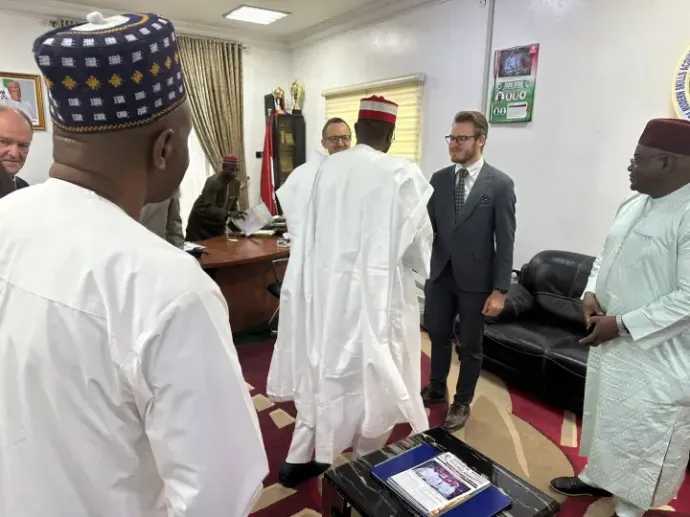
Kristóf Kőrösi expressed hin support for Fidesz and its local allies while serving as president of the Hungarian Student Association of Oradea. At the same time, he was a member of the executive council of MIÉRT (Hungarian Youth Council) and also appeared at the Tusványos summer university. After obtaining a bachelor’s degree in management from Partium Christian University in Oradea, he earned a master’s degree in international public administration from the National University of Public Service in Budapest. During this time he also studied at the Matthias Corvinus Collegium, where he would later occasionally return as a moderator and guest speaker.
He spent nearly three years at Hungary Helps, an organization launched in 2017 tasked with implementing the Hungarian government’s international humanitarian and development programs, which was led by Tristan Azbej of the Christian Democrat People's Party (KDNP). From there, he went on to spend a year as a department head at the Ministry of Foreign Affairs.
According to our sources, Tristan Azbej may have helped Kristóf Kőrösi secure an important position despite his limited experience in traditional diplomacy and the foreign service. After the publication of our article, Kristóf Kőrösi denied this, writing that the senior position had become vacant when the diplomat who previously held it was transferred to another post . The ambassador approached several experienced individuals about the position, but they all declined; the ambassador recommended the appointment based on professional considerations, and the decision on who would fill the position was made by the appointing authority.
Our sources said that the main problem with Kőrösi was that he threw himself into his position with great enthusiasm but did so without performing his original duties. For example, Hungarian expatriates living in the region reported that he drove around the Nigerian capital, Abuja, with a blue emergency light—a privilege not permitted even to diplomats in the country. According to reports, the embassy’s expenses spiraled out of control, with invoices for luxury items and expensive apartments among those cited in the accounts.
One reason why expenses may have spiraled out of control is that Kőrösi kept dogs, which forced him to move from his original apartment to a new location. However, due to the large number of stray animals in the country, many people there are afraid of dogs, so keeping them is not exactly appropriate for a diplomat. According to our foreign affairs sources, Kőrösi was able to secure embassy funding for the extraordinary expenses associated with his lifestyle thanks to his extensive high-level connections at home.
With regard to this, we received the following information from Kristóf Kőrösi: The change in accommodation was carried out based on a documented proposal and after central approval, affecting the entire delegation staff, due to the expiration of the previous lease agreement, the landlord’s desire to raise the rent, the condition of the properties, and security considerations. The annual rent for the new housing is equal to the amount the previous landlord requested for the lease extension.
According to Kristóf Kőrösi, the move was not related to him owning dogs, and he did not secure any funding on account of his connections at home from the embassy for covering these expenses. (In light of Kőrösi’s responses, our editorial team contacted the ministry. If we receive a response, we will update this article accordingly.)
We have contacted the Ministry of Foreign Affairs and Kristóf Kőrösi through the embassy in Nigeria with regard to all of the above, but have not received a response to our questions from either source yet. We have also tried to reach Tristan Azbej through the KDNP, but have received no response.
Modest figures
In light of the above, it is perhaps no surprise that Hungarian exports to the African continent have lacked momentum during the time in question. Between 2010 to 2024, among the countries in the region, Hungarian exports to Africa saw the smallest growth by far; Polish growth exceeded Hungary’s by 3.4 times, and the Czech Republic’s by 2.4 times.
There may, of course, be numerous other reasons for this—including, among other things, differences in economic structure—but it is certainly thought-provoking that, according to the most recent available data, Hungarian exports to Africa outperform only Slovakia's in the region. This is because our northern neighbor’s economy is, in absolute terms, much smaller than Hungary’s.
Political appointments became the routine
The cases of Pulay and Kőrösi are by no means unique; there have been several instances in recent years of politicians from the former ruling party, their relatives, or individuals with ties to the party being appointed to diplomatic posts despite their questionable professional qualifications:
- István Pálffy (2015): the former news anchor turned KDNP MP served as ambassador to Dublin between 2015 and 2020.
- Jenő Csiszár (2017): The former television and radio host switched to a diplomatic career and became Consul General in Milan after openly supporting Fidesz and Viktor Orbán. He is one of the recently recalled diplomats.
- Dávid Kun (2018): Zsófia Koncz, currently a member of parliament representing Fidesz was posted at the Hungarian embassy in the US through her political connections, while her husband was appointed to the position of foreign economic attaché in Washington. When they divorced in 2020, her ex-husband was already serving as a member of the new foreign economic team in Washington.
- Zsolt Csenger-Zalán (2022): The former Fidesz MP and vice chair of the Parliament’s Foreign Affairs Committee, became the ambassador to Canberra. His predecessor, István Mikola, didn’t have any diplomatic background either, and had previously served as Minister of Health in the first Orbán government. Australia seems to be especially attractive for political appointees: Prior to Mikola, another former member of Parliament, Attila Gruber, served as ambassador there.
- János Bencsik (2023): The former Jobbik MP was slated to be appointed as Consul General to Toronto. However, Canada denied his visa, so he was unable to take up the post. He eventually became a diplomat in Denmark in 2025.
- István Bebes (2025): The Fidesz-member mayor of Körmend, who had led the town through several terms, became the consul general in Düsseldorf in the fall of 2025. However, his term will be ending in August.
The Hungarian Ministry of Foreign Affairs is currently in the process of conducting a review aiming to identify individuals who may be in positions without the required background. There are approximately 1,600 people working in the Hungarian foreign service, so reviewing all of their backgrounds is a time-consuming process. Foreign Minister Anita Orbán recently recalled 34 mission chiefs. However, given that a high-profile scandal is not in the interest of Hungarian diplomacy, further recalls and replacements are likely to be carried out gradually.
For more quick, accurate and impartial news from and about Hungary, subscribe to the Telex English newsletter!