A farewell to Hungary's most harmful state institution
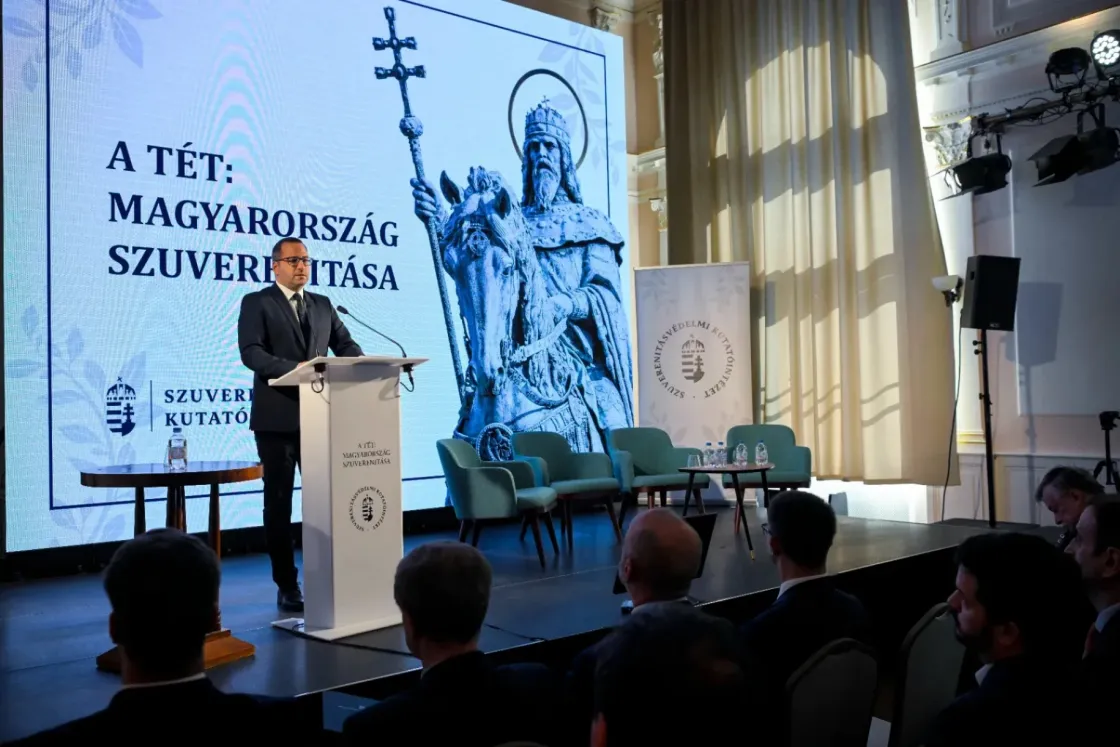


As of today, the Hungarian Parliament has officially dissolved the most harmful state institution in recent Hungarian history. The Sovereignty Protection Office (SPO) was an organization which clearly and unmistakably acted against Hungary's national interests—all while being funded with public money.
The SPO began operations in February 2024; its head, Tamás Lánczi was one of the last people to receive their appointment from President Katalin Novák—who stepped down shortly afterwards after being embroiled in the clemency scandal—despite his lack of any prior achievements or merits.
Even among the most loyal hardline party cadres, Lánczi was considered one of the most committed ones; in his positions within the System of National Cooperation (known for its abbreviation, NER in Hungarian, colloquially used to refer to Fidesz' governing elite, complete with the politicians and the oligarchs profiting from the system), he always went above and beyond expectations. He served Fidesz in numerous roles, from being part of Viktor Orbán’s staff to working at the pro-Fidesz think-tank Századvég, the House of Terror and the public media (MTVA); one of the most memorable points of his professional career came in 2018 when, under his leadership, the weekly magazine Figyelő—which had seen better days—published the so-called “list of the mercenearies of George Soros”.
Lánczi cynically described the drawing up of the list—which horrified anyone with good taste—as “real journalism,” even though he must have known full well that it was nothing more than fear-mongering propaganda evoking tragic historical analogies. By appointing Lánczi to head the Sovereignty Protection Office, the Orbán government was sending a clear message: the days of treating critical voices gently were over; from then on, a new phase of illiberal state-building would follow and instead of tolerance, there would be attacks.
They became emboldened
Hungary’s sovereignty took center stage in the government's communication during the 2022 elections after the opposition’s prime ministerial candidate at the time, Péter Márki-Zay disclosed the amount of financial support they had received from abroad during the election campaign. Fidesz politicians framed the matter as the most serious party-financing scandal ever; criminal complaints were filed, investigations were launched, but no official body found evidence of any legal violations.
Although the parties of (what is now referred to as) “the old opposition” were decimated in 2022, Fidesz saw this as an opportunity to attack any and all independent voices under the pretext of the funding received by the coalition led by Péter Márki-Zay. It was around the same time that they began to push the narrative of “foreign funding” (modelled after the Russian approach) with increasing intensity and under this banner they branded anyone critical of the government or who didn’t practice their profession in a way that suited the government’s tastes as agents—whether they were journalists, civil society activists, or judges.
Talking about “foreign agents” became the ultimate political product of Viktor Orbán’s final term as prime minister. In December 2023, together with representatives of the Mi Hazánk party, the ruling parties at the time passed the Sovereignty Protection Act, and they even established a state agency dedicated to demonizing their enemies: the Sovereignty Protection Office.
Stalinist methods for five million forints a month
The office received billions of forints from the state budget—their annual budget equaled the amount needed for operating half a dozen large, independent newsrooms which rely on the market, sponsors, and grants. His 5 million forints (14,170 euros) per month gross salary allowed its director, Tamás Lánczi to save up the equivalent of the price of a small Budapest apartment in just one year.
The body’s task was supposed to be to alert the public and policymakers to attempts at foreign influence. Instead, however, in line with the Orbán government’s intentions, it produced false, defamatory materials—reminiscent of the language used during the Stalinist leader, Rákosi’s era—about the targeted civil society actors, while turning a blind eye to the real problems.
Their duty should have been to examine how and why Hungarian society was being inundated with the Kremlin’s war propaganda, including through the public media funded by taxpayers’ money. They should also have investigated the financial background behind the Fidesz-aligned hate campaigns which were poisoning the daily lives and thinking of Hungarian citizens. Instead, they spent their time slandering organisations that regularly publish transparency reports more detailed than required by law—such as our paper.
No one ever thought for a moment that the Sovereignty Protection Office was in any respect an independent institution, or that its work mattered to decision-makers. In response to questions from the press, Gergely Gulyás, the minister who headed the Prime Minister’s Office in the most recent Orbán governments admitted several times that he had not read Lánczi’s reports, and other senior Fidesz officials have made similar statements on the subject as well. During a public debate, it even became clear that Lánczi himself is unfamiliar with (or is intentionally misinforming others about) the contents of their reports.
Intimidation and deception
The question of why this whole thing was necessary—and what goal Orbán and his team had in mind with this office—is a valid one. First and foremost, the intention was to intimidate critics of the regime and to sow doubt in the minds of anyone who might come into contact with them in the course of their work. If a paper is labelled a foreign agent, a company will think twice about advertising there, since it might even face retaliation itself as a result. The threat of accusations and sanctions was also useful in deterring those who might have considered giving statements to, or sharing information with that organization.
On the other hand, they sought to deliberately and completely mislead voters by touting claims that appeared to be investigative journalism but were completely divorced from reality—claims that the Fidesz propaganda machine adopted without any fact-checking whatsoever. A favorite tactic of theirs was to present facts that the papers themselves had published and that were in no way illegal as “scandalous revelations”. One such example was the question of foreign funding. They portrayed it as a crime that domestic media outlets obtained funding by applying for EU or U.S. grants, even though these were legal and the parties involved had communicated about them in a transparent manner. None of this bothered Lánczi, who, after the office was established, sought stricter legislation and greater authority for himself.
Instead of protecting our national sovereignty, the sole function of the SPO was to threaten and attack those who, for example, did extremely vital work in child protection that the state had failed to do, or who exposed affairs that were inconvenient for those in power.
Exposing the accumulation of wealth by the Orbán clan or other oligarchs, and clearly explaining the connections between the rampant corruption and the deplorable state of healthcare in some places, is not acting against the nation’s interests, but is in fact in the interest of every Hungarian, regardless of party affiliation.
Whoever attacks those who, through their work, are striving to create a more transparent, democratic, and just public life is the one acting against Hungary’s national interests. This is precisely what the Sovereignty Protection Office did, which is why we can call it the most harmful state institution in recent Hungarian history—even if it is difficult to objectively determine the extent of the damage it has caused.
They really meant it
Accusing someone of being a foreign agent is an extremely serious charge. Not only because it calls into question that person’s loyalty to the nation and fundamentally delegitimizes their statements, but also because this is just one step away from accusing them of the crime of treason, which is recognized under Hungarian law.
According to the Hungarian Criminal Code, a person commits treason if they “establish or maintain contact with a foreign government or foreign organization in order to violate Hungary’s independence, territorial integrity, or constitutional order.” Anyone found guilty of this offense is subject to imprisonment ranging between five and fifteen years, but in case of aggravating circumstances, the sentence may be even longer. At the level of political discourse, the terms 'agent' and 'treason' have become overused in Hungarian politics; however, with the Sovereignty Protection Office and subsequently with the 'transparency bill,' Orbán and his allies had made it clear that they were not bluffing—they meant business. Although we never received an official answer as to why the bill ended up being removed from the Parliament's agenda in June 2025, leading Fidesz figures—including Orbán himself—promised on multiple occasions thereafter that they would eventually see it through.
On April 12, the overwhelming majority of Hungarians rejected the plans of the Fidesz leadership. As a result, no newspapers were shut down in Hungary, nor were journalists or civil society activists imprisoned under the pretext of defending sovereignty. Although the desire to do so clearly existed at the former prime minister's office. In the election that brought Fidesz a crushing defeat, voters made it clear: they want neither Viktor Orbán nor Tamás Lánczi—who was earning 5 million forints a month—nor his office, reminiscent of the Rákosi-era.
For more quick, accurate and impartial news from and about Hungary, subscribe to the Telex English newsletter!