They booked a circus for Fidesz's campaign event to add a cultural element to the meeting funded by the National Cultural Fund
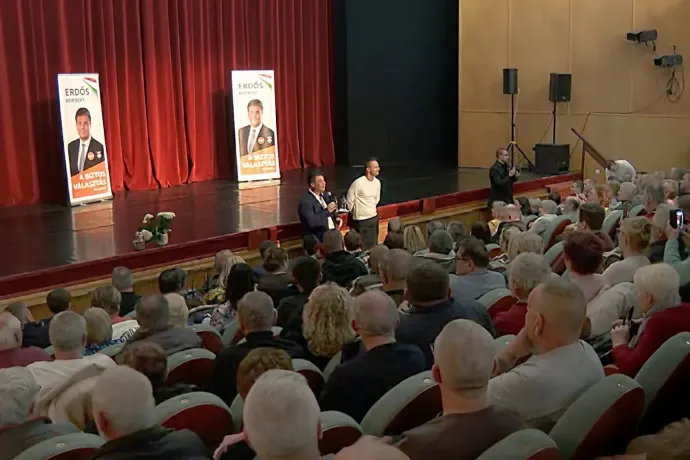


Two weeks before the election, on March 24, Fidesz MP Norbert Erdős held a community meeting with then-Foreign Minister Péter Szijjártó at the Petőfi Cultural Center in Orosháza. At the event, a recording of which—titled “Peti Itthon: Orosháza”—is still available on the YouTube channel of the former Minister of Foreign Affairs and Trade. Szijjártó spoke about the emergence of a warfare-based world order and described Erdős, who was running for re-election, as someone who is not “a novice adventurer.” But Erdős had previously appeared several times at other events held at the Orosháza Cultural Center too.
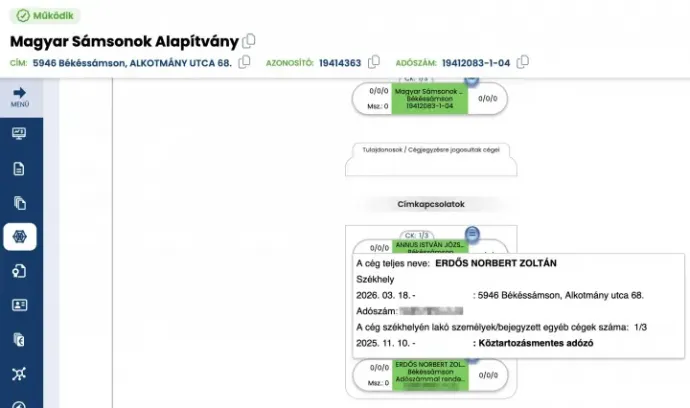
As the venue rental contracts obtained by Telex attest, five events organized by Fidesz politicians were paid for by the Foundation of Hungarian Samsons (Magyar Sámsonok Alapítvány), which received two grants of 50-50 million forints (143.200 euros) each from the National Cultural Fund’s (Nemzeti Kulturális Alap -NKA) secret 17-billion-forint budget. The foundation’s president, István Annus, is a member of Fidesz and serves as mayor of the neighboring village of Békéssámson; he is a close ally of Erdős. Furthermore, according to the Opten business database, the address listed for independent contractor Norbert Erdős matches the Békéssámson address of the foundation led by Annus.
Magyar Sámsonok Alapítvány was registered in March 2025, but there is virtually no public record of its activities. The only exception is the list of decisions taken by the Committee on Priority Cultural Programs (Kiemelt Kulturális Programok Kollégiuma) on NKA's website, which shows that they received one grant for a series of cultural, musical, and community-building programs aimed at preserving cultural heritage, and another for the implementation of cultural programs.
We asked mayor and foundation chairman István Annus why they footed the bill for the campaign event in Orosháza, to which he replied:
“Why would it have been a campaign event? There wasn’t even a Fidesz logo.”
When we pointed out to the mayor that there were Fidesz logos visible on stage behind Szijjártó and Erdős in the photos of the local paper's report about the event published the next day, and that it is clear from the report that they were campaigning on behalf of the former ruling party, Annus replied: it is true that the hall was rented on several occasions using the foundation’s funds, but they used "other donations" and not funds from the NKA grant for the event attended by Péter Szijjártó.
When asked what kinds of programs took place at the other four events linked to Norbert Erdős, Annus replied that those were community events. “Cultural programs: we invited a circus and various bands.” According to Annus, these met the criteria for community-building programs.
Hardly any trace of Szijjártó’s event
We also reached Norbert Erdős, who kept repeating that he had accepted invitations from hundreds of associations and foundations over the past four years and had attended about a thousand events. “I went everywhere II was invited. Other than that, I have nothing else to say, because I am no longer a member of Parliament and I am not a public figure,” he stated.
When asked what kind of events these were, Erdős answered: “They were all the same—cultural events,” and to his knowledge, there were also musical performers at them. Finally, we asked why it is that he, as an independent contractor is registered at the same address in Békéssámson as the foundation (Magyar Sámsonok Alapítvány) which organized Szijjártó’s event. The former Fidesz politician said that must be some kind of mistake, and he rejects the idea, and doesn’t know why that’s in the business registry. He said he has been a resident of Békéscsaba for a long time and has no special connection to the foundation. Be that as it may, this is the data which is visible in the company database.
Norbert Erdős used to be one of the most dependable members of Fidesz in Békés County; He was elected to Parliament as an independent candidate in 2002, 2006, 2010, and 2022; in between, he served as a Member of the European Parliament, and from 2020, for two years, he worked as State Secretary for Supervising the Food Chain at the Ministry of Agriculture.
Even among Fidesz politicians active on Facebook, Erdős stands out. During the final stretch of the election campaign, he posted as many as thirty to forty times a day and reported on every campaign event, large and small, from János Lázár’s street rallies to Zoltán Mága’s charity gala concert. However, there is no trace of Péter Szijjártó’s event in Orosháza on his page—or rather, there is this much only: the next day, Erdős posted a separately recorded video reporting that the Minister of Foreign Affairs had visited Orosháza and announced that a new investor would be taking over the site of the defunct float glass plant.
The close relationship between Annus and Erdős is well known in the region. For example, the MP previously campaigned alongside Annus—who was running for re-election as mayor—by pointing out that their collaboration had already “borne much fruit,” such as road upgrades, sidewalk renovations, and the opening of a modern sewing workshop in the town; Annus also posted a photo with Erdős the day before the election.
They had no doubt they were at a Fidesz campaign event
The foundation led by Annus rented the local event hall—which can accommodate nearly 400 people—for 260,000 forints for the March 24 event, which featured a speech by star politician Péter Szijjártó. Prior to this, they had used the services of the Orosháza Community Center four times (on October 30 and December 18, 2025, and on February 27 and March 12, 2026). On those occasions, they used the smaller, 180-seat hall, paying between 30,000 and 100,000 forints per event.
The term “community-building program” was used in the contracts each time. We spoke with several individuals who were present at these events. They said they had little doubt that they were attending a Fidesz campaign event, as they recognized several Fidesz mayors from the region there.
The grant application form submitted by the Magyar Sámsonok Alapítvány to the National Cultural Fund (NKA) states that they would like to organize a series of programs designed to preserve local values in 27 municipalities in the Orosháza and Mezőkovácsháza districts, which would “strengthen local communities and nurture their traditions through musical, gastronomic, and cultural programs.” The objective outlined in the other application was not much different: in this one, they planned programs based on the cultural, musical, artisanal, and culinary values in the communities of Southern Békés County.
When asked how the entire HUF 100 million in NKA funding would be spent, the mayor replied that most of the funds are still available and will be spent on community-building and musical productions, which are currently being organized. He promised that once the grant application process is complete, they will provide a full report to the NKA, just as they will do in the case of all other donations.
We also asked him about reports that he had asked several mayors in the area to organize events in the near future for roughly 500,000–600,000 forints. In response, István Annus said that, as the district president, he discusses such matters with the mayors. “Why shouldn’t we organize them? We secured the funding for 27 municipalities.”
We also spoke with Zsolt Juhász-Nagy, a member of the foundation’s board of trustees, who had previously also served on the municipal council in Békéssámson. Juhász-Nagy did not wish to comment, but he did mention that Annus is one of his best friends, which is why he was appointed to the board of trustees. He said he had not attended any of the events in Orosháza organized by their foundation, and that he is not obligated to tell us how many of the 27 municipalities actually put on community-building events.
100 million forints per electoral district
The Hungarian press and K-Monitor had previously revealed that Fidesz’s local election campaign was partially financed with state funds sourced from the National Cultural Fund. An analysis of the addresses of successful applicants, broken down by electoral district, revealed that in many cases, the funds allocated to each electoral district amounted to exactly 100 million forints. This was also the case in Békés County’s 4th electoral district: Magyar Sámsonok received two grants of 50 million forints each, which constituted the total NKA funding awarded in the district. The fact that a single organization receives 100 million forints is unprecedented anyway. In other electoral districts, the amount was often distributed among a dozen or so companies; in fact, in Heves County’s 2nd electoral district, 22 organizations each received grants worth between 3–10 million forints.
Since April, it has also been revealed that a whole host of organizations and companies which had received funding from the NKA’s “priority culture” budget had absolutely nothing to do with priority culture: hunting associations, sports clubs, labor market organizations, crime prevention groups, and even associations of auto mechanics had received money, and these organizations then somehow all turned up among the organizers of Fidesz’s local campaign.
In the April elections, in Békés County's 4the district, the Tisza Party’s candidate, Mária Gurzó ended up defeating Norbert Erdős by a margin of 20 percentage points.
For more quick, accurate and impartial news from and about Hungary, subscribe to the Telex English newsletter!