


Europeans are placing less and less confidence in the willingness of the United States, their NATO ally to defend the continent, and therefore believe that Europe needs to develop more effective defense capabilities of its own, according to a public opinion poll conducted by the European Council on Foreign Relations (ECFR).
The survey, timed just before the G7 meeting in France early next week and the NATO summit in early July, was conducted in 15 countries, including Hungary. Another key finding is that Europeans believe that transatlantic relations are likely to improve once Donald Trump leaves the White House in 2029. For now, Europeans remain committed to supporting Ukraine, but they do not believe that EU expansion to the east would be a good idea in the current situation.
The survey also revealed that the majority (44 percent) would still not purchase Russian energy resources, and many want to see developments in the field of renewables in Europe; while, 27 percent would consider it a good idea if Russian energy were to return to the EU. In Hungary, according to the survey, the majority—42 percent—support importing Russian oil and gas.
America as an ally? Not so much
While the United States has recently attacked Iran, it has been withdrawing troops from its bases in Europe, it has threatened Greenland, and Donald Trump has repeatedly spoken of the possibility of the U.S. withdrawing from NATO—all of which have shaken the confidence of the European public in the alliance with the United States. Only 11 percent of those surveyed saw the United States as an ally, and many do not trust it to act in accordance with security guarantees. This, in turn, has led many to favor a stronger Europe that is militarily less dependent on the U.S.
While 11 percent currently view America as an ally, six months ago that figure was 16 percent, and in November 2024—the month of the U.S. presidential election—it was 22 percent. An increasing number of Europeans consider Washington merely a necessary partner, rather than an ally. In most of the countries surveyed, the majority believe that the U.S. would not rush to their aid in the event of an attack—despite Article 5 of the NATO Charter.
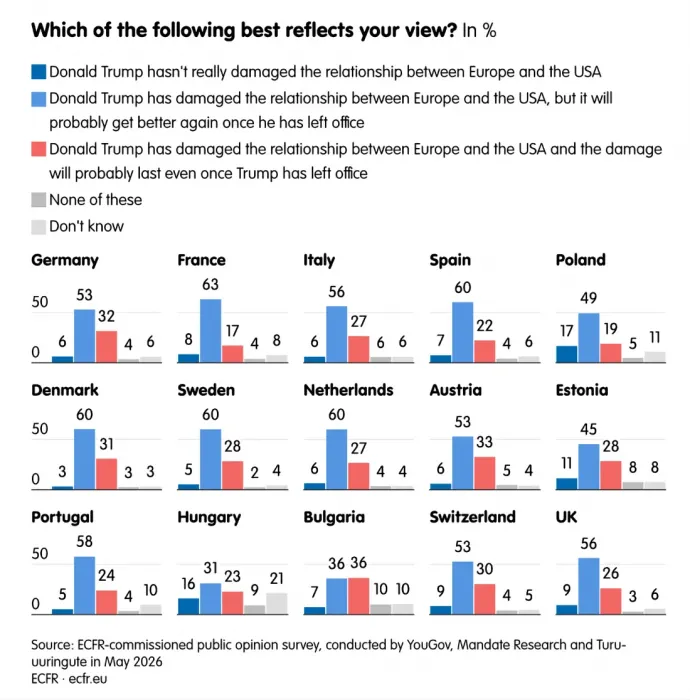
A surprisingly large number see the United States as Europe’s rival, or even its enemy (13 percent and 12 percent). Typically, these figures are worse in countries that have had some kind of conflict with Trump’s America: in the case of Spain, this is likely due to the country’s refusal to allow the use of bases for attacking Iran, in the case of Denmark it is likely related to Greenland, and in Switzerland it is connected to the trade war. In these countries, at least 20 percent of residents view the U.S. as hostile towards them. At the same time, Europeans are confident that relations will improve with Trump’s departure; this proportion is highest among the French (63 percent).
When evaluating the results of the survey, the authors noted that trust in Americans has declined gradually and incrementally in most countries, except for Hungary and Poland, where this is a new phenomenon.
According to the survey, 16 percent of Hungarians believe that Trump did not harm relations between Europe and the U.S., 31 percent believe he did harm them but that relations will likely improve after his term ends, while 23 percent believe the damage will remain even after his second term.
The public in many countries is confident that at least some European countries would come to their aid in case of trouble. This proportion is highest in Denmark (88 percent), the Netherlands (82 percent), and Sweden (81 percent). Poland is divided on the issue: 50 percent are confident that neighboring countries would come to their aid, while 45 percent believe the opposite. It is interesting that in many countries where the far right is strong, voters for such parties are also more likely to trust in mutual assistance.
People are not interested in a replacement for NATO, however; the Portuguese, the Spanish, the Swedes, and the Italians are most likely to support a new military bloc, but even there, only 35–38 percent of those surveyed would do so. The Estonians, the Dutch, the Danes, and the British reject the idea of a replacement for NATO in similar proportions.
According to the survey, the Danes and the Swedes are the most determined to take up arms if their country were attacked, while Italians lag far behind. When it comes to self-defense, the majority of Hungarians, along with Austrians, would not approve of a domestic nuclear weapons program for the purpose of deterrence to replace the American alternative, nor would they be particularly supportive of a pan-European program.
Public opinion is divided on the question of whether Europe should control its own defense. In Spain, the proportion of those who want to spend more on defense is growing—though it still stands at 32 percent, compared to 54 percent who oppose it—while in Italy, the proportion of those who reject increased military spending is very high (58 percent). On average, 47 percent support and 35 percent oppose Europe increasing its defense budget, even through joint borrowing. Portugal, located in the most peaceful part of the continent, has the highest proportion of supporters (59 percent), followed by Denmark and the Netherlands. In Austria and Switzerland, however, more than 50 percent oppose this.
In many countries, increasing defense spending at the expense of other sectors is not supported; for example, a clear majority of Germans, Italians, Spaniards, and Austrians surveyed are opposed to it. Forty-eight percent of the Hungarian public considers increased defense spending at the expense of other sectors a bad idea, while 28 percent view it as a good idea; meanwhile, Hungary has the highest proportion of "unsure" respondents (24 percent) among the countries surveyed.
Europe is also divided on purchasing weapons from the United States. Denmark, which the United States has threatened to take Greenland away from, leads the way in this regard as well, with 75 percent preferring not to buy American weapons. They are followed by the Dutch, the Swedes, and the Portuguese. Along with Hungary, Germany and Italy are far more divided on the issue. The majority of Poles—according to the survey, due to voters of the Trump-friendly main opposition party, Law and Justice (PiS)—remain supportive of buying American weapons.
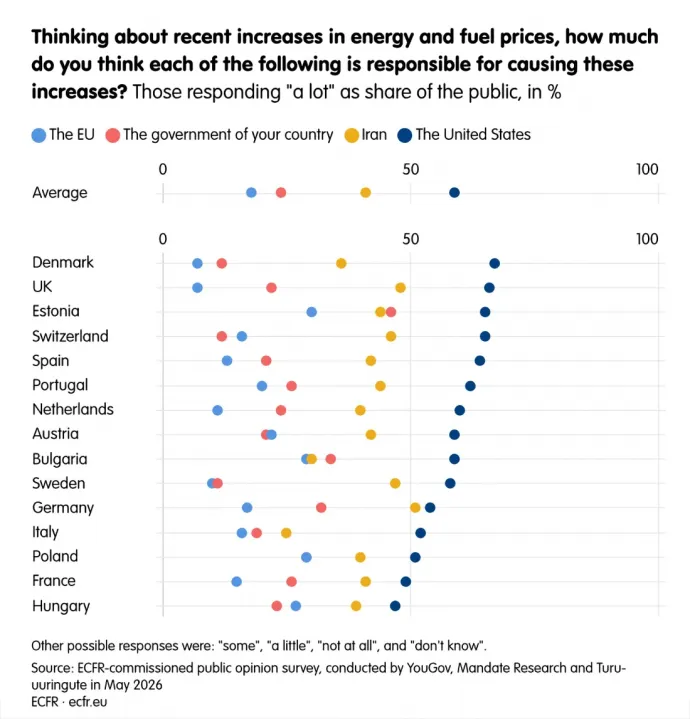
When it comes to higher energy and fuel prices, Hungarians are the least likely to blame the government and the EU, and the proportion of those who blame Iran or the United States does not even reach 50 percent. Among the countries surveyed, this is true only of France; everywhere else, more than half of the population blames the United States, and in Germany, an equal number also blame Iran.
Russian oil? Nyet
According to 44 percent of respondents, it would be a bad or a very bad idea to lift sanctions on Russian energy products and return to buying Russian crude oil and natural gas—which is one of the main sources of revenue for the Russian budget and also a source of funding for the war in Ukraine. However, 27 percent support easing restrictions on hydrocarbons.
The Danes are the most reluctant to use Russian fossil fuels (73 percent), but 69 percent of Swedes, 61 percent of Britons, 58 percent of Estonians, and 56 percent of Poles are also against resuming imports. At the other end of the spectrum are public opinions in Hungary, Italy, and Bulgaria: 42 percent in Hungary and 43 percent and 65 percent in the other two countries respectively would support the import of Russian oil and gas. The European far right is the most permissive on this issue, so supporters of France’s National Rally and Germany’s Alternative for Germany (AfD) would also buy Russian oil and gas.
Relations with Ukraine: Wavering
While European public opinion supports Ukraine’s fight against the Russian aggressor, Europeans are not keen on the idea of sending peacekeeping troops there in the future. EU expansion to include Ukraine is also unpopular. The northern and western countries appear to be the most pro-Ukrainian: the majority of Swedes, Britons, Danes, Dutch, and Portuguese view Ukraine as an ally or at least a necessary partner.
In Hungary, 15 percent view Ukraine as an ally, 28 percent as a necessary partner, while 5 percent see it as a rival and 25 percent as an opponent. In most countries, only a few percent view Ukraine as an opponent; besides Hungary, the only other country with a high proportion of such respondents—19 percent—is Bulgaria.
Sixty-one percent of Swedes would even send peacekeeper troops but support for this is also above 50 percent among Spaniards, Portuguese, Danes, and Britons. In Bulgaria, however, 75 percent would be against this, and the majority of Austrians (59 percent), Swiss (55 percent), Poles, and Hungarians also reject the idea—in Hungary and Poland, 56 percent oppose sending troops for peacekeeping.
Ukrainian accession to the EU, cited as an example of eastern enlargement, would be supported most strongly by the Portuguese, Spanish, and Swedish public (50-43-42 percent). Not surprisingly, the biggest opposition to this comes from Hungary, where anti-Ukrainian rhetoric was part of Fidesz’s election campaign; here, 47 percent view eastward expansion as a bad idea, while 15 percent see it as a good one. The difference is also striking in Bulgaria (46-19 percent) and Austria (42-24 percent), while in Germany 37 percent are against it and 28 percent would support it. Even in Estonia, one of the strongest supporters of Ukraine relative to the size of its population, public opinion is divided on the issue: 37 percent think it is a bad idea, while 32 percent think it is a good idea to admit Ukraine into the EU.
An opportunity that cannot be missed
Evaluating the survey, Paweł Zerka, Senior Policy Fellow at the ECFR and co-author of the report, said that in his view, the behaviour of the Trump administration has made Europeans much more pragmatic. The fact that they would prefer to rely on their own nations for their defence provides an opportunity for European leaders to build common security systems more broadly and more quickly. “This is an opportunity that political leaders cannot afford to miss,” Zerka said.
Jana Kobzová, the other author and Co-director of the European Security Program, emphasized that European public opinion is already more open to spending more on defense. Furthermore, people are more confident that they can count on help from other European countries in case of an emergency. Support for Ukraine remains strong, but EU accession is a divisive issue; therefore, according to Kobzová, there should be a willingness to explore interim solutions—such as “sectoral integration or defense cooperation synergies”—to ensure the deterrence of NATO’s eastern flank.
Methodology
The ECFR conducted the survey with the assistance of YouGov, Mandate Research, and Turu-uuringute between April 30 and May 19, 2026, via online and telephone interviews in Austria, Bulgaria, Denmark, Estonia, France, Germany, Hungary, Italy, the Netherlands, Poland, Portugal, Spain, Sweden, Switzerland, and the United Kingdom. The Hungarian data collection was carried out between 30 April and 19 May, surveying 1,005 people, with a margin of error being 4.46 percent.