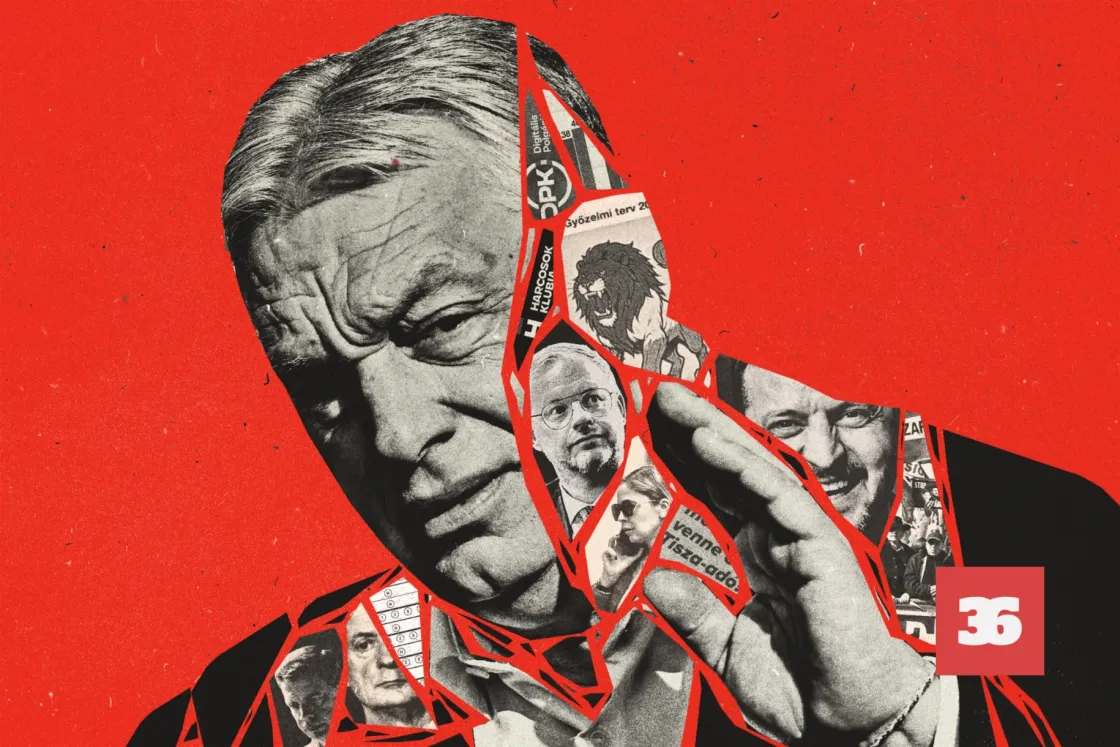


On the morning of April 14, a meeting took place in one of Fidesz’s headquarters in Budapest in a gloomy mood. Fidesz candidates running in individual constituencies gathered just two days after an election which brought disastrous results for the party, and which, for many of them also marked the end of their parliamentary careers.
Since many were taken by surprise by their ouster from parliament after several terms, they waited restlessly in the building’s ground-floor hall—painted white and furnished in a simple style—for the party leadership. They expected an explanation as to how all this could have happened.
Soon, however, they were disappointed. When party chairman and ousted prime minister Viktor Orbán, campaign manager Balázs Orbán (no relations to Viktor Orbán), and party director Gábor Kubatov took the podium-like stage, they began speaking about something entirely different.
The outgoing prime minister spoke first, saying that the defeat meant Fidesz had to rethink its position, including the composition of its parliamentary group. “You could sense that Orbán’s mind was on the future, on what would happen next,” said one attendee, who noted that the party chairman did not address the gravity of the defeat. “He said things like, ‘We’ve been in the opposition before; he’s seen this happen before,” the source said.
Several people raised their eyebrows when Orbán began talking about the need for those present to reconsider their role as constituency chairpersons in the future. This is one of the most important positions in the party; typically, constituency chairpersons also serve as individual candidates in their own constituency. After Orbán raised this issue, he emphasized that being in opposition would mean “less room to maneuver.” Therefore, anyone who decides to remain a constituency district chairperson would have to solve this using their own resources. Several of the politicians gasped at this, unable to understand why, after 16 years in power, the party did not have sufficient resources for this.
The bad mood was exacerbated by campaign manager Balázs Orbán’s presentation, in which he focused on the positives even two days after the crushing defeat. He said that they could have won the number of votes cast for Fidesz if voter turnout hadn’t been so high. Many were truly shocked that the campaign manager praised everyone, even the pollsters from the Fidesz government’s orbit. “They performed well too, they just didn’t get the result right,” said Balázs Orbán, according to one attendee, referring to the fact that pollsters close to Fidesz consistently showed the party in the lead in their public surveys. Several people reacted to this with mocking laughter.
Following this, party director Gábor Kubatov attempted to restore order in the room with his characteristic soft-spoken manner. Several attendees found it somewhat threatening when Kubatov spoke about everyone taking a step back and reflecting on their own mistakes. He then added: anyone who takes on the constituency presidency even in opposition must continue to work hard and carry out their duties. He also mentioned that under the Tisza government, Fidesz members could face investigations, so he urged them to delete sensitive information from their data storage devices.
Orbán and his team wanted to end the meeting there, indicating that the individual candidates could express their opinions on another occasion. However, there were some who did not agree with this and asked to speak. Among them was Sándor Font from Bács-Kiskun County, who, claiming to have a sore throat, did not want to speak from his chair, so he walked over to the microphone next to the table of the party leadership. Once there, he spent several minutes speaking about the need for deeper self-reflection and self-criticism. “It was clear from Orbán’s face that he wasn’t pleased with Font’s words,” said one of those present.
Afterward, Orsolya Ferencz, the party’s candidate for the 8th district in Budapest, also took to the microphone. Since the politician made an unusually sharp remark after the election criticizing Fidesz’s internal moral state, her comments drew serious attention. Ferencz spoke about how they had suffered a historic defeat.
That’s why, those taking a seat in the parliament would be sitting in hell,”
she said, according to one participant, referring to the fact that Tisza would put the small Fidesz faction under enormous pressure. For this reason, she believed that the faction should consist exclusively of politicians who provide Tisza with little potential targets for attack.
Ferencz directed serious criticism at the party leadership sitting next to her. “Looking at Balázs Orbán, she said she appreciated his theoretical thoughts, but nobody was interested in them,” said one participant, who added that Ferencz advised the campaign manager to look at the results instead. To Kubatov, she said she appreciated what he had done for the party so far, but he “shouldn’t threaten anyone.” Still addressing Orbán’s team, she added: those who caused the defeat should not be the ones to assess it. The politician received loud applause at the end of her speech.
Alexandra Szentkirályi, who played a leading role in managing the campaign, felt she couldn’t let what was said go unanswered. Addressing Ferencz, she said that she would “proudly take her seat in parliamentary hell.” She then added-again referring to Ferencz- that the defeat was partly due to the fact that the individual candidates had not done their jobs properly. Many in the room reacted with disapproval to her comments.
Others also spoke up after Szentkirályi, either expressing opinions similar to Ferencz’s or criticizing her. After further comments, the increasingly disorganized meeting, which had lasted about two and a half hours, was adjourned.
However, the tension did not ease in the days that followed. On April 16–17, under the leadership of party director Gábor Kubatov, election committee chairman László Kövér, chairman of the Fidesz ally KDNP party Zsolt Semjén, and minister János Lázár, discussions took place in which individual candidates were asked separately whether they would accept the position of leading their constituencies. Several of these meetings took place in a tense atmosphere. According to multiple sources, the representatives of the party leadership rejected criticism that they were unwilling to learn from the defeat. According to several participants, on one occasion László Kövér even refused to shake the hand of a Fidesz member who voiced such criticism.
Fidesz is currently undergoing one of the most serious crises in its history, and it remains divided on the question of what Viktor Orbán’s role should be in the future. Several high-ranking politicians believe Orbán must step down from the party’s leadership, as Fidesz has been so morally crippled that a recovery is hopeless with him at the helm. At the same time, they aren’t speaking about this publicly, as they fear both Orbán and his voter base.
During the election campaign, Orbán was still confident, and the worst-case scenario he could imagine was that even if he lost the election, he would be able to return to power relatively quickly. According to a source close to him, last summer, the prime minister was still saying that in the event of an election defeat, he would watch the Football World Cup in the summer, and by fall, a political climate favorable to him would emerge. He believed that Péter Magyar was so inexperienced that he would be unable to govern. Orbán did not, however, anticipate that the Tisza Party would ultimately secure a two-thirds parliamentary majority, which would allow it to begin dismantling the power structures of the Orbán era.
Direkt36 spoke with nearly twenty sources—who have insight into the party’s operations but requested anonymity due to the sensitivity of the subject—to investigate what happened within Fidesz in the year leading up to the election. These conversations revealed that Fidesz was not particularly interested in the social processes that led to Tisza’s rise. They attributed it to technological factors, such as the fact that Péter Magyar was more adept at using Facebook than they were. Even though it became obvious to them that their attempts to take over social media were not working, due to political and financial considerations, they stuck with them. After their multi-billion-forint spending spree proved ineffective, they further escalated the tense relationship with Ukraine for party political reasons. And even until the very last moment, they believed they had a chance to remain in power.
Responding to an inquiry from Direkt36, Fidesz communication director Bertalan Havasi wrote that Orbán reacted “sympathetically” to Ferencz’s criticism, and he was Sándor Font’s “old friend and admirer.” He called it “nonsense” that Orbán considered his quick return to power in case of an election defeat the worst-case scenario. Balázs Orbán and Gábor Kubatov did not respond to our questions.
I. Frustration
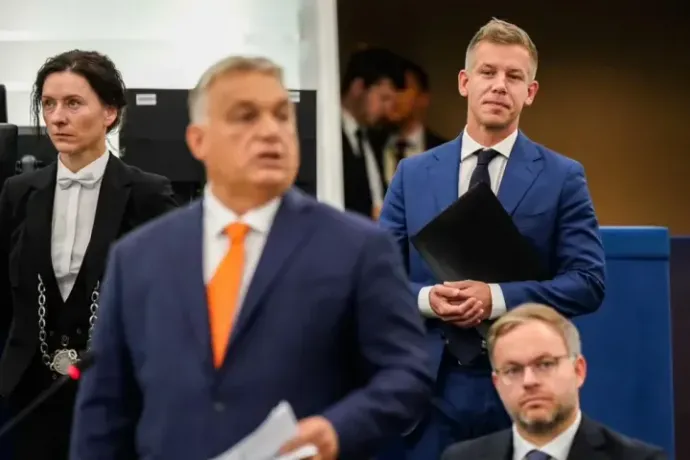
By early 2025, the team of 15–20 people working on the second floor of Fidesz’s headquarters on Lendvay Street in central Budapest had become increasingly frustrated. Sitting in an open space office separated by a large glass wall, they were reviewing Péter Magyar’s public statements but found nothing they could use against the politician.
This was so despite the fact that the team members had experience in this kind of work.
This was Fidesz’s central digital team, tasked with collecting—or “scraping”—politically relevant information appearing on social media or other public forums. The aim was to extract details that could be used to the political advantage of Fidesz.
The team was led by Magor Dukász, a key behind-the-scenes figure in Fidesz campaigns who had served as the party’s digital director for years. Dukász’s name appeared repeatedly in the Hungarian press after it emerged that one of his companies operated in the same office building as Megafon, which has financed social media influencers close to the Fidesz government.
During the 2022 election campaign, for example, the digital team reviewed the social media posts of Budapest mayor Gergely Karácsony and monitored his public statements. Then, after Péter Márki-Zay, the mayor of Hódmezővásárhely, won the opposition primary in the fall of 2021, they began to focus on him. “Once they had the posts and materials, they identified the parts they thought were vulnerable and usable,” said the source, who added that all of this went through various filters, and Fidesz’s communications team only began using them afterward.
The digital team also quickly seized on Márki-Zay’s interview excerpt from February 2022, a few days before the outbreak of the Russia-Ukraine war, in which the politician said that if elected, he would even provide military aid to Ukraine in accordance with a potential NATO decision. Relying on this, Fidesz’s propaganda machine began repeating the claim that the opposition would drag Hungary into war. With the help of the digital team, among others, Fidesz ultimately secured another two-thirds victory in 2022.
The team’s next major target was Péter Magyar, who, in a February 2024 interview with the independent Youtube channel Partizán, harshly criticized the Orbán government, from which he himself had long benefited. “After his March 15 demonstration, it was clear that he had burst onto the Hungarian social media scene,” —said the source about Magyar’s first major event, held in early 2024.
Fidesz’s digital team began scrutinizing Magyar’s statements in early April 2024. “They monitored how much he contradicted the Fidesz narrative,” said the source. In doing so, they analyzed, for example, whether Magyar said anything about the war or the government’s family policy measures that the ruling party could twist and use against him. However, despite their best efforts, they found nothing of the sort.
With his travels across the country, countless speeches, and lengthy interviews, Magyar posed an ever-greater challenge to the Fidesz team watching him with eagle eyes.
“It was an overwhelming onslaught,”
said the source, referring to periods when the staff had to track Magyar’s speeches—which often lasted for hours and stretched into the evening—on a daily basis. According to one source familiar with the team’s work, this represented a workload two to three times greater than what was typical during the Márki-Zay campaign.
Meanwhile, in early 2025, the Orbán government prepared a trap for Magyar and his Tisza Party, which had become Fidesz’s primary challenger. At that time, Viktor Orbán brought up several ideologically divisive issues that outraged liberal voters. These included banning the Pride parade and cracking down on civil society groups and independent media outlets. The goal was to draw Magyar into the ensuing controversies. Fidesz believed that if they could get Magyar on the same platform with liberal, left-wing voters, they could accuse him of being part of the network of George Soros, whom they portrayed as an enemy in their propaganda.
Magyar, however, dismissed these topics as irrelevant and did not engage in the debates surrounding them. Dukász, who heads the digital team, thus informed his superiors—András Gyürk, Fidesz’s campaign manager, and Antal Rogán, the cabinet minister overseeing government communications—that they couldn’t find any leverage against Magyar.
Meanwhile, Gyürk, who has been directing Fidesz’s campaigns since 2010, faced another problem. It was still unclear what the so-called “80-20” issue should be—the one that would allow Fidesz, as it was preparing for the 2026 election, to secure the support of 80 percent of voters while pushing the opposition into the remaining 20 percent. Fidesz had won the previous elections by following such a strategy. In 2010, “the past eight years” (of the previous Socialist-Liberal governments) was the central theme; in 2014 it was utility bill cuts; in 2018 migration; and in 2022, it was Russia’s war full-scale invasion against Ukraine.
According to government sources, this led to an increasingly tense relationship between Orbán and Gyürk in the spring of 2025. “The prime minister blamed the campaign manager for failing to handle the challenge posed by the Tisza party and for failing to push Magyar to the left block,” said a high-ranking official in the Orbán government.
By this time, it was evident that the government’s machinery, which had operated like a steamroller in the past, was facing serious problems this time around. Fearing a loss of popularity, in early June 2025 the so-called “transparency” bill, which aimed to cripple independent media groups and civil society organizations was removed from the parliament’s agenda. Three weeks later, the Pride Parade of the LGBTQ community was held in the capital with record attendance, despite the government’s ban.
As Tisza’s lead over Fidesz continued to grow in the polls, Gyürk’s position became precarious. “Gyürk indicated to Orbán that the election could not be won using his methods,” said a source familiar with the events, who added that the campaign manager also informed Orbán that he was resigning from his post. This aligned with Orbán’s own wishes, as by this point he was already considering not only a new campaign manager but also a completely different communication strategy.
II. The impulse campaign

In August 2025, Viktor Orbán traveled to Croatia to retreat with his confidants and work out the details of Fidesz’s election campaign. It was then that he posted the photo that has since become a meme: he and three colleagues, including Balázs Orbán, are leaning over a tablet displaying a male lion in the national colors with the caption “Victory Plan 2026.”
This photo clearly signaled that the duties of the campaign manager had been taken over by the prime minister’s closest confidant, Balázs Orbán, for whom a previously nonexistent position of political director was created within the government in 2021.
However, before this decision was made, the prime minister had been pondering for some time who he should entrust with leading the campaign following Gyürk’s departure. During this process—according to Fidesz sources—János Lázár, the minister of construction, and Péter Szijjártó, the minister of foreign affairs were also considered, but they did not accept the role. “The idea of bringing in someone from the outside who could see things with fresh eyes was also raised,” said a source close to the Orbán government who participated in several meetings where Fidesz leaders discussed the matter with US and UK campaign strategists. However, these discussions did not lead to any results.
At the same time, Balázs Orbán was constantly presenting the prime minister with his ideas. He argued that the methods of Donald Trump’s 2024 US presidential campaign should be incorporated into Fidesz’s campaign. “He thought those tactics could be copied,” a source close to the Fidesz government said.
He learned about these tactics because his positions brought him into contact with the US Republican world. The Mathias Corvinus Collegium, an educational institution with close ties to Fidesz, which he directed and was intended to train the future governing elite, for example, collaborated with several well-known figures from the pro-Trump subculture. In addition, he played an important role in organizing the CPAC Hungary conferences, which have in recent years become a meeting place for US Republicans and Fidesz politicians.
Based on his impressions in the United States, Balázs Orbán envisioned a campaign completely different from those Fidesz had run previously. According to a high-ranking government official in the Orbán administration, Balázs Orbán believed that the campaign strategy should not be built around major issues like migration, but rather that political battles should be fought on a daily basis, thereby “dominating every moment.”
These ideas also appealed to the prime minister, who, according to several Fidesz politicians, spoke to the Fidesz parliamentary group around May-June of last year about Balázs Orbán leading a so-called “impulse campaign.” It was then that it became clear within Fidesz that the political director would be appointed campaign manager, although the prime minister did not officially announce this until his speech in Kötcse last September. (Responding to our question about how Balázs Orbán was selected for the position, Fidesz communication chief Havasi said “this is what we got.”)
The term “impulse campaign” also referred to the increasingly prominent role social media was playing in Fidesz’s campaign. Balázs Orbán’s inner circle had concluded that Fidesz was at a disadvantage in only one area compared to the Tisza Party, which lacked an economic base and traditional media. That area was social media; in other words, Péter Magyar was far more adept at using Facebook than they were.
According to a source working on the Fidesz campaign, the campaign team believed that Tisza’s lead could be narrowed by strengthening the party’s presence on social media.
According to this source, the campaign staff did not meaningfully address the social discontent that had led to Tisza’s rise. Instead, they simply attributed the situation to being at a disadvantage in the online space.
To close this gap, the group known as Harcosok Klubja (Fight Club, HK), which supports Fidesz on social media, was created in the spring of 2025. It soon became clear, however, that they were unable to produce any meaningful results. According to Telex’s “Championship of Likes”—which tracks politicians’ Facebook activity—in the weeks following its creation, the HK increased the sharing of posts by well-known Fidesz figures by only a few percentage points. This rate did not increase significantly in the following months either.
This came as no surprise to Fidesz politicians, as they had already faced problems with recruiting members. The party’s constituency chairpersons were required to recruit 100 people in the first round, and then another 100 later on. According to the party headquarters’ plans, they intended to eventually increase the membership to 1,000 per constituency, but the constituency chairpersons were even struggling to meet the 200-member quota. One politician, for example, said that they only managed to meet the quota by adding one of their children and their 80-year-old neighbor to the group.
“We were deceiving ourselves,”
the politician said, noting that these people did not make any effort to spread Fidesz’s messages.
The campaign team also recognized this problem. For this reason, in his speech in Tusnádfürdő (Romania) in July 2025, the prime minister announced that they would establish the so called Digitális Polgári Körök (Digital Civic Circles, DPK) for Fidesz supporters. “This rebranded the Fight’ Club,” said a source working on the Fidesz campaign. According to him, this was necessary because the HK had increasingly become a subject of ridicule: phrases mocking the ruling party’s comment culture began spreading as memes.
Although Fidesz’s voter base initially welcomed the DPKs with enthusiasm, this too proved not to be a silver bullet. By last fall, more and more people within the ruling party had come to realize that the DPKs weren’t working. “Anyone with eyes could see it, it was obvious from the “Championship of Likes” articles, said a source working on the campaign, signaling that he, too, had followed Telex’s monthly summaries showing that Péter Magyar remained the Hungarian politician with the highest reach on Facebook, while the number of Fidesz figures among the political profiles generating the most interactions was steadily declining.
According to Fidesz sources, the campaign team stood by the DPKs despite the problems. On the one hand, they believed that even this was better than ceding the online space entirely to the opposition; on the other hand, those involved in operating the system had a vested interest in maintaining it due to their own influence and positions.
Starting last fall, Fidesz also sought to boost its online communication with the help of the party’s individual candidates. The campaign team sent topics to the candidates on a daily basis so they would know what to post on their Facebook pages. In addition, they constantly provided the candidates with advice. Among other things, they were advised to create short, static reel videos lasting just a few seconds. “They also said that the lower the quality, the better it works,” one candidate noted.
Not all Fidesz candidates were able to identify with the top-down online campaign. One candidate, for example, complained that in practice, the advice received from the campaign team often didn’t work. The content and formats suggested by Balázs Orbán’s team frequently received only a few dozen likes. According to the politician, this often made their social media efforts seem like “pointless guessing.”
Another constituency candidate pointed out that the campaign staff allowed them only minimal autonomy. As an example, they explained that the staff did not count posts about the opening of playgrounds toward the nearly ten mandatory daily posts, since those posts were not about Russia’s war against Ukraine. The politician brought this up with Alexandra Szentkirályi, who held a leading role in the campaign team, and she responded by saying,
“You can’t win with a ‘cute and fluffy’ campaign.”
By this point, the campaign’s focus had increasingly shifted toward the war.
III. Threats instead of a spending spree
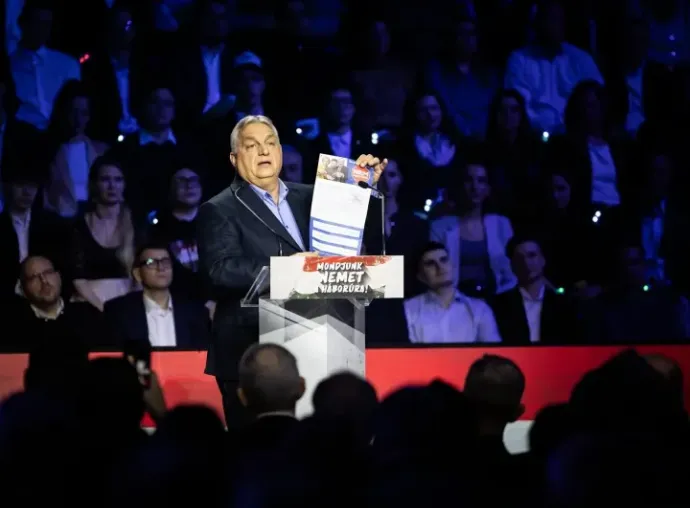
On January 26 of this year, a video was posted on Viktor Orbán’s Facebook page indicating a shift in the campaign’s direction. In it, the prime minister claimed that the statements made in recent days by members of the Ukrainian government criticizing him were part of “a series of coordinated measures.” According to him, the Ukrainians intended to interfere in the Hungarian elections through these actions. He therefore instructed foreign minister Péter Szijjártó to summon the Ukrainian ambassador.
Although relations between the Hungarian and Ukrainian governments had been tense for years, the prime minister—according to a source with insight into the Orbán government’s operations—wanted to further escalate this conflict starting in January 2026. He resorted to this because Fidesz’s support had not grown in recent months, so he wanted to try a new approach.
A few months earlier, the ruling party still had high hopes related to its spending spree. Last summer, the prime minister regularly spoke about how his government would provide a 3% subsidized mortgage to young people buying their first home and would gradually exempt mothers of two and three children from paying personal income tax. Last fall, Orbán came up with additional handouts: for example, he announced the introduction of a 14th-month pension and a preferential loan program for small businesses.
These measures were carefully orchestrated. As part of this, Fidesz politicians claimed that Tisza would increase public burdens if it came to power.
“They take away, we give,”
a source familiar with Fidesz’s internal workings said, capturing the essence of the strategy. The groundwork was laid by articles published at the pro-government online news site Index in August and November of last year. Citing Tisza’s alleged internal documents, these articles claimed that the party was preparing for significant tax hikes should it come to power. (Tisza called the cited documents forgeries and filed several lawsuits. The court ordered Index to publish a correction regarding its article from November, which the site complied with after the election. In it, Index acknowledged that the document presented did not contain Tisza’s tax plans.)
Although Fidesz officials felt confident last fall when communicating about the “Tisza tax”, by the end of the year it became clear that their strategy wasn’t working. This was also indicated by a December survey by the 21 Research Center (21 Kutatóközpont), which found that Tisza was ahead of Fidesz by 17 percentage points among voters who were certain of their party choice. According to the research, the ruling party was unable to improve its popularity: while Fidesz’s support began to grow slowly last summer, by the end of the year this momentum had completely evaporated.
For this reason, in January of this year, Fidesz’s campaign team began brainstorming about what direction to take the campaign in for the remainder of the campaign period. “In other words, how to turn the situation into a Fidesz victory,” said a source familiar with Fidesz’s operations, who noted that Századvég—the Orbán government’s leading research institute—played a decisive role in these considerations.
Early this year, the campaign team drew inspiration from one of the research institute’s surveys. This was a so-called thematic survey that examined which issues and problems concern voters in their daily lives. According to a source familiar with the details of the research, Századvég found that the war in Ukraine ranks high on people’s list of concerns.
“That is why the decision was made in January 2026 to shift the focus back to Ukraine,”
said the source familiar with the events, who noted that the campaign team made this decision with the prime minister’s approval. From that point on, messages about the dangers of war and the threat posed by Ukraine provided the ammunition for Fidesz’s impulse campaign focusing on the online sphere.
For example, at the end of February, Szijjártó announced that the Hungarian government would block the €90 billion EU loan to be provided to Ukraine, as they claimed Ukraine was reluctant to restore the Druzhba pipeline, which supplies Hungary with crude oil. Tensions between the two countries were heightened when, in early March, the Hungarian Tax Authority (NAV) and Center for Counter-Terrorism (TEK) raided a Ukrainian money transport passing through Hungary on suspicion of money laundering. The war hysteria was further fueled by an AI-generated video posted on the Budapest Fidesz Facebook page, in which a Hungarian little girl’s father is shot in the head by an officer wearing clothes reminiscent of the Nazi uniform.
While Fidesz politicians were busy scaring people with the Ukrainian threat, in mid-February pensioners received the first installment of their 14th-month pension. However, this did not play a prominent role in the campaign.
“It wasn’t even properly communicated; this issue practically faded away,”
said a source with insight into the Orbán government’s operations.
For Fidesz politicians, however, it also became clear that the subject of war was not really resonating with voters either. By early March, Századvég had completed another internal survey containing data on all individual constituencies. This comprehensive survey concluded that Tisza would likely outperform the ruling party in the party-list vote. However, the researchers thought that Fidesz could still remain in power thanks to its strong performance in the individual constituencies.
According to a source familiar with parts of the research, Századvég outlined two possible scenarios for the expected election results. Under the optimistic estimate, even if Tisza wins the party list vote by a few percentage points, Fidesz could win 66 of the 106 individual constituencies. Thus, Fidesz would ultimately hold a total of 103–115 seats in the 199-member Parliament, which would be sufficient to form a government.
According to the other, more pessimistic estimate, Fidesz would win 54 individual constituencies, giving it a total of approximately 85–95 seats. Since this is not enough to form a government on its own, in this case Fidesz would have needed far right Mi Hazánk as a coalition partner. According to a source familiar with Fidesz’s internal workings, this was the worst-case scenario acknowledged within the party during the campaign. (Regarding this, Havasi wrote that “There were as many surveys as stars in the sky.”)
Fidesz’s precarious position was evident when they resorted to a previously unusual campaign tactic. On March 10, they announced that the prime minister would embark on a public tour of the country. With this move, Orbán stepped out of his comfort zone; in previous years, he had only campaigned before select audiences, excluding the general public, but this time anyone could attend his events.
However, the prime minister made it clear to a small circle of people that he was dissatisfied with the way the campaign was going.
IV. The collapse
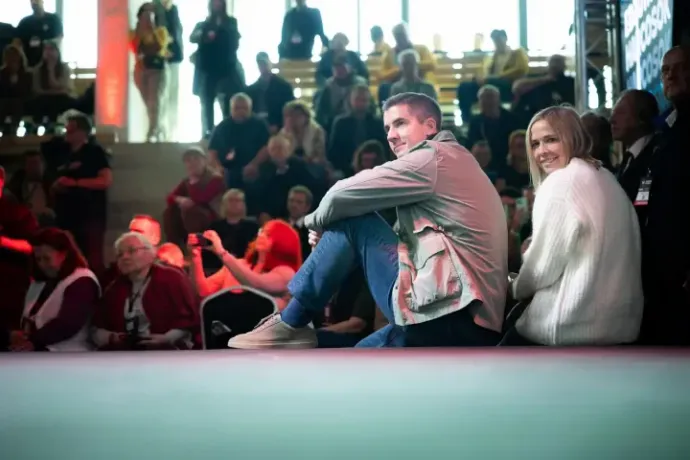
During the final month of the campaign, Orbán continued to make optimistic and confident public statements about his party’s prospects, but in private he appeared more uncertain and frustrated. In early March, for example, he complained to a senior Fidesz politician that he could not see the details of the campaign for the coming weeks. “I’m sure there are some plans, but I haven’t been told about them yet,” he told his conversation partner.
With this, the prime minister was hinting at being dissatisfied with the way Balázs Orbán was managing the campaign. He was not alone with this; other Fidesz politicians also felt that the campaign manager was unable to keep things under control. Because of this, the pressure was mounting on Balázs Orbán.
Last summer, when he took over the campaign, the prime minister’s political director was confident. “He thought, like a military commander, that he understood the daily political landscape and would tell us where to strike,” said a source working on the Fidesz campaign. One of the party’s leading politicians noted that the prime minister had initially planned for Balázs Orbán to effectively take over the campaign leadership, just as András Gyürk had done previously.
However, this did not happen. According to sources familiar with the inner workings of the campaign, Balázs Orbán—known more as a theoretical thinker—was ill-suited for the practical work associated with his new position.
“He wasn’t assertive enough; he was often indecisive,”
said one source, noting that the position of campaign manager—which requires quick decisions and constant organization—was less suited to Balázs Orbán.
As a result, mistakes occurred that were previously uncharacteristic of Fidesz campaigns. For example, early this year, the party’s campaign newspaper was printed without the imprint. Since election publications are required to indicate who is responsible for the content, the absence of the imprint could have posed a legal problem for Fidesz. According to a source working on the campaign, the information that needed to be in the imprint was subsequently added to the newspaper in the form of stickers or, in some places, handwritten notes.
Balázs Orbán’s situation was further complicated by the fact that the leaders of previous Fidesz campaigns found it difficult to accept being sidelined. Among them was, for example, Gábor Kubatov, who was responsible for signature collection and mobilization; although he remained a member of the campaign team alongside Gyürk, this was by no means as influential a position as before. Kubatov found it difficult to accept being sidelined and—according to a source working on the campaign—repeatedly harshly criticized Balázs Orbán over the campaign’s stumbles.
Parallel to these developments, Fanny Kaminski—who has a background in tabloid media and has been working on the prime minister’s communications team for years—became increasingly influential. Those close to the prime minister observed that Kaminski’s voice was carrying more and more weight in Orbán’s inner circle.
For example, a source who had a lengthy private conversation with the prime minister last year reported that Kaminski sat down with them several times during the conversation and asked how they could pose a trap to Péter Magyar.
“It seemed like Fanny was the political mastermind,”
the source said, referring to the fact that Kaminski was also involved in strategic planning.
In addition, she became essential in organizing the prime minister’s campaign events. One constituency candidate recounted that when he asked to attend Orbán’s campaign event held in his constituency, Kaminski did not allow it. “She said this was the program of the boss,” the politician said about the discussion with her.
As a result, control increasingly slipped from Balázs Orbán’s hands. According to a high-ranking official in the Orbán government, the role of the prime minister and Kaminski gradually increased and by March of this year they were effectively in charge of the campaign. (Responding to our questions, Kaminski called this “fake news.”)
However, this did not lead to a significant turnaround; for example, the March 15 pro-government Peace March also failed to make a decisive impact. “We couldn’t repeat crushing the opposition the way we did on March 15, 2022,” said a source working on the campaign, referring to the fact that four years ago it was clear that there were more people at the Fidesz event than at the opposition’s. This time, that clear show of strength failed to materialize, leading to a war of numbers between the parties over which rally had more attendees. (Based on a research led by the independent Sociologist Andrea Szabó, Tisza’s event clearly had the larger attendance.)
Throughout the campaign, Fidesz constantly struggled with its inability to bring enough people to its events. “It was clear that Fidesz had run out of steam,” said a former high-ranking official in the Orbán government. By this he meant that, due to a lack of sufficient supporters for Fidesz rallies, government employees were repeatedly mobilized; and at the Peace March, according to the former government official, many participated only in exchange for full board and vouchers.
The days following March 15 turned out even worse for Fidesz. On March 25, Direkt36 published a video in which Bence Szabó, a captain with the National Bureau of Investigation, spoke about how the Hungarian secret service had been covering for the mysterious figures working to undermine the Tisza Party. On April 2, Army Captain Szilveszter Pálinkás told Telexthat the prime minister’s son, Gáspár Orbán, was behind the government’s planned military mission to Chad, and that he would consider it acceptable if Hungarian soldiers were to die during the mission in the African country.
The fact that members of the armed forces had come forward publicly to make harsh allegations about corruption and abuse of power within the government caused bad optics. The campaign staff were also aware that these interviews posed a serious threat to them.
For this reason, the prime minister commissioned another survey from Századvég, this time based on face-to-face interviews. According to a source familiar with the data, the survey—completed a few days before the election—yielded surprising results: it showed Fidesz leading Tisza by two percentage points. This was in total contrast with the results of not only independent surveys but even with the findings of Nézőpont Institute, which was close to the government, and which showed Tisza’s increasing popularity. “Századvég had greater influence; the Fidesz leadership tended to believe them,” explained a source with insight into the party’s operations.
Even on election day on April 12, at the results-watching party held in downtown Budapest, Fidesz’s leadership still put its trust in the Századvég poll. They believed that the high turnout meant that the less enthusiastic voter bases had mobilized during the campaign, and the result predicted by Századvég would materialize.
This hope was also reflected in the way the Fidesz leadership reacted on election night to the polls conducted by independent pollsters.
"They thought they were trying to delegitimize Fidesz’s victory with these,”
said a source familiar with the events, referring to the polls published by the 21 Research Center and Medián after the polls closed, which showed a substantial lead for Tisza. Due to the unfavorable data for Fidesz, the Center for Fundamental Rights (closely connected to the Fidesz government) released its projection at 7:30 p.m., showing a 2.5-percentage-point lead for Fidesz among voters who were certain of their choice. “This reflected the Fidesz leadership’s expectations,” said one source.
Shortly thereafter, the ruling party’s leaders realized that things were turning out worse than they had anticipated. One of Fidesz’s constituency candidates called the prime minister before 8 p.m. to tell him that he was going to lose in his district. The politician knew this because by then it had become clear that he had lost in several smaller towns that he had won in 2022. Based on this, it was clear to him that he would lose the entire constituency.
The prime minister replied that “the problem is nationwide.” He also added that “we are in a very difficult situation.” By then, Orbán already knew they would lose the election, which, according to sources familiar with the events, he received with anger, raising his voice. Later, it also became clear to him that Fidesz had suffered a historic defeat. In contrast to the results predicted by Századvég, they were able to win only ten individual seats.
Tisza secured a two-thirds majority, bringing Viktor Orbán’s reign to an end after 16 years.
(András Pethő contributed to this article.)
This article is part of a partnership between Telex and Hungarian investigative journalism center Direkt36.