Slovak FM lectures Péter Magyar for talking about Hungary being its own neighbour
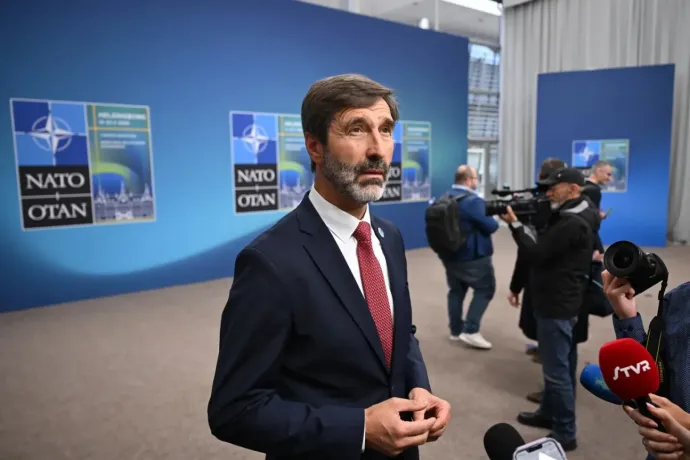


“Hungary supposedly borders Hungary. This absurd and historically inaccurate statement was uttered by the new Hungarian prime minister on Kossuth Square on the occasion of The Day of National Unity. He literally said that Hungary is perhaps the only country in the world which is its own neighbour…”–Slovak Foreign Minister Juraj Blanár wrote on Facebook, according to Új Szó. Blanár was referring to the speech delivered by Hungarian Prime Minister Péter Magyar in Budapest’s Kossuth Square on Thursday to mark The Day of National Unity.
At the event commemorating the signing of the Treaty of Trianon in 1920, when Hungary lost two-thirds of its territory, Magyar spoke about the country’s current position at the international level. In his view, we must be a strong ally and a reliable partner. “Everyone knows that this is especially true in our case, because we are perhaps the only country in the world which is its own neighbour,” he continued, and added: “We need to have a good relationship with the countries surrounding us,” which has not always been the case in recent years, as relations with the Visegrád Four have also soured.
Previously, during his speech, Magyar also spoke about the land confiscations in Slovakia, which are primarily affecting Slovak citizens of Hungarian ethnicity: “We must stand by our fellow Hungarians in Upland (Felvidék), from whom private property is still being confiscated today, citing the Beneš Decrees.” According to the Prime Minister, “such incidents, which trample on European values and the rule of law, are still occurring in the hundreds.” He also mentioned a Slovak law under which the decrees cannot be challenged, threatening anyone who dares to criticize them with imprisonment.
The Slovak Foreign Minister—a member of Prime Minister Robert Fico’s Smer (Direction)—responded to all this by stating that “your borders, and thus ours as well, were clearly defined in the Trianon peace treaty following World War I, and were reaffirmed after World War II, in which, incidentally, Hungary was on the losing side.” He added, without mentioning the Slovak fascist puppet state operating during the world war, that “out of respect for the heroes of the Slovak National Uprising, through which our country stood firmly on the side of the anti-fascist coalition, we reject any attempt at calling into question the borders, territorial integrity, or sovereignty of the Slovak Republic.”
Blanár also noted that if the two countries are to maintain lasting, friendly, and constructive relations, this must be achieved without the false rhetoric of irredentism or the questioning of history.
Incidentally, the newsletter of the Hungarian-language paper Napunk, published in Slovakia, framed Péter Magyar’s remark as similar to the rhetoric commonly used by Fidesz politicians. In 2010, a similarly worded phrase caused diplomatic tension; according to the paper, then-Foreign Minister Miroslav Lajčák also protested its use. This time, however, the Slovak government did not object to the use of the term “Felvidék,” as it had in the past. Our previous article detailed why this expression is an extremely sensitive issue in Slovak politics.
For more quick, accurate and impartial news from and about Hungary, subscribe to the Telex English newsletter!