Magyar: Case files of clemency case to be published
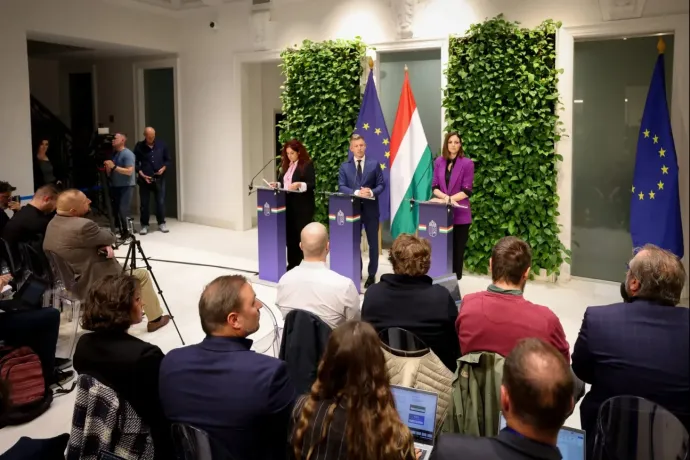

Péter Magyar's government held its second official cabinet meeting on Monday, this time in Budapest, which was followed by a long press conference about the subjects discussed at the meeting, as well as the next steps the government intends to take on several crucial matters.
The asbestos contamination along the Austrian border
The PM started by announcing that they will immediately investigate the case of the crushed rocks from Austria and will establish a task force to look into the asbestos contamination previously uncovered by Greenpeace.
Earlier this year, Greenpeace uncovered severe asbestos contamination in both Hungary and Austria, in public areas where aggregates were presumably delivered from some now-closed mines in Burgenland—following this, the Vas County Government Office also began its own investigation. It was found that several streets in the Hungarian towns of Szombathely and Sopron had been paved with the crushed rocks containing asbestos, and several other areas along Hungary’s western border regions are probably also affected. The Hungarian state had previously agreed to cover the costs of protective measures and of providing damage control.
The Prime Minister said that he intends to bring up the subject with the Austrians during his upcoming visit there, and will stress that they expect Austrian mines to stop extracting and then selling such heavily contaminated materials to Hungarian businesses. He said it will take a while before it is clear whether the businesses in question were aware that these materials were so heavily contaminated, but the administration would like to make sure that those responsible for the damage are held responsible.
Péter Magyar also added that added that Minister of Health Zsolt Hegedűs already has suggestions on how to handle health screenings for the affected population and that the national Chief Medical Officer, the Minister Responsible for the Environment, and officials from other ministries are all participating in a working group addressing this contamination.
Poland, then Austria
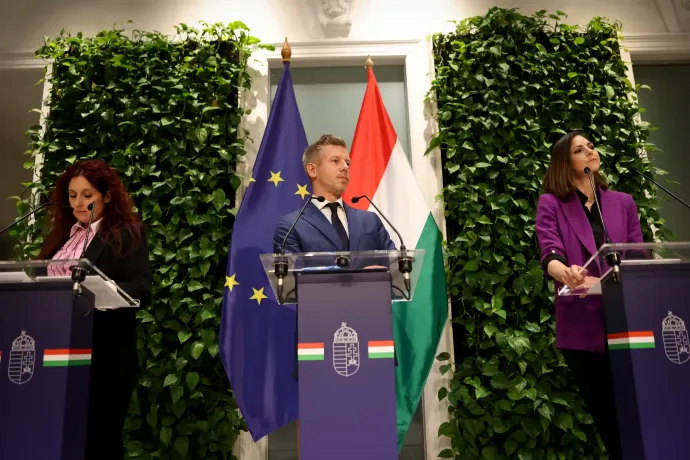
In the coming days, the Prime Minister and a sizable delegation (Foreign Minister Anita Orbán, Minister of Economy and Energy István Kapitány, Defense Minister Romulusz Ruszin-Szendi, Minister of Agriculture Szabolcs Bóna, Minister of Transportation and Investment Dávid Vitézy, and Minister of Culture Zoltán Tarr) will be traveling to Poland and Austria. According to the announcement, they will travel to Kraków on a scheduled commercial flight with a layover in Vienna. They will first meet with the Archbishop of Kraków, then take a train to Warsaw, where they will hold talks with the Polish government, the Polish president, the mayor of Warsaw, and representatives of NGOs, before traveling on to Gdańsk.
In response to a question from the press about his trip to Poland, Magyar said that the ministers accompanying him are, to some extent, an indication of the topics that they intend to discuss, but they essentially see the trip as an opportunity to establish initial contact—it will mostly be about feeling things out.
Finally, on Thursday morning, they will travel on to Austria, where they will meet with the Austrian chancellor and the Austrian president.
Securing EU funds a top priority
Securing EU funds remains a top priority for the Tisza government, Péter Magyar said. He exchanged letters with Ursula von der Leyen over the weekend, and negotiations between members of the Hungarian government and the European Commission have begun today, with the EC delegation scheduled to remain in Hungary until Friday. Magyar hopes that by the time he goes to Brussels, they will be able to sign the agreement on EU funds, and the funds could arrive in Hungary by this fall.
The Prime Minister later added that the requirements for the funds include 27 major milestones, hundreds of smaller milestones, reforms, and a list of projects; the latter being the most difficult part, as it remains to be seen which projects can still be implemented in time.
He also said that there are certain requests of the Commission that will not be fulfilled. As an example, he said that there's an expectation to stabilize the budget, but then there's an expectation to introduce certain taxes. He said that Hungary will not meet these requirements given the current fiscal situation.
Concerning the daily fine of one million euros imposed for rejecting the Migration and Asylum Pact, Magyar said that there are other countries which also do not accept illegal migrants but they do not have to pay one million euros a day because of it. Poland is one such example, where Magyar plans to discuss this as well. “Perhaps Finland is like that too—there are no migrants, but there is money,” the Prime Minister said. They need to find a solution to prevent illegal migrants from entering the country without having to pay the daily fine, which now amounts to more than one billion euros.
Hungarian minority’s language rights a prerequisite for first chapter of Ukraine’s accession
Péter Magyar said that he recently spoke with António Costa, informing him that the Hungarian government has begun negotiations with the Ukrainian side to restore the language rights of the Hungarian minority there. They see this as a prerequisite for the European Union potentially opening the first chapter of the country's accession process. Magyar understands that the Ukrainian side is also open to negotiations.
He later confirmed that if Ukraine wants to join the European Union, it must first settle the situation of the Hungarian minority.
The Prime Minister said that the current negotiations between the two countries are at a technical level; which is the standard diplomatic approach—they are assessing the attitudes of the parties and whether their positions could converge, and if so, then a meeting between the foreign ministers could take place. He said that he continues to stand by his offer to meet with the Ukrainian president in Berehove, provided that the situation of the Hungarian minorities in Ukraine is resolved.
Case files of the clemency scandal to be opened
The Prime Minister said that last week, the government decided to examine the file of “the clemency case” (which led to the resignation of then President Katalin Novák and Justice Minister Judit Varga) which has now been done so far as the file held at the Ministry of Justice is concerned. Details of this will be made public on Tuesday morning, while making sure that privacy rights are respected. According to Magyar, what can already be revealed is that when the President of the Republic granted the pardon in question, the Minister of Justice had submitted a package containing more than 40 requests. Among these, she made three recommendations for pardons; the case from the Bicske children’s home was not among them, as she submitted that one with a negative recommendation.
Ultimately, it was then President Katalin Novák who changed this decision for reasons and grounds which still remain unknown.
Magyar also said that it will soon become clear which lawyer drafted and countersigned the petition. The background reports will also be made public, in which former employers made statements about the individual in question; according to the PM, everyone there said they fully agreed with him being pardoned.
Magyar had asked President Tamás Sulyok to release the entire dossier held at the Presidential Palace which could reveal which considerations led to the decision to grant a presidential pardon in the case. He believes he speaks on behalf of all Hungarians when he says that everyone is right to expect that the background of this case be made public.
In response to a question from Telex about whether the documents to be released on Tuesday contain any information on why, after Katalin Novák granted the pardon, Judit Varga countersigned it, Magyar said that, in his view, what happened was that when the pardon with the amended terms returned from the head of state, these 40 cases were put forward all at once; the submission went through multiple levels, and there was no indication anywhere that one of the decisions had been changed. According to Magyar, this was a mistake on the part of the cabinet, but ultimately the minister in charge had to take responsibility for it, which, in his view Judit Varga did.
A thorough review of the public media coming soon
According to the government’s position, the role of public media would have been to provide truthful, balanced, and comprehensive information to all Hungarian citizens, but it has been clear to everyone that they had failed to meet these criteria. The Magyar administration believes that public media must never serve a single party or political side, as it operates on Hungarian taxpayers’ money and is therefore accountable to them. For this reason, the government will conduct a thorough review of the public media’s operations and background, with the goal of establishing a public media provider that genuinely fulfills its public service duties and provides balanced information.
The outgoing government had falsified this year’s budget
The Prime Minister announced to the press that the outgoing government had falsified this year's budget. For example, a sum of 87.2 billion forints spent on the Budapest-Belgrade railway—which had already been built and paid for—was not included in it, presumably to make the budget deficit appear smaller ahead of the election.
He claimed that the missing items located at the Ministry of Construction and Transportation total 286 billion forints.
The Fidesz faction was quick to react to the PM's announcement and said that it is not true that infromation pertaining to the budget had been withheld by the Ministry of Construction and Transportation. Nevertheless, Péter Magyar asked Finance Minister András Kármán to assess the actual budgetary situation of the country and identify areas where adjustments may be necessary. The government’s goal is for the budget to guarantee Hungary’s financial stability. They believe that fiscal policy can only be based on an accurate assessment of the situation and transparent budgetary data.
Reviews, reviews, and more reviews
The Prime Minister said he had requested István Kapitány to examine the enlargement of the Paks Nuclear Power Plant and the delays thus far, as well as the contracts for the whole project and the elements which have already been paid for, as well as the progress of the investment, and to make recommendations for moving forward.
The cabinet also made a decision to investigate the assets of the Hungarian Air Force having been used for government and diplomatic missions. According to the government, aircraft of the Hungarian Armed Forces cannot be used for luxury travel; the air fleet is maintained by Hungarian taxpayers, so all aspects of its use must be justified, verifiable, and subject to public accountability. They will investigate whether their use in recent years has met all of these requirements.
The government is also conducting a review of the diplomatic passports which have been issued in recent years; according to officials, more than a thousand such passports are in circulation without justification. On Monday, violinist Zoltán Mága for example, confirmed to Telex that he had also received a diplomatic passport. His name has also come up recently in relation to huge amounts of public funds being handed out by the former Minister of Culture and Innovation to Fidesz-affiliated individuals. The review will cover the number of passports, the grounds for their issuance, and the practice of granting special authorizations.
For more quick, accurate and impartial news from and about Hungary, subscribe to the Telex English newsletter!