He invited him without telling him everything: By inviting Netanyahu, Magyar ran into his first foreign policy tangle
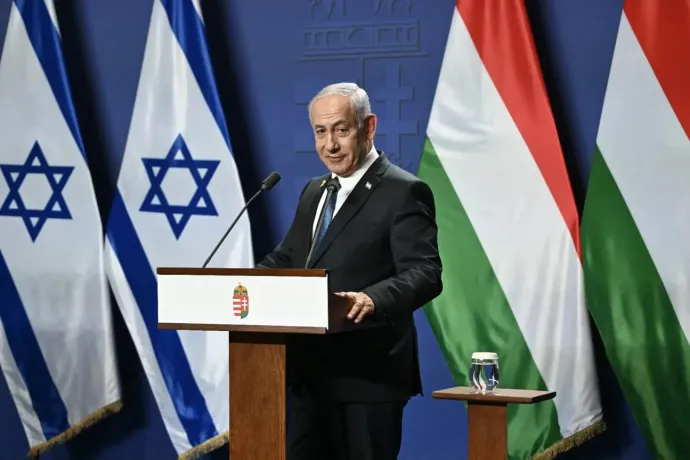


The week and a half that followed the elections brought unexpected twists and turns in the relationship between the newly elected Hungarian government and the Israeli government. Three days after the election, on April 15, Israel’s ambassador to Hungary and the Israeli Ministry of Foreign Affairs announced in a statement that Péter Magyar had invited Benjamin Netanyahu—who is subject to an international arrest warrant—to Budapest for the October 23 commemoration, along with numerous other foreign leaders, and that he had accepted the invitation and plans to come here in October.
Five days later, on April 20, Péter Magyar stated that the fact of the invitation does not mean that the Israeli Prime Minister will not be arrested upon his arrival in Budapest—if he will still be under an international arrest warrant.
Israeli diplomats failed to respond to this latest announcement at all; they did not issue a statement, nor did they reveal whether they would cancel Netanyahu's planned trip to Budapest in light of Magyar's announcement. We sent detailed questions on the subject to several Israeli diplomatic bodies, but none of them provided a substantive response, so it is unclear what their plans are with regard to the October 23 commemoration.
But what exactly was this turn of events, what did Péter Magyar say, and what does this mean in terms of the Magyar government's foreign policy?
Many were outraged when Orbán welcomed Netanyahu in Budapest
Benjamin Netanyahu’s international reputation has been severely tarnished since the beginning of the war in Gaza. The International Criminal Court (ICC), which comprises mainly European, Latin American, and African countries, issued an arrest warrant against him in October 2024, accusing him of crimes against humanity, including the deliberate use of starvation as a weapon of war, war crimes constituting deliberate attacks against the civilian population, and murder. A similar international arrest warrant issued by the ICC is also in effect against Vladimir Putin.
According to the rules of the International Criminal Court, member states are under obligation to apprehend persons arriving on their territory who are wanted under an international arrest warrant. Most member states respect this, and accordingly, in recent years neither Netanyahu nor Putin—who is also accused of war crimes—have been invited to their territories.
There have been occasional hesitations, however; German Chancellor Friedrich Merz, for example, last year said he would try to “find a way” to invite Netanyahu to Germany despite the arrest warrant, but this has not yet materialized. In recent years, mindful of the risk of arrest during his international travels, Netanyahu has even avoided flying over Western European countries.
However, the International Criminal Court cannot compel its member states to actually comply with the requirement of apprehending wanted persons. Taking advantage of this, the outgoing Orbán government has repeatedly indicated that it does not intend to comply with the ICC’s applicable rules; in 2023, for example, they announced that they would not arrest Putin (who is under an arrest warrant) if he were to arrive in Hungary. Then, in April of last year, Benjamin Netanyahu came to Budapest on an official visit and was not arrested. Before the Israeli Prime Minister’s arrival, the government announced that it would initiate Hungary’s withdrawal from the International Criminal Court, which was confirmed shortly thereafter by the Fidesz majority in parliament.
When questioned about Netanyahu, Magyar started talking about criminals
At that time, it was unclear what position the Tisza Party—which was then considered merely a strong challenger—would take on this issue. Although Péter Magyar was careful throughout the campaign to say as little as possible about the highly divisive issue of the Gaza war—which could alienate some of his supporters and potential supporters—he was asked about it at least once.
Last August, shortly after Netanyahu’s visit to Budapest, at an event in Kecskemét, a young man complained about the Orbán government having allowed Netanyahu— wanted internationally on suspicion of war crimes—into Hungary, and the fact that the government had openly declared that it would not comply with the International Criminal Court’s decision. Péter Magyar did not even wait for the young man who raised the issue to finish his question; rather, he interrupted him and said:
“The Tisza government will comply with the International Court’s decision. And let there be no doubt as to why this is happening—this, too, is a business deal, a joint business deal. Perhaps the representative (a Fidesz municipal representative had previously asked a question, provoking disapproval from the audience—ed.) can tell us about the Israeli spyware that the Hungarian government uses to monitor and intimidate civilians, journalists, and politicians. Under the Tisza government, we will abide by international conventions. There will be no more cases where a politician who is accused of budgetary fraud and other crimes in his own country can flee to Hungary from Poland, and then be granted political asylum by the government, as was done for Gruevski and other criminals. Hungary will not become a dumping ground for criminals, whether the representative and her colleagues like it or not.”
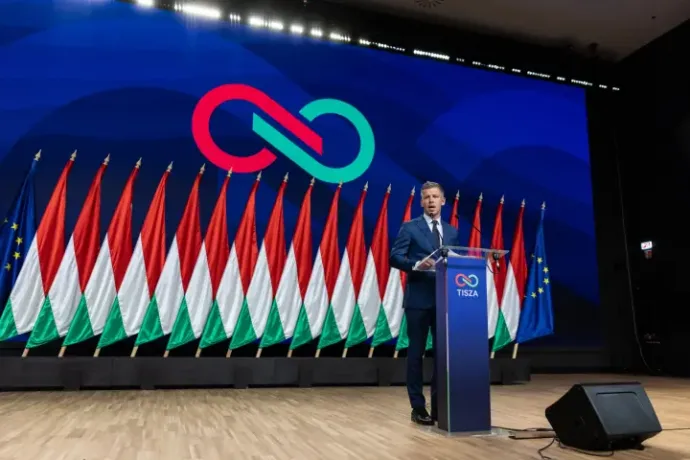
Magyar thus accused the Orbán government of allowing Netanyahu—who is subject to an arrest warrant—into the country purely for business interests, and strongly implied that the Tisza Party would not do so if it came to power. Then, still in response to the question about Netanyahu, Magyar shifted the focus to Polish politicians wanted in their own country and to Gruevski of North Macedonia, stating in relation to them that “Hungary will not become a dumping ground for criminals.”
Communication became contradictory after the election
After winning the election, at an international press conference held on April 13, Deutsche Welle asked Magyar about Netanyahu and the International Criminal Court. He replied that, to his knowledge, Hungary’s withdrawal from the International Criminal Court had begun and would be completed in June, and that the process could not be stopped, adding: “We will reverse this though. Not reverse it, but we will re-initiate Hungary’s admission into cooperation with the International Criminal Court. I believe it is in the interest of the entire international community and of Hungary that we remain there, just as we have been there until now.”
Magyar then spoke about the close Israeli-Hungarian ties, and said, “I cannot guarantee—of course, every case and every decision must be examined—that Hungary will continue to block the EU’s decisions regarding Israel. But as I have said, I don’t want to get ahead of myself here. We will have to see what decisions the EU is making, what the interests are, and what the truth is.” Magyar was referring here to the fact that under the Orbán government, Hungary had blocked—or attempted to block—a proposal for EU sanctions against Israeli settlers. According to Magyar’s statement at the press conference then, once Hungary’s withdrawal from the International Criminal Court is finalized this summer, we will reapply to join the organization.
Two days later, on April 15, the Israeli Embassy in Budapest announced that a "warm" introductory conversation had taken place that day between Péter Magyar, the prime minister-elect, and Israeli Prime Minister Benjamin Netanyahu. According to their statement, Magyar had invited Netanyahu to the state ceremony marking the 70th anniversary of the 1956 Revolution, which will be held in Budapest in October, and the Israeli Prime Minister had accepted the invitation. The invitation makes sense in light of the fact that, of the hundreds of thousands of refugees who left the country during and after the 1956 Revolution, thousands later settled in Israel. Netanyahu is thus the Prime Minister of many refugees from 1956, as well as of countless descendants of those refugees.
After the news about this broke, some began to argue that Magyar had broken his previous promise, while others—including the Szikra Movement and Member of Parliament Bence Tordai—voiced their protest. A theory also emerged in the international press that Magyar had not actually invited Netanyahu, but rather that Netanyahu had made that up himself, hoping that Magyar would later not back out of such a gesture.
He invited him, but did not promise that he would not be arrested
We were finally able to address our questions about the invitation to Péter Magyar during his press conference held on Monday, April 20. There, he confirmed that he had invited every head of state he spoke with to the October 23 commemoration, including Netanyahu.
Magyar also clarified his previous statement that, under his leadership, Hungary intends to rejoin the ICC. He said that his colleagues have examined this issue and have concluded that the withdrawal process can still be stopped, which is what they intend to do, meaning that Hungary will remain a member of the organization.
The president of Tisza added: “I believe I wasn’t being disingenuous in any way; if a country is a member of the International Criminal Court and a person who is wanted by the court enters our territory, then that person must be taken into custody.” When our colleague asked if he had said this over the phone, Magyar replied: “I don’t have to explain everything over the phone; I assume that every head of state and government is aware of these legal provisions.”
The scene in question may be viewed here:
Magyar’s statement quickly made international headlines, with European and British newspapers also covering the topic. Israeli newspapers, from Ha’aretz to The Times of Israel, also covered the subject on their front pages.
Following Magyar’s press conference on Monday, we sent questions to the Israeli Embassy in Budapest, the Israeli government’s press office, and Netanyahu’s office. We were curious to know whether they had received official notification from the Hungarian side about whether Netanyahu would be arrested in Budapest, and whether, in light of Magyar’s statement, they would retract the announcement that Netanyahu had accepted Péter Magyar’s invitation for an October visit.
We were also curious to know whether any consideration had been given to having President Yitzhak Herzog represent Israel at the October 23 commemoration instead of Netanyahu, since there is no valid international arrest warrant against Herzog. We received no response to these questions from either party.
Although it is unlikely, there is a possibility that Netanyahu’s arrest warrant will be lifted by October, which, if it happens, would render speculation about his possible arrest irrelevant.
Incidentally, Israel will hold elections on October 27, just a few days after the 70th anniversary of the 1956 Revolution.
For more quick, accurate and impartial news from and about Hungary, subscribe to the Telex English newsletter!