'Nonsense' – Orbán on Gulyás's comment that Hungary would consider helping in Hormuz if Trump requested it


“It was a tough, bumpy ride; the car shook a bit,” Hungarian Prime Minister Viktor Orbán said early Friday morning, describing the summit of EU heads of state and government that lasted into the night. “They weren’t happy” that we “changed” the unanimous decision made in December regarding Ukraine’s 90-billion-euro loan, he added. Orbán and Slovak Prime Minister Robert Fico blocked the implementation of the political deal due to the dispute over the Friendship oil pipeline, which had been shut down following a Russian attack.
As Orbán saw it: “The legal situation is completely clear – we have the right to do this because the decision-making process has not been concluded.” “They threatened us a bit, but then realized this wouldn’t work.” (One of the laws essential for the implementation of the decision must be adopted unanimously, and this is what they are blocking. According to António Costa, the President of the European Council, this backtracking violates a fundamental principle of EU law, and others have pointed this out as well.)
Citing its sources, Politico previously reported that at the meeting, Orbán argued that he had upheld the decision in December, because at that time, oil was still flowing through the pipeline that transports Russian oil via Ukraine. He himself reiterated this to reporters as he left the meeting. “We definitely need Russian oil,” he said, “without it, Europe cannot survive”. He considered the strategy of the “Europeans” – referred to in the third person plural, which other members of his government have often used – to be madness. In his view, Brussels – especially the center-right People’s Party – is banking on there being a change of government in Hungary after the upcoming elections. When speaking about the EPP, in a slip of the tongue, he mixed up the terms “pro-Europe” and “pro-Ukraine,” and later corrected himself to the latter. He pointed to the building of the European Council and brought up the accusation that “the opposition is financed from there”; because in his view, every EU institution wants to see a change of government in Hungary.
He opined that “the EU’s misguided policies” had isolated it, and that “the situation is more serious than anyone could have imagined.” (Decisions on EU foreign policy are made unanimously by the governments of the member states.) “In just two days, the global energy situation has deteriorated to an extent that would previously have been unthinkable,” — he stated, citing reports from the Eurogroup and the President of the European Central Bank (despite the fact that gas prices are still far from the levels seen at the start of the Russian invasion of Ukraine in 2022).
On the issue of migration, which has dominated the summit, he said that there is "fear" – , three or four countries would not even grant entry to "legal refugees," which is "the Hungarian model," and added that they are considering the scenario in case of a potential migration wave.
“Nonsense,” he replied when asked by RTL whether there could be a scenario in which, at Donald Trump's request, Hungarian troops would be sent to assist in liberating the Strait of Hormuz, which has been blocked by Iran. When answering the same question at Thursday's Government Briefing, Gergely Gulyás, who heads the Prime Minister's Office, said that "if he were to ask for it, we would consider it."
"Is what Gergely Gulyás said nonsense?" Orbán was then asked specifically about the minister's statement. "Yes," he replied.
“We'll consider it when we have a sea and a ship” he added, tempering his response when it was pointed out that Trump had, in fact, requested assistance.
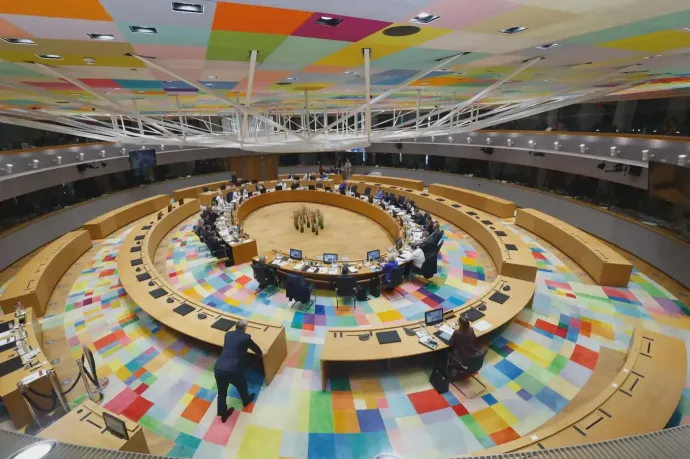
He also called it nonsense that he was supposedly “walking around restlessly” while Ukrainian President Volodymyr Zelenskyy was being heard via video link. (In the photos uploaded to the European Council’s website, Orbán’s seat is empty, just like that of Austrian Chancellor Christian Stocker. According to Euractiv’s sources, the Hungarian PM stayed in the room – which is confirmed by a wider-angle photo from AFP, showing him standing further back, leaning on a chair – he said he was merely stretching his legs. Euronews was told that Orbán had restlessly walked around during the speech and occasionally grumbled.)
“One leader is not keeping his word”
“The leaders took the floor and clearly condemned the attitude of Viktor Orbán", António Costa stated following the summit of EU heads of state and government. The President of the European Council made these remarks after Viktor Orbán – with the backing of Slovak Prime Minister Robert Fico, due to the dispute over the Friendship pipeline following a Russian attack – retroactively blocked Ukraine’s €90 billion loan, which had been unanimously agreed upon in December.
“All leaders need to honour their word, and nobody can blackmail the European Council or EU institutions",
the President of the body of heads of state and government declared at a press conference early Friday morning.
He emphasized that an agreement had already been reached in December and that it would be executed one way or another. “Of course, we didn’t discuss today what we had already discussed before,” but the leaders did speak up. “We welcome Ukraine’s efforts and commitment” to repair the pipeline within six weeks. (According to the Hungarian government, the Friendship pipeline would be suitable for shipments; the only thing needed is a political decision.)
According to Costa, it is not in good faith to impose conditions that the EU or its member states cannot guarantee, because it is up to Russia to decide whether to attack the pipeline again, as it has done 23 times so far. He deemed the Hungarian government’s actions “completely unacceptable,” stating that “the leaders cannot accept this” and have condemned it. He recalled that the European Commission has offered technical and financial support for the repairs.
The Hungarian government is blocking the decision until transportation resumes; upon arriving at the meeting, Orbán dismissed everything else as mere fables, while numerous member state leaders had already publicly criticized their Hungarian colleague’s backtracking prior to the meeting. EUrologus learned that there were twenty speeches and condemning statements at the closed-door session; Politico reported that Giorgia Meloni spoke more sympathetically about Orbán’s situation, although the Italian government denied the statement attributed to her by the publication.
Commission President Ursula von der Leyen also emphasized at the press conference that a decision had already been made in December. There was only one condition then: the exclusion of three member states – including Hungary – from the loan itself, and that condition has been met. “The loan remains blocked because
one leader is not keeping his word,”
but one way or another, the promise will be fulfilled, she said.
According to HVG and EUrologus, German Chancellor Friedrich Merz and French President Emmanuel Macron essentially repeated the same message following the summit: it is unacceptable, unprecedented in EU history, and a violation of the EU’s core values for the leader of a member state to go back on their word. The former noted that the version adopted in December was, in fact, Plan B instead of the reparations loan using Russian assets, while Macron stated that there is no Plan B. The member state leaders have asked the Commission to work out a solution to bridge the gap, which they can discuss at the informal EU summit in late April.
For more quick, accurate and impartial news from and about Hungary, subscribe to the Telex English newsletter!