How the words of a retired Ukrainian officer were edited to make it seem like he was threatening Orbán's children
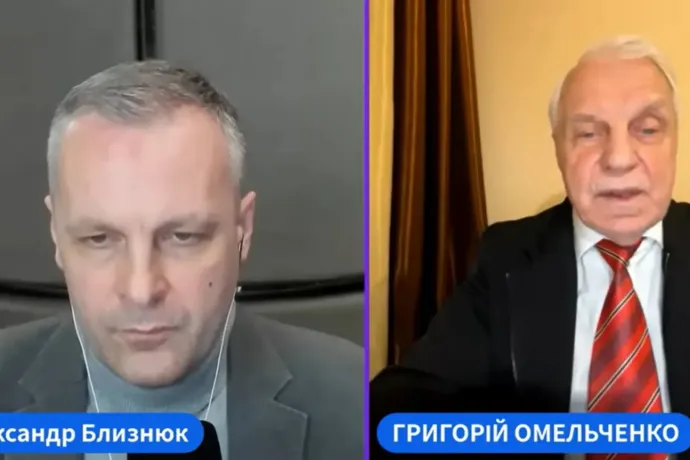


It only has around 18,000 views in Ukraine, but in Hungary, a statement given by a former Ukrainian MP, Hryhoriy Omelchenko has been widely covered by Fidesz and the pro-government media, and has been presented to the Hungarian public as a personal threat to Viktor Orbán and his family. Omelchenko, a 75-year-old retired secret service major general, has not served in the Ukrainian parliament since 2007. He is best known to the Ukrainian public for his anti-Semitic conspiracy theories and his penchant for self-aggrandizement. But even given all this, it is not true that he threatened Viktor Orbán's children and grandchildren. In order for his words to sound threatening in the version circulated in the Hungarian pro-government media, his sentence had to be cut off at just the right place.
However, he does indeed use extreme language when talking about Orbán. In each case, this is because his confrontational policy in the EU, his refusal to support Ukraine, and his continued import of Russian raw materials are essentially helping Russia's war machine.
That particular sentence
Omelchenko, who served at the Ukrainian Security Service (SBU) more than 30 years ago, did indeed warn Orbán that he knew "where he lives and where he sleeps," which is close to being a threat, but this is tempered by the fact that Omelchenko primarily condemned the Hungarian PM's politics on moral grounds, as well as by the fact that Omelchenko has no official position or real influence. Incidentally, the retired officer also likes to talk about how some people want to hand over part of Ukraine to the Jews.
In the interview where he talks at length about Orbán's democratic past and his role during the regime change, he also makes some harsh statements. He quotes from an earlier open letter he wrote to the Hungarian Prime Minister, in which he called him Putin's mistress and a neo-fascist.
"Vitya! We'll rip your stinking tongue out and throw it to the dogs. Your neo-Nazi blood will flow in the Danube before Russian oil flows through the Friendship pipeline."
This statement is already circulating in pro-government circles, the tabloid, Bors also reported on it, as has Dániel Deák, the pro-government influencer.
In the video, Omelchenko identifies himself as the leader of an organization called "Karma." The name is an acronym formed from the words "Ares' Sword of Punishment." There is no sign of any substantive activity of this organisation. He also referred to this group when he recalled President Volodymyr Zelensky's recent words, which could be interpreted as a threat to Orbán, he stated that he did not need Orbán's address because he knew "where he lives and where he sleeps, where he drinks beer and wine, and where he smokes hookah".
He went on to say that if "Orbán does not change his anti-Ukrainian policy and continues to be an accomplice to Putin's war crimes, then he should remember that there is no escaping karma, and no amount of money can buy him freedom." In this sentence, karma appears in its everyday sense, as a synonym for fate; there is no mention of the organisation that Omelchenko had previously referred to.
The retired officer then moved on to the most delicate part of his message: "Orbán should think about his five children and six grandchildren." However, his train of thought did not end there.
The pro-government press simply cut the rest off here, even though he continued his train of thought.
"Is the blood of Ukrainian children not worth anything? Is Russian oil more valuable to him than the lives of Ukrainian children?" Omelchenko asked, before going on to say that Orbán is also to be blamed for "the blood and tears of Ukrainian children" because Russia is partly financing its war machine from the sale of Russian oil and natural gas. This Russia has already killed three thousand children in its aggression against Ukraine, he said.
Omelchenko's words quickly spread across Hungarian pro-government media outlets on Wednesday: It is worth noting that while the first article, published on Index still refers to "Ukrainian messaging," which roughly reflects the fact that the message in question came from a former Ukrainian MP and former national security officer, the rest of the articles all refer to "Ukrainians" in general, and this seems to be the approach that stuck.
- At 1:54 p.m., Index published an article titled “Ukrainian messaging has reached a new level: Orbán should think about his five children and six grandchildren.”
- At 2:15 p.m., Mandiner published an article titled "Orbán should think about his five children and six grandchildren" – the Ukrainians have crossed all boundaries and are now threatening the Hungarian prime minister and his family (VIDEO).
- At 2:17 p.m., Magyar Nemzet was next. Here, the headline was simply “The Ukrainians are threatening Viktor Orbán's five children and six grandchildren (video included)”
It is worth noting that while the Index article still refers to "Ukrainian messaging," which roughly correspond to the fact that the message came from a former Ukrainian MP and former national security officer, the articles that followed generally refer to "the Ukrainians," and this remains so from this point on.
- Before 2:30 p.m., the social media page of Fidesz's Budapest division also reported that "The Ukrainians threatened Viktor Orbán's five children and six grandchildren."
- 2:37 p.m.: Bors also published a piece on the threat made by the "Ukrainians."
- 3:03 p.m.: Hirado.hu, being relatively late compared to the others, wrote about the news that "The Ukrainians threatened Viktor Orbán's five children and six grandchildren."
- Finally, a video was posted on Viktor Orbán's social media page, in which the prime minister, looking worried and holding his head in his hands, calls his daughter to tell her that she, her siblings, and his grandchildren have been threatened by “the Ukrainians”, but there is no need to be afraid, although that the threat must be taken seriously.
The fact that the term "Ukrainians" was used in the headlines is no coincidence. Our colleague Zsolt Hanula wrote about this method in his recently published book on propaganda and manipulation in the media, entitled Ne higgy ennek a könyvnek (Don't Believe This Book):
The title usually contains a strong statement, leaving unclear who it came from, "but in such a way that the reader can still piece together some kind of picture from the ambiguous wording.” Origo is fond of using this method, here's a relevant quote from Zsolt Hanula's book again:
- “Even the Americans are telling Zelensky to resign and flee Ukraine.” Who could the "Americans" in this rather vaguely worded sentence refer to? The American people themselves? Is this the result of a public opinion poll? Or the government, a minister, or perhaps the president himself, who has the authority to speak on behalf of the American people? Well, no. The source is a former American intelligence officer named Scott Ritter, who happens to be a freelance contributor to Sputnik, one of the official channels of Russian propaganda. He said this in the program of a totally insignificant YouTuber named Danny Haiphong.
- "The Germans called Zelensky a coward." But who are these Germans, important decision-makers, politicians, or even the chancellor himself? Not at all: it was commenters under an article from Der Spiegel. To be exact, four commenters, whose posts were cherry-picked by the Russian Izvestia, one of the Kremlin's propaganda outlets, and then reposted by Origo.
- "French opinion: Zelensky is a mafioso" – It will probably come as no surprise that this quote also didn't come from a referendum nor is it the opinion of some influential public figure. Instead, it came from Florian Philippot, a far-right, pro-Russian French politician whose party has run in two elections so far and received 0.6 and 0.9 percent of the vote, respectively.
These quotes clearly reveal the purpose behind using the term “Ukrainians” instead of referring to the 75-year-old retired officer who no longer holds any official position and has not appeared in public for years, except for giving several long interviews in recent months. In one of these interviews, for example, he claims that Orbán is an agent of the Kremlin.
Prjamij TV happens to be a reputable media outlet with 4.5 million subscribers on its YouTube channel—although Omelchenko's interview had only 11,000 views on Wednesday and 18,000 by Thursday afternoon. It was later broadcast on several other channels as well.
There was another interview he gave three months ago that has been viewed 6.8 million times since its release. In it, Omelchenko also talks about the possibility that Zelensky is being blackmailed by Putin, who is probably in possession of some compromising material – known as kompromat in Russian and Ukrainian spy jargon. The 75-year-old retired major general seems to enjoy presenting himself as someone who is extremely well-informed and who is constantly sought after by those at the highest levels.
A man of conspiracy theories who supposedly knows everything
In the interview where he spoke about Orbán, he casually mentioned that he himself warned Ali Khamenei 24 hours before the American-Israeli air strikes, but in the end, "God's will" prevailed, and the supreme leader of Iran's theocracy died in the first wave of attacks.
In the interview where he speaks about the potential compromising information about Zelensky, he also claims that the US Congress has approached him with various pieces of information in the past.
Omelchenko was born in 1951 and was a member of the Communist Party of the Soviet Union. Between 1994 and 2007, he served as a member of parliament of independent Ukraine and was also a member of the Batkivshchyna (Fatherland) party of former Prime Minister Yulia Tymoshenko. However, he later distanced himself from them: in 2009, he accused his former party of operating a pedophile network in a children's camp in Crimea, which was still under Ukrainian control at the time. The investigation lasted for years and found no evidence to support Omelchenko's allegations, but it did succeed in damaging Tymoshenko's reputation. In 2012, he claimed that the former prime minister, who was imprisoned during the presidency of Viktor Yanukovych who eventually fled to Russia, was in fact an agent of the Russian secret service (FSB).
In 2017, he spoke about a supposed plan to turn most of Ukraine – roughly where Russia wanted to establish Novorossiya, but was only able to occupy part of – into a “New Jerusalem” by bringing in five million Jewish settlers who would also take over the farmland. In 2018, he claimed that if he managed to arrange a personal meeting with Putin, he would kill the Russian president.
His statements are given seeming weight by the fact that, according to his biography, he was head of the organised crime department at the Ukrainian Security Service (SZBU) between 1992 and 1994. He claims to have been involved in the investigation of the case of former Prime Minister Pavel Lazarenko, who was later convicted on corruption charges in the United States. He has no influence, nor does he play an active role anywhere, but his words can be sold well, given that he is a former major general of the SBU, who was even awarded the Hero of Ukraine state decoration by outgoing President Viktor Yushchenko in 2010.
The retired officer gets airtime on the former president's TV channel
His recent statement certainly came in handy for Fidesz during the election campaign, serving to prove that Ukraine poses a threat to Orbán personally. The answer for why the popular Prjamij TV's YouTube channel is giving him so much airtime may be as simple as clickbait, as his provocative statements generate a lot of clicks. Prjamij TV is owned by former president Petro Poroshenko, who also had interests in Hungary through his confectionery businesses.
Poroshenko lost the 2019 presidential election to Zelensky and was accused of treason in 2021 due to his financial ties to separatists in eastern Ukraine. He was placed under moderate house arrest, but no verdict has been reached in any of his cases yet. However, it is known that his relationship with Zelensky is tense. At the end of 2023, his financial disclosure statement showed that he had sold Hungarian government-backed bonds worth nearly $1 million, which he used to support the Ukrainian army.
Poroshenko was supposed to meet with Orbán that summer, but the former president was not allowed to cross the Ukrainian-Polish border, so the meeting he had initiated, the intention for which was also acknowledged by Péter Szijjártó, Hungary's Minister of Foreign Affairs and Trade, couldn’t take place in the end. The Hungarian government did not disclose what Orbán and the former Ukrainian president would have discussed.
For more quick, accurate and impartial news from and about Hungary, subscribe to the Telex English newsletter!