How Transylvanian students became campaign activists for Fidesz: door-to-door campaigning for a daily wage




The recent revelation that an increasing number of young Hungarians from Transylvania have become involved in the Hungarian election campaign by going door to door to collect signatures for Fidesz candidates, has caused outrage among many. What's more, the story broke at a time when the public mood among ethnic Hungarians in Romania was already charged: there has been more and more debate recently about whether it is right or healthy to involve the Hungarian community in Transylvania in Hungarian political campaigns, and to what extent the community is being used as a mobilization reserve for Hungarian domestic politics.
The story really blew up when Transtelex reported that students from Târgu Mures were taken to Szolnok to canvass on behalf of Fidesz, and that the group included high school students who were in Hungary while school was in session. The story caused quite a stir: journalists, NGOs, and public figures criticized the practice of bringing young people from Transylvania across the border to campaign. The impact of publicity did not take long to show: one day after our article was published, the students returned from Szolnok to Târgu Mures and went back to school.
However, the story does not end there. Since then, Transtelex has received reports from several sources that various groups of young people from Transylvania have been regularly crossing the border to help with the campaign in Hungary, including in districts in Pest County. Their participation is usually communicated as voluntary political activity, but the accounts of the students we spoke with paint a very different picture: most of them are not committed activists, and in many cases, they are not particularly supportive of Fidesz.
In the past few days, we have been able to speak with several young people who have participated in such trips, and they told us how these trips are organized, what conditions they worked under, and how they became door-to-door mobilizers in Hungary. Their stories reveal a rather straightforward mechanism: Fidesz gets signatures, and the students get money, accommodation, and meals.
The students who campaigned for Balázs Hankó in Gödöllő
The first reports about Balázs Hankó's Sekler (in Hungarian: Székely) helpers came to light when, during his tour of Seklerland, the minister wanted to meet with students at Sapientia University. Not all the questions he received here were polite questions, he was also asked why he had paid Sekler youth to campaign for him. All the shocked minister managed to say in response was that it was because "we belong together." Some of the university students contacted us after the publication of our article, and we were able to piece together a clearer picture of how the trip was organized and what the students' stay in Hungary was like.
We heard different parts of the story from several students, but ended up relying on István's account as the basis for our article because he provided the most details.
According to István (not his real name, as he asked to remain anonymous), the invitation came from within the university: a group of students were approached with the offer of a week-long campaign trip to Hungary, and his roommates eventually convinced him to go along. He decided to do it, because at first glance it seemed like a short trip to somewhere near Budapest, although they were not told exactly what kind of campaign work they would be doing. The trip was organised via a Messenger group, where they received information about the travel details and their work. In the end, a team of thirteen university students from Seklerland set off for Gödöllő by car. According to István, their university’s leadership was also aware of where the students were going and probably had more detailed information about what their hosts expected of them.
The students arrived at their accommodation on Sunday evening, where they were greeted by an organizer in his thirties. It was at this point that it became clear to them that over the next few days they would be collecting recommendations for Fidesz candidate Balázs Hankó. The next day, they were given a briefing, handed tablets, and shown how the system worked: the devices contained addresses and names of voters who, according to the organizers, had previously been in contact with the party and had already registered their support for Fidesz on previous occasions. The students' task was to go from house to house to collect new signatures.
They were instructed to introduce themselves as associates or aides of Balázs Hankó, even though they had never met the candidate himself. According to István, neither Balázs Hankó nor any other high-ranking politician visited them during the entire time; their relationship was limited to the organizer who handed out the tablets in the morning and collected them back in the evening. The students were initially based in Gödöllő, but were later transferred to other towns, such as Veresegyház. They occasionally saw other groups arriving and leaving the office with tablets, suggesting that there were other similar activist groups working in the area.
According to István, the job was organized in a pretty relaxed way: even though they were supposed to be collecting signatures every day, no one kept a strict check on exactly how much time they spent in the field, and they never found out how many recommendations their team had collected in total, because at the end they were simply told that they had "done a good job." They encountered mixed reactions when knocking on doors: in many places, no one opened the door, while in others, people talked to them at length. It was mainly older voters who spoke to the Transylvanian students, often sharing with them their opinions on Hungarian politics. Due to the students' accents, it sometimes became apparent that they were from Seklerland, and although this was rare, they sometimes asked why they were the ones collecting signatures for a Hungarian candidate.
They were provided with accommodation in Gödöllő and were served breakfast and lunch at a nearby restaurant, but they had to arrange their own dinner. At the end of the campaign, on the last day—when they had to finish earlier than planned because of rain—the organizer gave them their money in an envelope, in cash, at a restaurant.
According to István, their daily pay was roughly 12,000 forints, (31 euros) and they were reimbursed for travel expenses such as highway tolls and fuel separately, by bank transfer.
During the week, the students also signed a contract stating that they were participating in the work as activists, but they were given few details. According to István, most of them took the job for practical reasons: it was money they could earn within a week, it also included accommodation and meals, so for many of them it was a way to make some extra cash.
István says that after the first few days, he began to keep notes about the events of each day. It wasn't an official record, but rather short memos: where they went each day, what they were told at the briefing, when they received their money, how the tablets worked, and what instructions they received for door-to-door canvassing. He says he had a bad feeling about the whole thing from the very beginning, so he felt it was important to record the details. "Somehow I felt that I would have to talk about this one day," he said. It wasn't the door-to-door canvassing itself that bothered him, but the way the whole thing worked:
as if it were completely natural for Transylvanian university students to walk the streets of a Hungarian constituency during the campaign, while everyone pretended it was just an innocent student program.
Transylvanian "volunteers" filled the gap of missing local volunteers in Tibor Pogácsás's constituency too
According to an enthusiastic report posted on the Facebook page of the Szentegyházi Ifjúsági Társaság (SZIT – The Youth Community at Szentegyháza or Vlăhița in Romanian), a group of young people from Szentegyháza have a "busy week" behind them: they supported the campaign of Fidesz representative Tibor Pogácsás in the 10th constituency of Pest County.
However, according to the photos and videos accompanying the post, this was not just a simple job: for example, at a closed campaign event, Minister Gergely Gulyás gave a lecture the young people, while in the background, the faces of Ukrainian President Volodymyr Zelensky, European Commission President Ursula von der Leyen, and Péter Magyar, leader of the Tisza Party, were projected onto the wall as enemies threatening the nation. According to the videos, the minister heading the Prime Minister's Office and the local representative tried to convince those present that only Fidesz could protect the country from war.
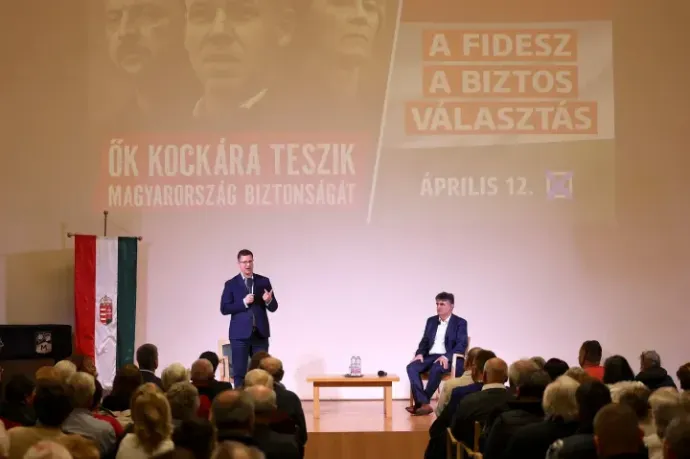
Transtelex contacted SZIT to clarify the circumstances of their participation in the campaign. An anonymous representative of the organization said that the eight-member delegation's trip was coordinated by Árpád Lőrincz, president of the Udvarszék (Odorheiu Secuiesc in Romanian) charter of the Association of Hungarians in Transylvania, and that they were hosted by the mayor of Úri in the first week of March.
Although SZIT stresses its "independence," their six-day stay was all about hardcore political work. The spokesperson for the young people from Vlăhița revealed that all logistics (travel, accommodation, and meals) were financed by their Hungarian hosts. In return, the Transylvanian youth collected signatures for Tibor Pogácsás's candidacy for eight hours each day, between 9 a.m. to 5 p.m. They spent their "working hours" in twos, assigned to specific streets, and although they did not receive any cash, the representative made it clear that the accommodation and the meals were compensation, because “we got what we wanted.”
The interviewee from Vlăhița admitted with unexpected honesty that assistance from Transylvania was necessary because the ruling party's local activist network had simply dried up: "There are a lot of settlements, and I think there are too few Fidesz volunteers to help them with this. We didn't really meet anyone else," they said, referring to the fact that in several settlements, the Transylvanian delegation was the only one to carry out door-to-door mobilization. At the same time, according to this person's observations, the majority of the Hungarian youth are either openly opposed to the ruling party or completely apathetic, so when knocking on doors, they were only able to have meaningful conversations with older voters.
While the youth from Vlăhița helped the representative in his promise to "protect them from war," the atmosphere in the district remained tense throughout the campaign: in Szentmártonkáta, for example, a woman was physically assaulted because of her political views, which Tibor Pogácsás tried to downplay. Although the members of the Transylvanian delegation heard about the incidents, they said that they "fortunately didn't encounter any trouble." The SZIT representative remains open to similar requests in the future, and although the Hungarian partners promised to return the favour in Transylvania, the exact nature of this "support" remains shrouded in blissful obscurity.
This Hungarian campaign of SZIT is a natural continuation of the unique political symbiosis that has formed between some representatives of Vlăhița’s ethnic Hungarian community and pro-government circles in Hungary in recent years. As we revealed in our previous report, the local Hungarian leadership and local civic organizations are recurring players on the Hungarian political stage: last year, for example, the city's deputy mayor, dressed in traditional Sekler folk costume, provided the visual backdrop for "national unity" in the front rows of the Peace March.
The "Budapest gig" also came in handy for university students in Cluj-Napoca
We also spoke with a university student in Cluj-Napoca about what collecting signatures for a Fidesz campaign is like from the inside. The student, let's call her Réka, agreed to talk to us anonymously and did not want to give any further details: she did not reveal which candidate she had worked for, nor did she say how much she was paid. However, her story clearly shows that the same model was used as the one described by the students from Miercurea Ciuc: a few days of door-to-door canvassing for Fidesz, with accommodation, meals, and a daily wage.
It all started the way university rumors usually spread: someone told someone else, someone then forwarded a message, and a few days later everyone knew that there was a "job in Budapest." They said it paid well and didn't require any special skills, just knocking on doors. When Réka contacted the organizers, they confirmed this: she could go out for two weeks to do campaign work, they would cover her accommodation and meals, and she would receive a daily wage at the end.
This doesn't sound bad given the current reality of university life in Cluj-Napoca. Rent prices are constantly going up, scholarships have been cut due to budget constraints, and tuition fees have also increased in many places. For many students, such an offer is therefore not a question of political preference, but a simple matter of calculation: how much money will they earn and is it worth it?
The application process was not complicated either: there was no screening, no questions about which party they would vote for or how much they knew about politics. Anyone who wanted to go could go. When Réka arrived in Budapest, they were greeted with a warm meal, followed by a quick briefing on what they would be doing in the coming days. The task was simple and monotonous: go from house to house, ring the doorbell, introduce yourself, and ask people if they would be willing to sign a recommendation form for a Fidesz candidate for parliament.
She also received a letter of authorization to prove that she was working on a candidate's campaign, should anyone ask. However, there were no further instructions. They did not receive talking points, nor were they trained on how to persuade voters. "I introduced myself, said the candidate's name and the party, and asked if they would sign," Réka summarized.
The days quickly became monotonous: they set off in the morning with their addresses, rang the doorbells, waited, and tried to figure out based on the noises coming from behind the door whether anyone was home. Often, no one answered the doorbell. Other times they did, but after a few sentences, they shut the door again. Sometimes it turned into a conversation, other times they just said no and there were times when they weren't the most polite.
By the end of the day, the results were usually quite modest: there were days when they didn't get a single signature, other times they got a few, and on rare occasions they got a list of around ten names. But no one really cared about that, there was no quota, and no one asked them how many they had collected. There was no one around during the day to check how many doors they knocked on or how much time they actually spent in the field.
The only thing that was predictable was the money. At the end of each day, they received their daily pay in cash, regardless of how many signatures they had collected. According to Réka, this is how the whole story makes sense. It is not about political enthusiasm, nor is it about anyone being particularly committed to a Hungarian party. It's a simple matter of math: they get paid for a few days of knocking on doors, their accommodation and meals are provided, and they get to spend a few days in Budapest.
Fidesz needed signatures, the students needed money. And for Réka, as she put it, the money came in very handy.
This article is part of a partnership between Telex and Transtelex.